The following is from a work-in-progress about the history of Fullerton. You can support my ongoing research and writing on Patreon.
The Fullerton Observer newspaper was formed in 1978 by Ralph and Natalie Kennedy and friends to provide a more progressive counterbalance to the more conservative Fullerton News-Tribune and Orange County Register. The Fullerton Public Library has digital archives of the Observer stretching back to 1979. I am in the process of reading over each year and creating a mini-archive. Here are some top news stories from 1991.
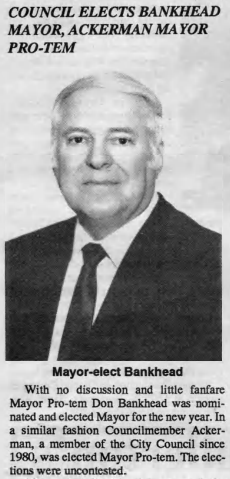
In 1991, Don Bankhead was chosen as Mayor and Dick Ackerman became Mayor Pro-Tem.
Housing & Homelessness
Throughout the 1980s and 1990s, the City Council generally preferred not to use city redevelopment funds for affordable housing.
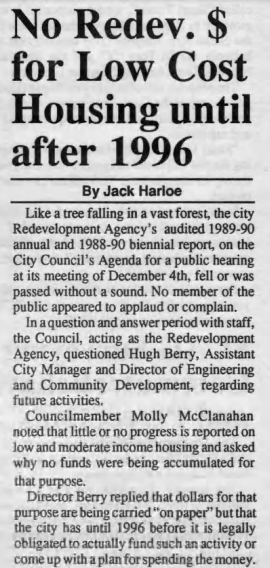
If not housing, what was the City spending its redevelopment money on? Why, a $10 million dollar sports complex, for one.

But then a (sort of minor) bright spot. Council approved a 10-unit affordable housing project–converting the former Allen hotel into low-cost housing.
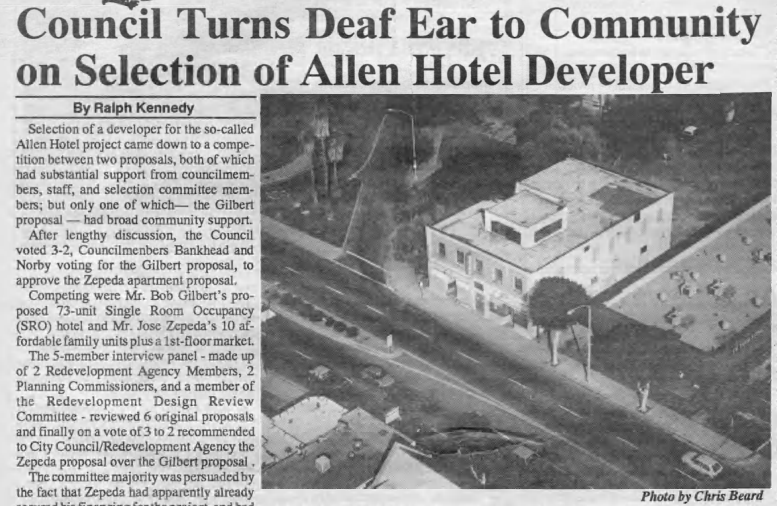
Unfortunately, instead of approving a 73-unit project, council instead preferred a 10-unit project, thus making a very tiny dent in the problem.
Two Fullerton residents took it upon themselves to sue the city for its lack of affordable housing.

“Two longtime Fullerton homeowners, Nadene Ivens and Roy Kobayashi, have filed suit in Orange County Superior Court against the City of Fullerton and its Redevelopment Agency, challenging their right to establish Redevelopment Project Area 4, until such time as they get their low-income-housing affairs in order,” the Observer reported.
“I have been watching and waiting for the city to use their state mandated set-aside funds, generated from prior redevelopment areas, for low income housing. I was upset when the City’s Redevelopment Agency, Project Area 3, committed so much money to build a football stadium for CSUF,” Ivens said. “Then, when Project Area 4 was designed only to assist auto dealerships, I determined that I must take some action to make the city conform to the requirements of State law. Beyond the law I feel there is a moral obligation to provide affordable housing in Fullerton which is as least as great as any obligation to build football stadiums or subsidize private business.”
Most of the housing approved by City Council was “market rate” (i.e. not affordable to many people).

Council voted 4-1 to approve revisions to the city’s General Plan thus implementing UNOCAL’s plan for 20 years of development in the 380 acre area bounded by State College Boulevard, Bastanchury Road, Brea Boulevard, and Ladera Vista/Skyline Drive.
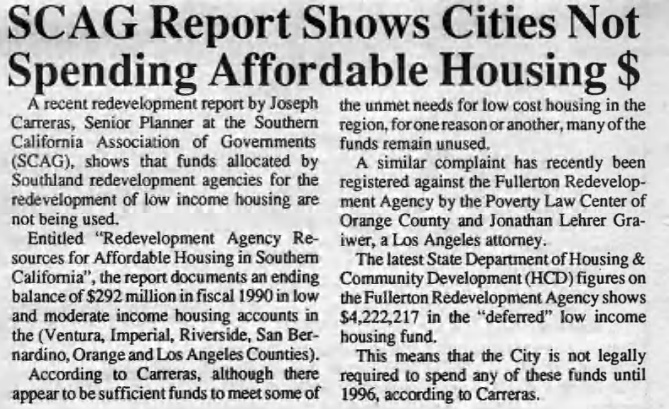
The growing affordable housing problem was, unfortunately, not unique to Fullerton.
Homelessness
An obvious result of the lack of affordable housing was an increase in homelessness, another issue which council was reluctant to deal with.

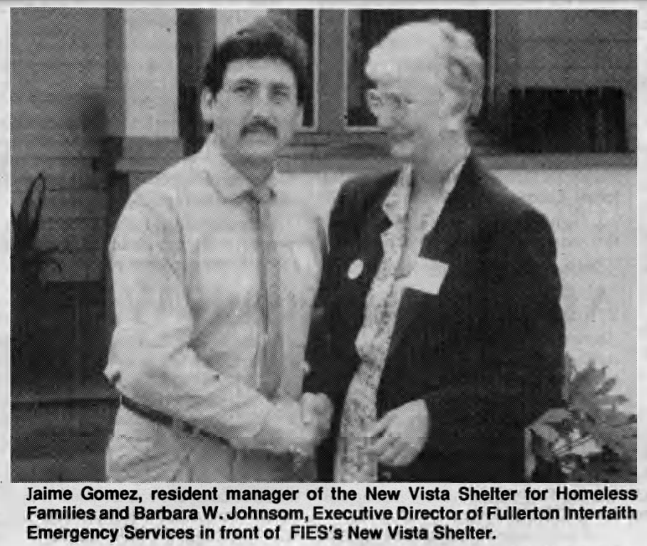
A group called Fullerton Interfaith Emergency Services (now Pathways of Hope) was doing its part by providing food, shelter, and other services to the local poor and homeless–although this was of course not sufficient to fully deal with the problem.
According to FIES director Barbara W. Johnson, the estimated number of homeless people in Orange County was 10,000 in 1991, “one half of whom are estimated to be children with an average age of 5 years old.”
In an interview with the Observer, Johnson talked about the rapid increase of homeless people starting in the late 1970s.
“The number one reason is lack of affordable housing,” she said. “And number two is that income has not kept up with the cost of housing.”
She also mentioned “the release of many patients from state mental institutions, patients who today comprise part of the 10,000 homeless.”
FIES ran the city’s only year-round homeless shelter, called New Vista, which opened in 1986. By 1991, they were able to provide temporary shelter for about 48 families a year. But this was a temporary, not a permanent, solution.
FIES also ran a food distribution center in the low-income Maple neighborhood.
Meanwhile, a conservative City Council majority was doing its part to ignore the problem. Council rejected a proposal by city staff and local advocates (like Barbara Johnson) to hold a series of workshops, to better understand and develop solutions to homelessness.
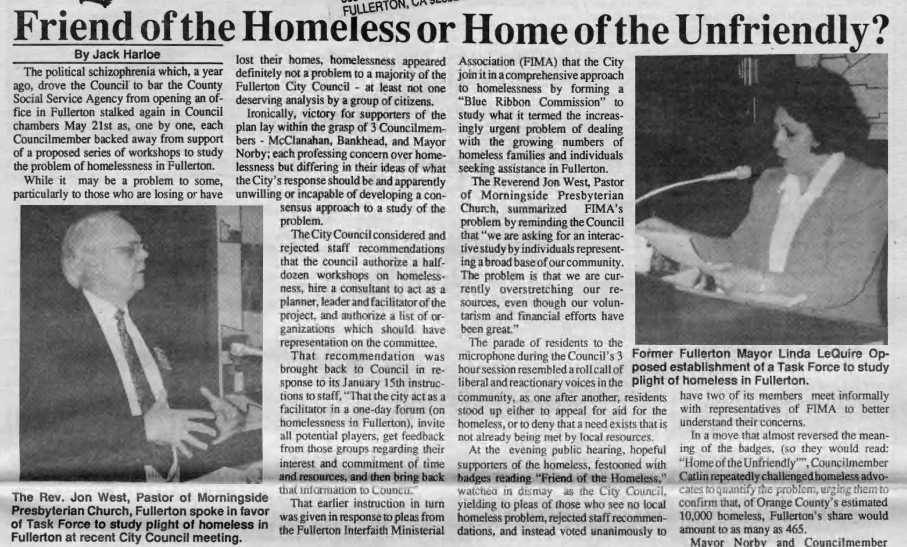
“Councilmember Catlin repeatedly challenged homeless advocates to quantify the problem, urging them to confirm that, of Orange County’s estimated 10,000 homeless, Fullerton’s share would amount to as many as 465,” the Observer stated. “Mayor Norby and Councilmember Bankhead noted that their own research on the problem produced small figures, such as 25 homeless, visible during a typical evening.”
Driving around town is not the best way accurately quantify the problem. As elected officials, Catlin, Bankhead, and Norby almost certainly had access to more accurate data.
Education
Back in 1972, facing state desegregation mandates, the Fullerton School District voted to close Maple School because it was a de facto segregated school, and bus all of its (majority Latino) students to other schools in the district.
The Maple neighborhood and school were initially segregated because of overt housing discrimination starting in the 1920s (such as racially restrictive housing covenants that prevented non-whites from purchasing properties outside certain areas). By the time housing discrimination became illegal in the 1960s, the neighborhood was mostly Latino, some with ties still to Mexico, so new immigrants tended to settle there as well.
By the early 1990s, facing overcrowding schools, the district was considering re-opening Maple. They hired a consultant to study the problem and give a recommendation. A major concern was whether re-opening Maple would re-create a segregated school, as the neighborhood demographics [mostly Latino] were virtually unchanged since the early 1970s.
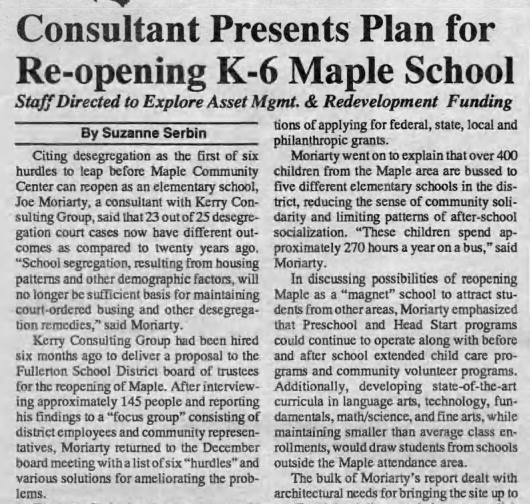
“Citing desegregation as the first of six hurdles to leap before Maple Community Center can reopen as an elementary school, Joe Moriarty, a consultant with Kerry Consulting Group, said that 23 out of 25 desegregation court cases now have different outcomes as compared to twenty years ago,” the Observer reported. “‘School segregation, resulting from housing patterns and other demographic factors, will no longer be sufficient basis for maintaining court-ordered busing and other desegregation remedies,’ said Moriarty.”
One idea to prevent re-segregation was to make Maple a “magnet” school, with such unique and outstanding programs that white parents from the north part of the city would want to send their children there.
School Board trustees were skeptical.
“Trustee Anita Varela said she agreed with the statement that Maple would probably never emerge as an integrated school if it were designated a ‘magnet;’ however she was willing to sacrifice integration in order to give the Maple community a stronger sense of pride and relationship,” the Observer reported.
In retrospect, these trustees’ concerns would prove correct. Today, Maple School is still over 90% Latino.
The only way to fundamentally deal with de facto school segregation is to deal with historic housing segregation and poverty.
An interview with Captain Lee Devore of the Fullerton Police Department about a program called Operation Clean Up gives a bit of context about a low income (largely Latino) neighborhood around Maple.
DeVore described an area with a large percentage of people living in overcrowded and substandard housing.
“Sometimes you have two families living in one apartment for economic reasons,” DeVore said. “Then there are some units that are occupied by 10, 12, 15 single guys.”
Poverty and overcrowded housing led to an increase in crime. The area had over 100 times the number of police calls than other areas of the city.
According to DeVore, the two biggest concerns of the area were fear of deportation (the area has many immigrants) and high rents. Part of the blame lay with landlords (or slumlords) who charged these high rents and did not keep their properties up to code.
“If you talk to the people that live there, they’re good people,” DeVore concluded. “They’re mostly families and people that are here trying to get ahead in life, and come from areas where there wasn’t really a chance. They want to make it, and given a little bit of help, I think they can.”
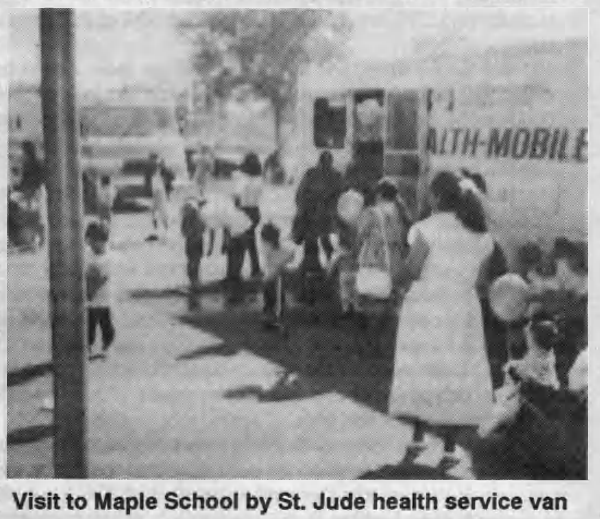
When Maple School closed in 1972, the buildings became the Maple Community Center, which became home to a host of social services for low income families over the years, including a mobile health clinic, food distribution, ESL classes for adults, Head Start (a federally funded program which provides early childhood education, meals, and parent education for low income families), a preschool, a day care, and more.
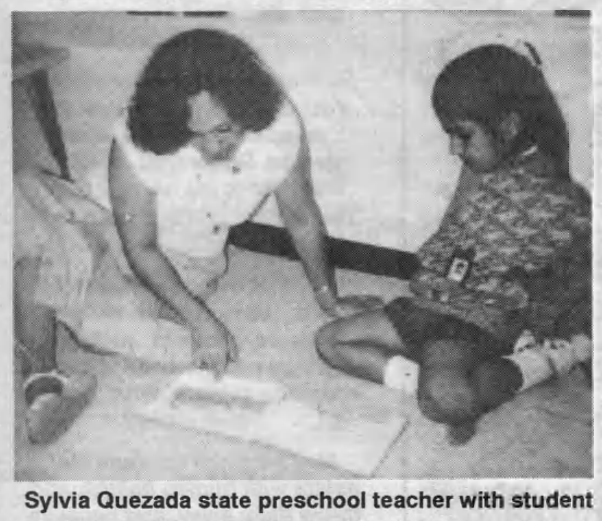
Another issue facing immigrant students were low test scores and the need for bilingual education.

While the Maple neighborhood in south Fullerton was dealing with those issues, Sunny Hills High School in northwest Fullerton was dealing with an influx of immigrants from another part of the world…Korea.
Starting in the 1980s, many Korean immigrants began to settle in Fullerton.
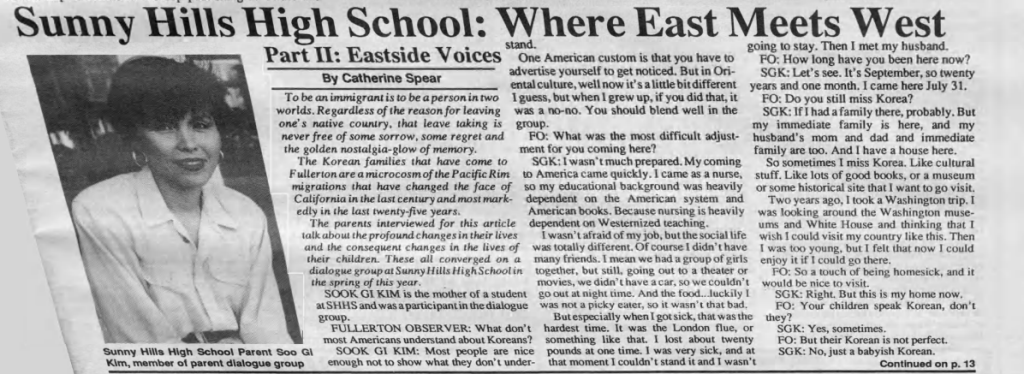
“In the last ten years, Sunny Hills High School has undergone a dramatic transformation from a school that was virtually 100% white upper middle class to a shrinking majority of 52% caucasian students,” the Observer reported. “The bulk of the 48% minority students is Asian (36% of whom are Korean), but also includes groups as diverse as Hispanic, AfroAmerican, Indian, Egyptian, Chinese and Malaysian.”
Prompted by tensions between white and Asian students, the Orange County Human Relations Commission led a series of workshops to address these issues.
“Since we come from other countries, lots of times we feel like we are strangers,” Sook Gi Kim told the Observer. “Maybe from your point of view, we are invading your country. From our point of view we are strangers. We learn that we are (all) human beings and share the same philosophies, just that the expression is a little bit different, because we grew up differently. So don’t be afraid. Be a little bit brave.”
Young Lee, the mother of a SHHS student, said, “My first feeling when I went on campus was that there was segregation.”
Another parent of a biracial student said that his son, “feels that there is a lot of segregation there, that there is voluntary segregation. That is, white students hang around with whites and Korean students tend to hang around with other Koreans. He’s not totally comfortable with that, but he accepts it as the way things are there.”
“To live in two worlds. That is the task of every immigrant,” said another parent. “To see one’s children become the product of an alien culture. That is the burden of every immigrant parent. But that is how worlds and cultures assimilate. These are the growing pains.”
Racism
Immigration has always been a fundamental aspect of American culture and society. However, over the decades, waves of immigrants from different parts of the world have often triggered backlash and discrimination from longer-settled Americans. Unfortunately, in the 1990s, anti-immigrant sentiment would reach fever pitch with things like Proposition 187 in California.
Perhaps to give a bit of background/context on this, local historian Warren Bowen wrote a piece for the Observer about the Ku Klux Klan in Fullerton in the 1920s.

It was in the mid-1920s, exactly 100 years ago, that the Ku Klux Klan was the most popular it had ever been in American history, with a national membership in the millions, and a presence all over the United States, including Fullerton.
“The Klan took the position that it was the only hope for America and its values, among which it listed native American [white, not indigenous] birth, Protestantism, etc. It opposed new immigration, particularly of Oriental and Mexican people. It opposed the Roman Catholic Church, Judaism, and such social trends as the theory of evolution, pacifism, and birth control,” Bowen writes.
The leader of the local Klan, which reached a membership of over 1,200, was Reverend Leon Myers of the First Christian Church of Anaheim.
“School leaders saw erosion of social values while the skilled workers faction sought protection of their jobs from encroachment by immigrants,” Bowen writes. “Merchants who were sympathetic displayed American flags in certain locations in the stores as a sign of support….One of the greatest concerns of the KKK was law and order.”
In addition to holding scary rallies and burning crosses, the Klan also sought to oppose “a special housing section into town for the purpose of housing Mexican workers and their families for agricultural and railroad work.”
This was during Prohibition, so the Klan made a big deal about illegal booze coming in from Mexico.
For a while, the Ku Klux Klan had real power in Fullerton.
“Among the strong supporters of the Klan were men like Roy Davis, later the fire chief, Louis Plummer, and R. A. Marsden of the school system, and prominent civic leaders like Albert Stuelke, William Starbuck, and O.M. Thompson,” Bowen writes.
Other civic leaders like C.C. Chapman and Albert Launer strongly opposed the Klan. Eventually, the Klan died down, but many of its core beliefs have stubbornly stuck around, such as Christian nationalism, white supremacy, racism, and anti-immigrant views.
Fast-forwarding back to 1991, four skinheads were arrested for beating up some Asian youths at Gilman park in Fullerton after harassing a Black family at Tri-City park.
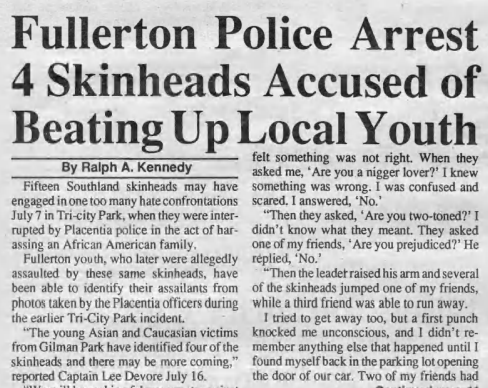
“Fifteen Southland skinheads may have engaged in one too many hate confrontations July 7 in Tri-city Park, when they were interrupted by Placentia police in the act of harassing an African American family,” the Observer wrote. “Fullerton youth, who later were allegedly assaulted by these same skinheads, have been able to identify their assailants from photos taken by the Placenta officers during the earlier Tri-City Park incident.”
In 1991, the U.S. was at war with Iraq (the Persian Gulf War), and unfortunately anti-Arab sentiment was on the rise.
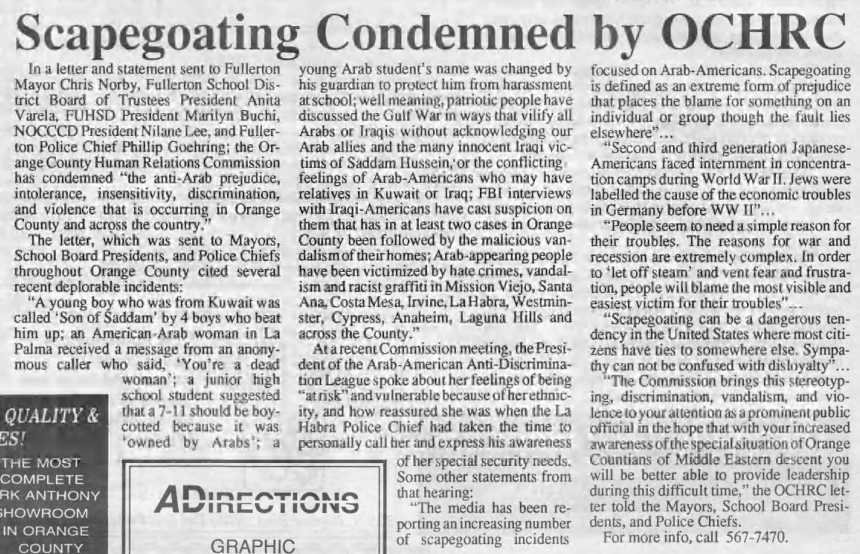
One of the only groups around with the expressed mission to document hate crimes and try to build bridges of understanding between different groups was the Orange County Human Relations Commission (OCHRC).
The OCHRC condemned “the anti-Arab prejudice, intolerance, insensitivity, discrimination, and violence that is occurring in Orange County and across the country.”
“A young boy who was from Kuwait was called ‘Son of Saddam’ by 4 boys who beat him up, an American-Arab woman in La Palma received a message from an anonymous caller who said, ‘You’re a dead woman’; a junior high school student suggested that a 7-11 should be boycotted because it was ‘owned by Arabs’; a young Arab student’s name was changed by his guardian to protect him from harassment at school,” the Observer reported. “Well meaning, patriotic people have discussed the Gulf War in ways that vilify all Arabs or Iraqis…Arab-appearing people have been victimized by hate crimes, vandalism and racist graffiti in Mission Viejo, Santa Ana, Costa Mesa, Irvine, La Habra, Westminster, Cypress, Anaheim, Laguna Hills and across the County.”
Unfortunately, the Orange County Board of Supervisors voted that same year to cut funding for the OCHRC.
“Perhaps most important of all has been the role played by the OCHRC as intermediary between members of various members of the community and their local police departments to develop better understanding and respect between these diverse members of the community,” the Observer wrote.
Environment
In the ongoing saga of the McColl toxic waste dump in west Fullerton, the EPA announced more delays in the cleanup. Toxic chemicals from oil waste had been leeching into the groundwater since the 1940s. What was another few years?
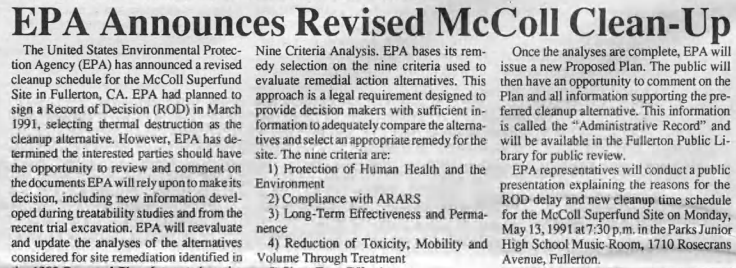
The EPA at first had chosen as its preferred solution to burn the toxic waste, but then said it wanted to give interested parties time to consider alternatives.
Meanwhile, neighbors who lived around the toxic site were losing their patience with the EPA’s plan, and were starting to come around to the oil companies’ plan to “cap” the waste–leaving it where it is.
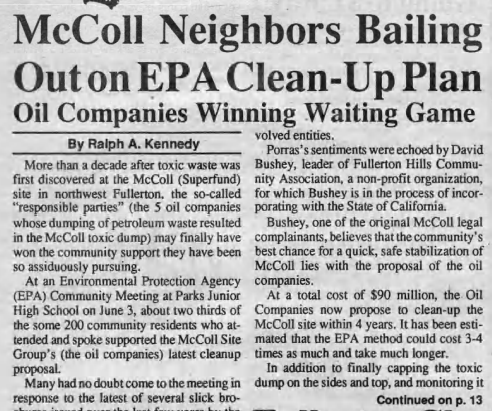
“More than a decade after toxic waste was first discovered at the McColl (Superfund) site in northwest Fullerton, the so-called “responsible parties” (the 5 oil companies whose dumping of petroleum waste resulted in the McColl toxic dump) may finally have won the community support they have been so assiduously pursuing,” the Observer reported.
At a Community Meeting at Parks Junior High, about two thirds of the some 200 community residents who attended and spoke supported the McColl Site Group’s (the oil companies) latest cleanup proposal.
“Many had no doubt come to the meeting in response to the latest of several slick brochures issued over the last few years by the McColl Site Group (the five oil companies responsible for the McColl toxic dump), this one entitled ‘How Much Longer Should Fullerton Wait?,’” the Observer reported. “At a total cost of $90 million, the Oil Companies now propose to clean-up the McColl site within 4 years. It has been estimated that the EPA method could cost 3-4 times as much and take much longer.”

“I firmly believe the time has run out for the agencies,” said Betty Porras, until recently the principal spokesperson for the residents surrounding the McColl site, and consistently a supporter of the EPA preferred cleanup method – thermal destruction (burning the waste).
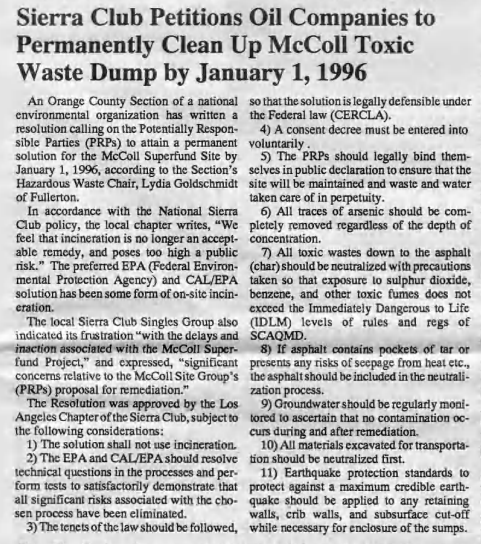
The Sierra Club implored the oil companies responsible for the waste to clean it up by 1996, that is, within the next five years. It would take longer.
Meanwhile, the Observer reported on another nearby toxic waste site, courtesy of the Hughes aircraft plant (which is now the Amerige Heights shopping center and housing development).

“Subterranean seepage of trichloroethylene (TCE), a volatile, carcinogenic, organic compound, from a former Hughes Aircraft Co. underground tank on N. Gilbert Avenue could pose a threat to Fullerton’s water supply,” the Observer reported. “Since half of the City’s water comes from its own wells, the toxic plume, which has already spread at least a half mile out to a depth of 210 feet, does represent a serious contamination threat to Fullerton’s drinking water, which is being drawn from aquifers at depths as shallow as 435 feet.”
Testing showed TCE concentrates of up to 150,000 parts/billion when the state allowed concentration for potable water was 5 parts per billion.
The plume was about a half mile from the nearest water well.
Hughes was in the process of drilling testing wells to best determine how to clean up the contamination. They said it would take about two years. Stay tuned.
In slightly more positive environmental news, plans were in the works to open parts of 72 acres of land in Coyote Hills for public enjoyment.

“The area is currently divided into two major sections by a chain link fence, the upper 34 acres, on which the former owners, Chevron Inc., are in the process of discontinuing oil extraction operations and subsequent clean-up; and the lower portion which is free and now to be available for limited uses by designated organizations,” the Observer reported. “Longtime advocate and defender of the West Coyote Hills Nature Park, former Fullerton Mayor Robert E. Ward…said he looks forward to the time when the upper, northernmost portion of the designated nature area will also be accessible to nature groups.”
“It is the more ecologically interesting section,” he said. “But it will probably take up to 6 months before Chevron will complete capping its wells and cleaning up the waste and debris,” Ward conjectured. In the meantime, limited use of the southernmost section of the Nature Park for nature outings will serve as an introduction to the emergence of this newest, incomparable recreation resource in the City of Fullerton.
The 72-acre area would eventually be named the Robert Ward Nature Preserve, and it would take another 30 years for it to be fully opened to the public. It opened in 2021, and the trails are amazing! For more about the rest of West Coyote Hills, check out www.coyotehills.org.
One special thing about Coyote Hills is that it is home to a threatened species of bird, the California gnatcatcher. In 1991, the state was still considering whether to declare it a protected species.
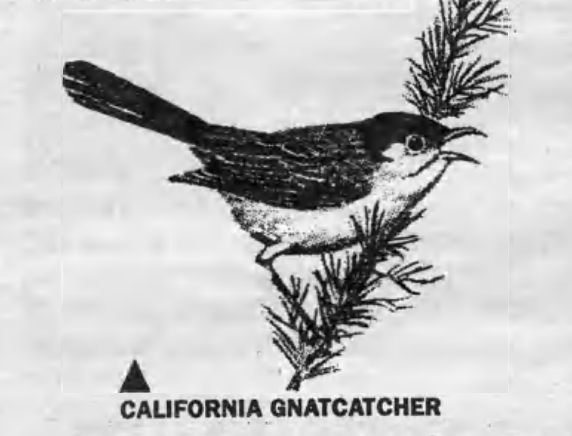
“The tiny sedentary blue-gray bird is restricted to the coastal sage scrub vegetation at lower elevations in Orange, Riverside and San Diego counties,” the Observer reported. “Areas in both the east and west Coyote Hills, Fullerton’s last remaining open space, contain breeding pairs of the bird. Proponents for the petition claim the numbers of California Gnatcatchers has declined greatly with the rapid development in all three counties.”
In park news, did you know that the area around the Summit House restaurant at the corner of Bastanchury and State College is actually a city park? If you were confused, that might be because the city approved a sign that played up the restaurant, rather than the park.
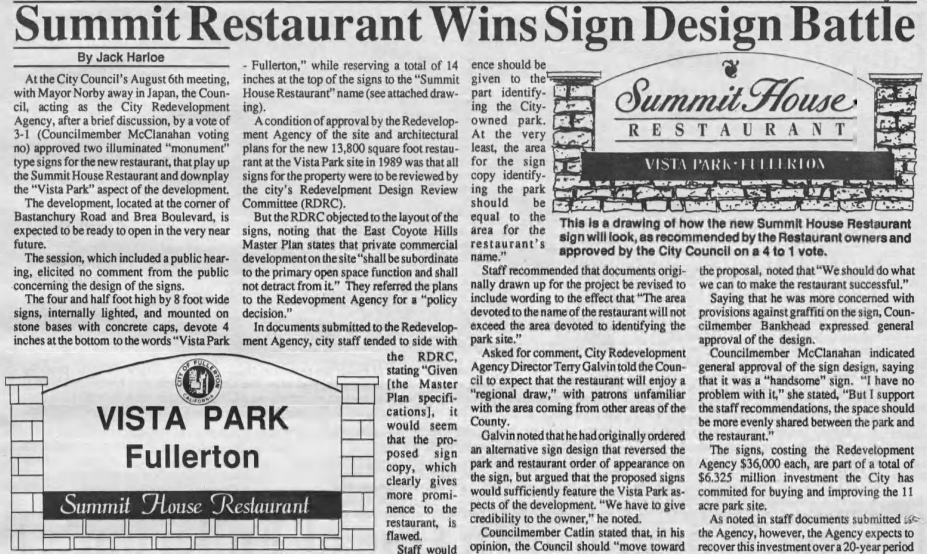
“City Council approved two illuminated ‘monument’ type signs for the new restaurant, that play up the Summit House Restaurant and downplay the ‘Vista Park’ aspect of the development,” the Observer stated.
This despite the fact that the Redevelopment Design Review Committee (RDRC) had objected to the layout of the signs, noting that “a greater presence should be given to the part identifying the City-owned park.”
The signs, which cost the City’s Redevelopment Agency $36,000 each, “were part of a total of $6.3 million investment the City committed for buying and improving the 11 acre park site.”
Culture
As I write this post, I’m struck by a common theme–local residents having to wait a really long time for things in Fullerton–things like access to Coyote Hills, or for a toxic waste dump to be cleaned up, or for the Fox Theater to re-open. In 1991, plans to refurbish and reopen the Fox were again delayed.
“Fullerton’s downtown Fox Theater renovation project received a shot in the arm from the City Council on November 19th when it granted an extension of time to June 16,1992 to allow owner Ed Lewis to complete tenant selection and financial arrangements,” the Observer reported.
“I’m in a limbo situation,” he told the Council, “for a project which can cost from $1.55 million upwards to $4.5 million.”
Meanwhile, the building that once housed Fullerton’s other historic theater (the Rialto) was being renovated, albeit not as a theater.
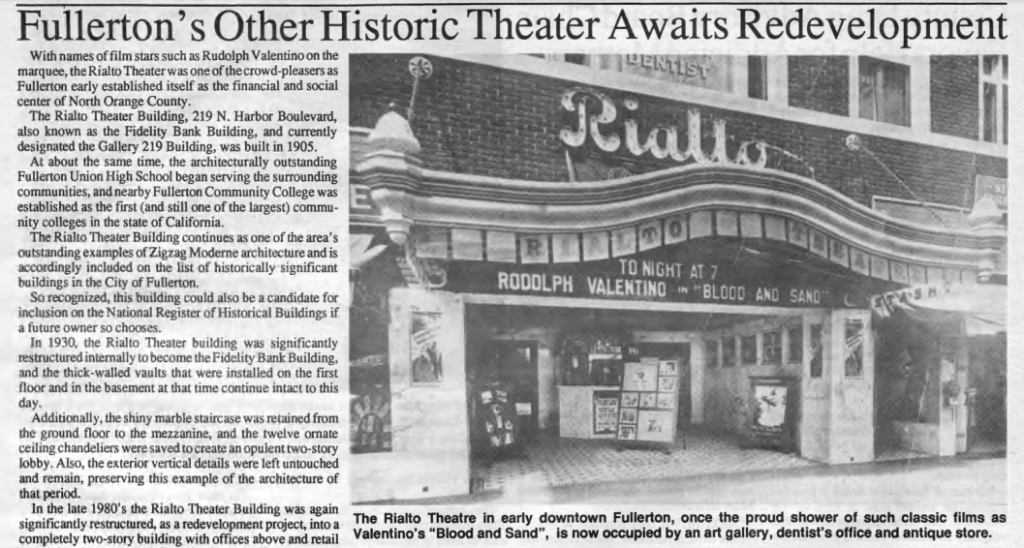
Built in 1905, the Rialto Theater Building (219 N. Harbor Boulevard) was an example of the Art Deco style Zigzag Moderne. In 1930, the Rialto Theater building was significantly restructured internally to become the Fidelity Bank Building.
In the late 1980’s the Rialto Theater Building was again remodeled, as a redevelopment project.
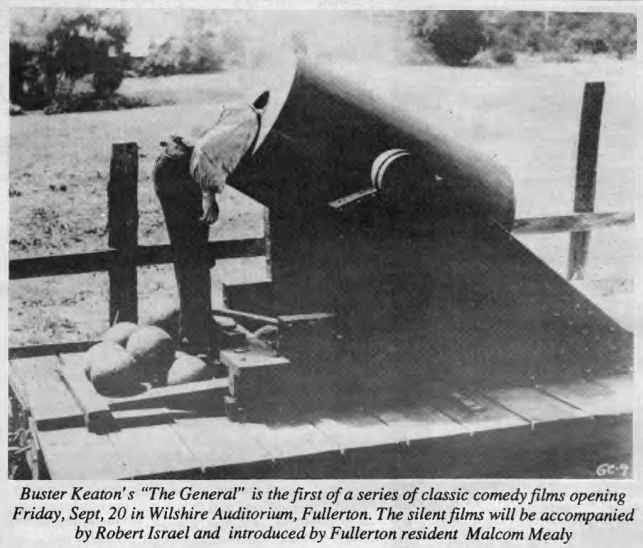
Another historic theater in Fullerton which remains and is (in my opinion) underutilized is the Wilshire Auditorium. In 1991, old silent films were shown there.
In the 1980s and early 1990s, there were a handful of art galleries downtown, such as Watermark Press Gallery.

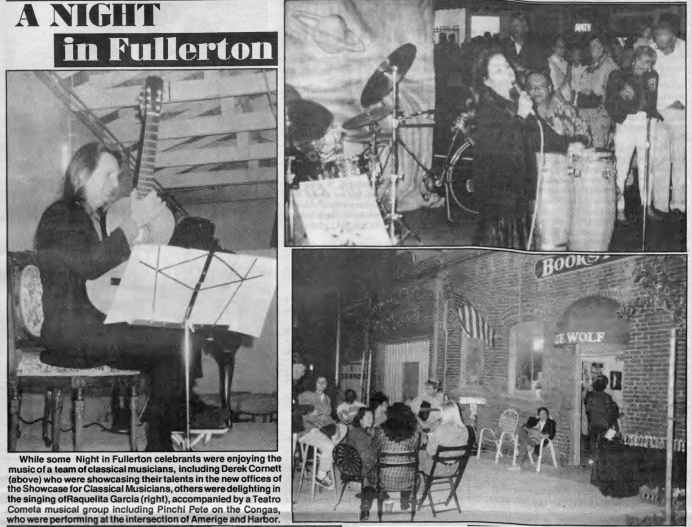
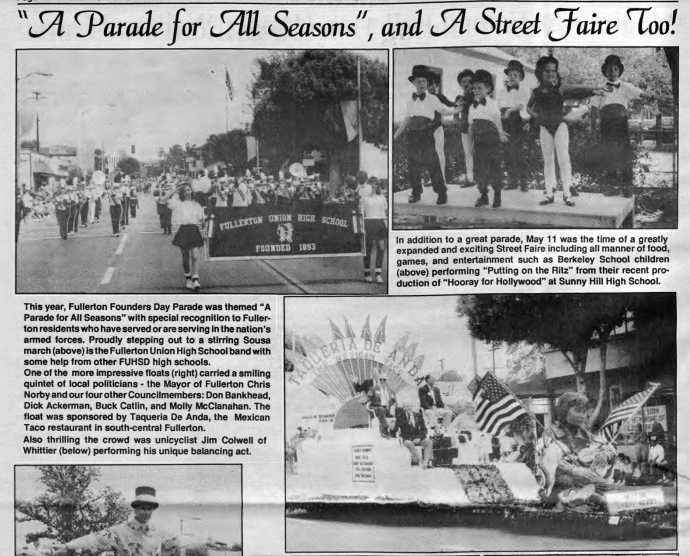
Other cultural events in 1991 included the annual “A Night in Fullerton” and the Founder’s Day Parade.
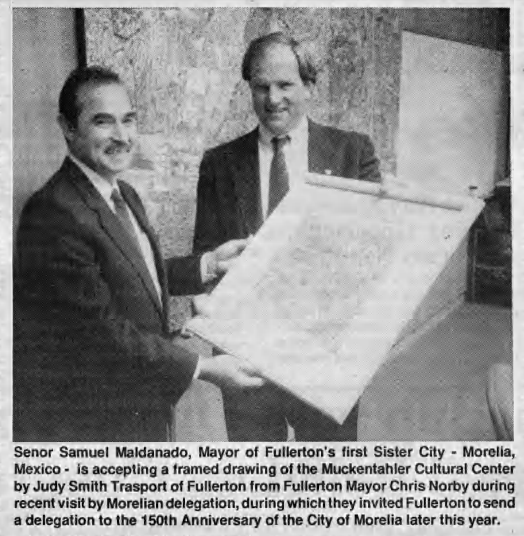
Fullerton has long had a sister city program, encouraging cultural exchange.
Transportation
In transportation news, the City continued its policy of ignoring the needs of bicyclists.
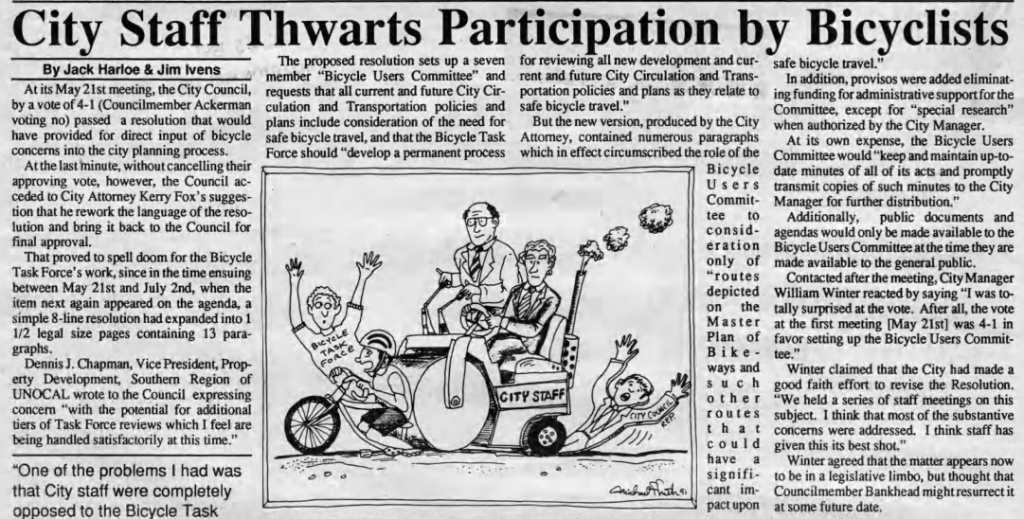
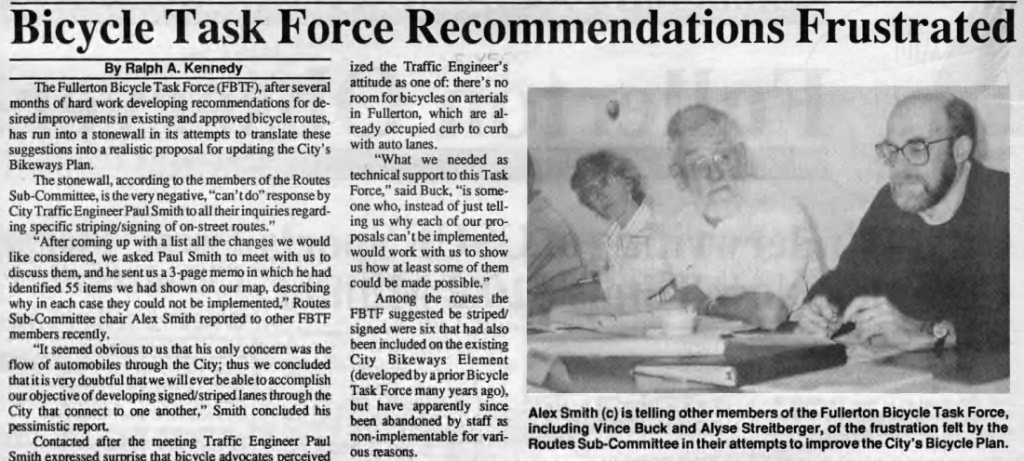
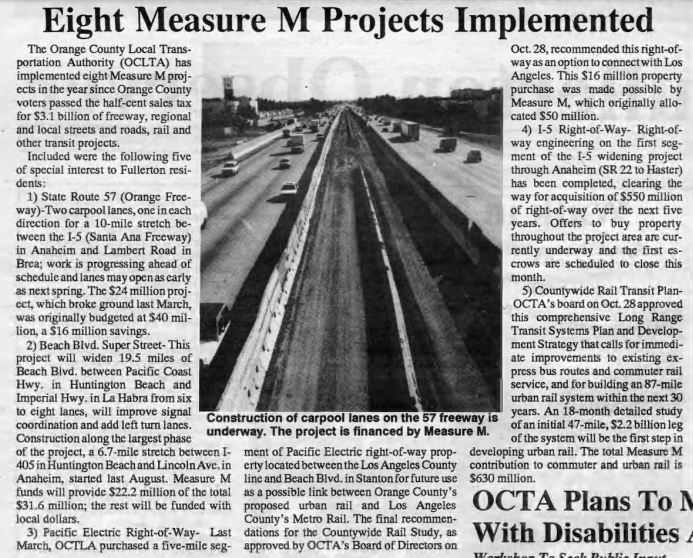
Measure M, a countywide measure for transportation improvements had passed the previous year and improvements were being proposed, many of them to benefit cars.
Protecting the Vulnerable
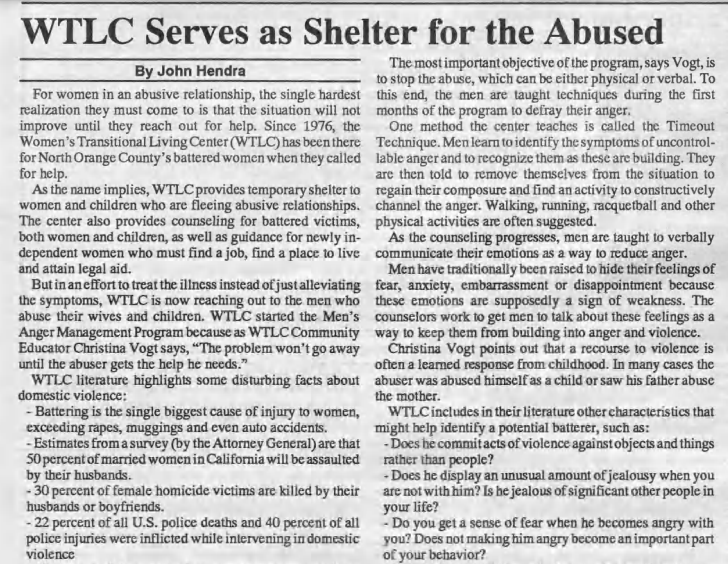
Two groups doing work to protect abused women and children in Fullerton were the Women’s Transitional Living Center (now called Radiant Futures) and Crittenton Services. Both still exist today.

National and International News
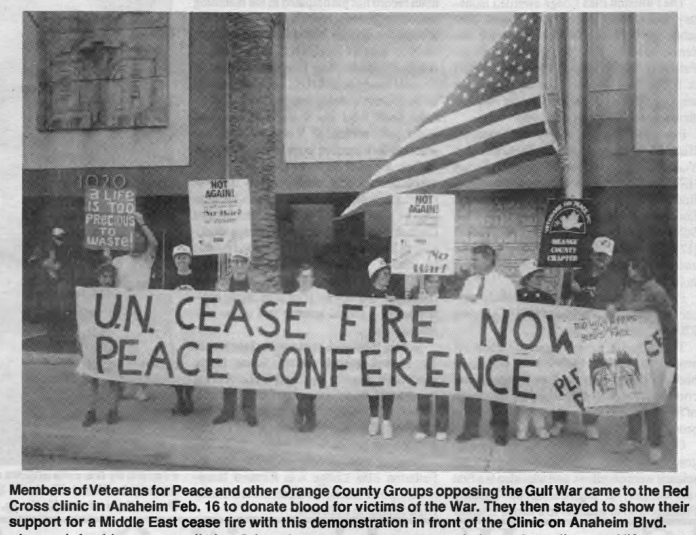
As mentioned earlier, in 1991, the US was at war with Iraq, and some protested it.
The Observer interviewed Jennifer Olmsted of Fullerton, a Ph.D. candidate in Economics at the University of California who, for her doctoral dissertation, researched the connections between education, employment and migration among Palestinians in Israeli Occupied Territories. Her insights below feel quite relevant today.
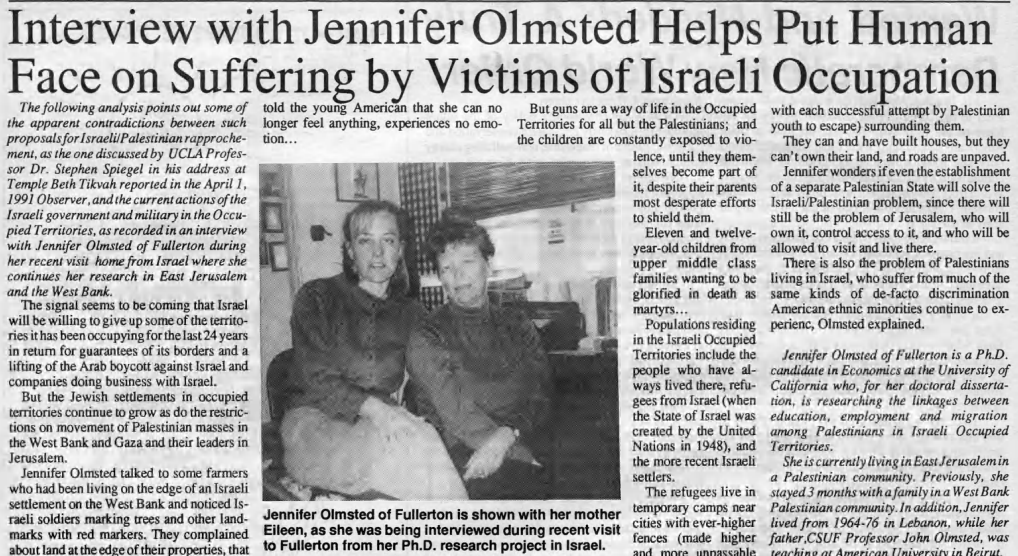
“Jewish settlements in occupied territories continue to grow as do the restrictions on movement of Palestinian masses in the West Bank and Gaza and their leaders in Jerusalem.
“Palestinian children in the Occupied West Bank and Gaza territories have been suffering closed schools for years, as the Israeli military claims that they are centers for political opposition, according to Olmsted.
“The refugees live in temporary camps near cities with ever-higher fences (made higher and more unpassable with each successful attempt by Palestinian youth to escape) surrounding them.
The world was pressuring South Africa to end its apartheid regime, as shown by a Fullerton Museum Center exhibit.

Miscellaneous
Below are a few interesting miscellaneous articles from 1991:
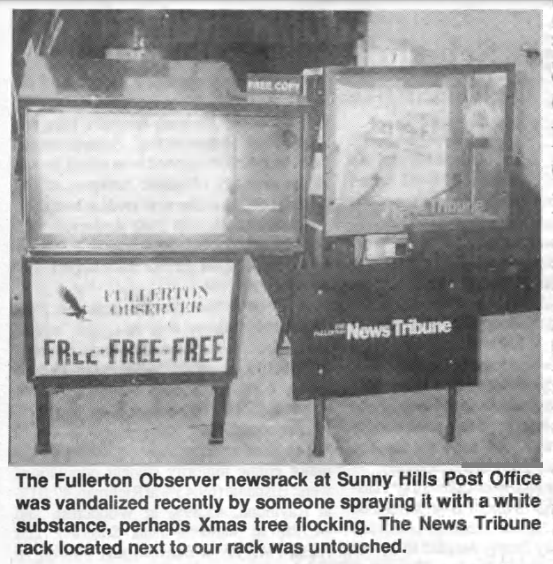
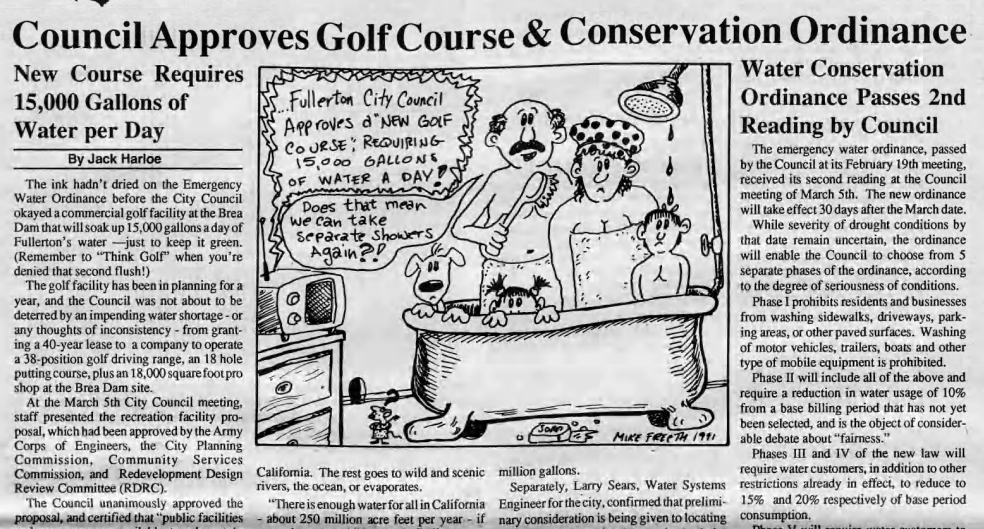
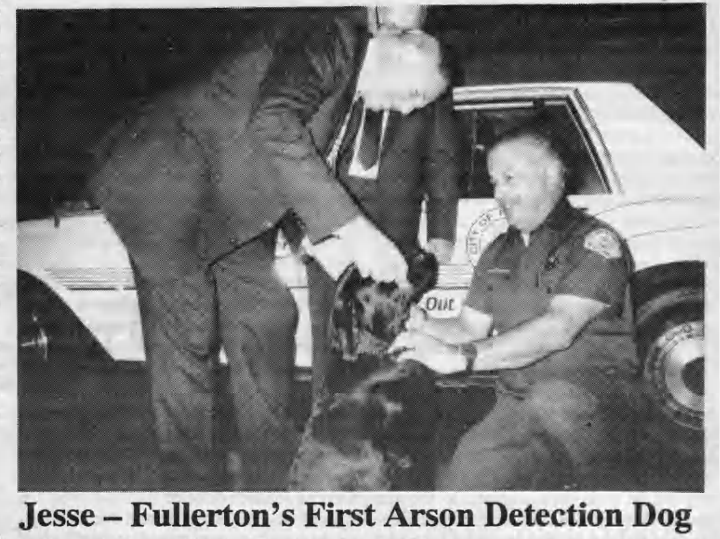
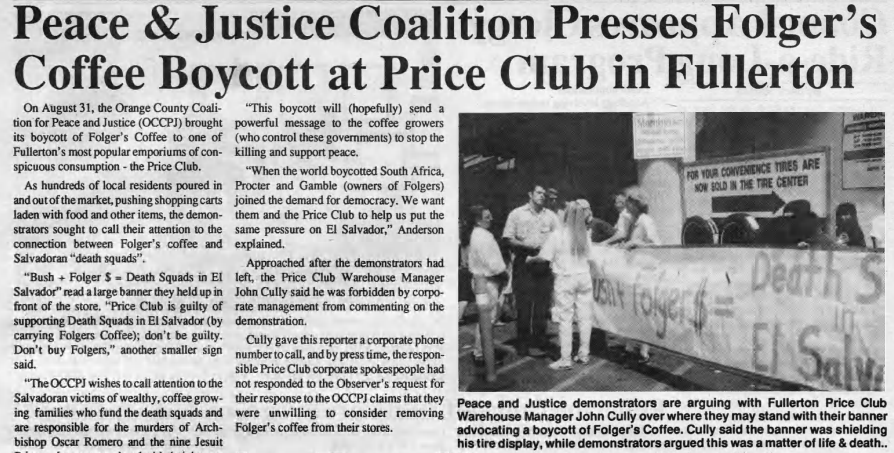

Observer founder and editor Ralph Kennedy had a heart attack, but he was okay.

Deaths
Candelaria (Candy) Garcia died at age 73.

An active member of her community, Garcia was President of the Latin Y-Wives (YWCA), the only club in the U.S. when it was formed, geared exclusively towards Hispanic women and their needs.
She was a member and leader in the Guadalupanas at St. Mary’s Church, with services directed towards recent immigrants.
She was a member of the Maple Action Committee (MAC), “a neighborhood organization which was principally involved in improving the relations between the residents of Fullerton’s Maple Area and the Fullerton Police Department.”
History
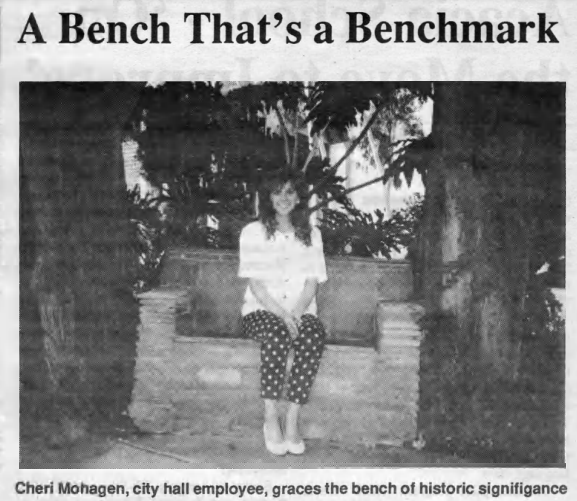
A local history article delved into the mystery of who built the little flagstone bench nestled between two Cypress trees near City Hall. Here are some excerpts:
Librarian Evelyn Cadman, who oversees the Fullerton Public Library’s collection of Fullerton historical documents, said the earliest recorded owner of the property was Herbert A. Ford, who moved his family to the area in 1884, and built the family home on the land.
In 1889, Ford opened one of the first grocery stores in town. Given the fact the trees flanking the bench were planted by the Fords, it’s plausible to assume the family also built the bench, “especially since flagstones were indigenous to this area, and were a ready source of building material,” Mrs. Cadman said.
However, no conclusive evidence has been found linking the Fords with the bench. From the Fords, the search for the builder of the bench jumps ahead 40-something years to the 1940s and a second contender—E J. Steen, a local physician whose practice was in an office building on the former Ford property.
“One long-time resident told me that Dr. Steen may have built the bench,” Mrs. Cadman said. Steen later moved his practice up on North Harbor Boulevard, where he opened the Seventh Day Adventist Hospital. That building would later became the old Fullerton Community Hospital, and is now part of Florence Crittenden Services.
It’s here that the search for the mystery bench builder ends—at least in terms of historical facts known now.
The next time you visit City Hall, stop by the little stone bench and rest a spell. Chances are, in the comforting shade of the towering Cypress trees, you’ll find your thoughts drifting to a gentler time when people made time to just sit and visit with one another, and even an unassuming little stone bench could offer a window on a rapidly changing world.

Another history article tells of local community Christmas celebrations in the 1940s and 1950s.
One of the signals for the beginning of the season was when the Fullerton merchants’ association put up the downtown decorations over Harbor Blvd and on the lamp poles, always after Thanksgiving. Then there was the announcement of the annual Christmas decoration contest. Families who wanted to participate spent lots of time on it. There were big prizes, up to $25 for the best displays.
Sometimes family or neighborhood people would don costumes and be in a pantomime manger and shepherd scene on the lawn. The schools had Christmas concerts and plays which weren’t just attended by doting grandparents and aunties. These were community events, attended by hundreds.
Fullerton Union High School and Fullerton Jr. College (now Fullerton College) had a series of four Christmas presentations, so scheduled that a kid could be in or see all four during his or her high school career. The Auditorium (now Plummer Auditorium) was packed for this show.
In the late 1940s the Fullerton Kiwanis Club began an outdoor pageant in Hillcrest Park. The Kiwanians and their family members who took part would have a small flock of sheep, a couple of burros, a cow and the like in the work area of the park above the old duck pond.
Participants worked on a schedule so the “cast” differed from one night to the next. That gave lots of people a chance to help out, but it meant a different crew of shepherds each evening.
The community loved it. The performance, complete with manger scene, was originally fairly lengthy but after a couple of years people would come from miles around to view it, and the traffic on Harbor was jammed. Some would parallel park and stay quite a while so the show was shortened by turning out the lights every so often, allowing a new audience to see it.
The same cars which stopped to see the pageant put on by the Kiwanians would then drive through the park (not closed at night) and then up or down Harvard Ave. (now Lemon St.) to see the decorated lighted trees on the west side of the street. Many of the large trees are still there. Then, as likely as not, a carload of wide-eyed children would get to see the various homes which were decorated, paying special attention to those which had won the first, second and third prizes in the Chamber of Commerce home decorating contest. You always took visiting relatives from Iowa around to see.
Stay tuned for headlines from 1992!
 Fullerton History