The following is from a work-in-progress about the history of Fullerton. You can support my ongoing research and writing on Patreon.
The Fullerton Observer newspaper was formed in 1978 by Ralph and Natalie Kennedy and friends to provide a more progressive counterbalance to the more conservative Fullerton News-Tribune and Orange County Register. The Fullerton Public Library has digital archives of the Observer stretching back to 1979. Here are some top news stories from 1990.
Culture
The City of Fullerton was planning to spend around $5 million to help Fox Theater owner Edward Lewis re-open the historic theater as a “triplex cinema,” to be operated by Landmark Enterprises, showing “first run cameo films, foreign films and other artistically distinguished pictures to Fullerton.” Built in 1925, the Fox Theater closed in 1987.

But Angelos and Vinci’s owner Stephen Peck and theater owner Lewis were taking a while to reach an agreement about how the restaurant would operate during the extensive renovations.

The total cost of the project had grown to about $7.3 million, with Landmark and Lewis agreeing to spend about $1.5 million to restore lavish Italian murals in the theater, and the City spending $4.7 million in redevelopment funds “to purchase and raze homes behind the theater, relocate occupants, and build a 200-space parking structure on the space thus made available.”
Residents would have to wait longer, much longer, for the Fox to re-open. Thirty-four years later, they are still waiting.
In another loss of a local movie house, the Wilshire Theater (which showed independent and foreign films), was going to be converted into an apartment building.

On a more positive note, A Night in Fullerton was still going relatively strong.
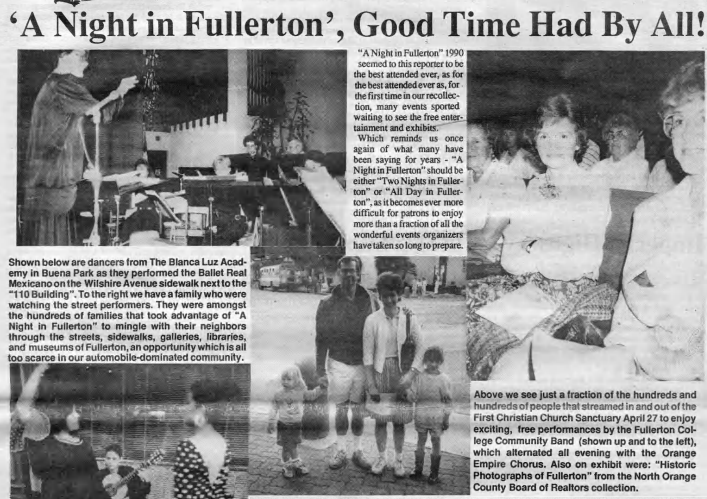
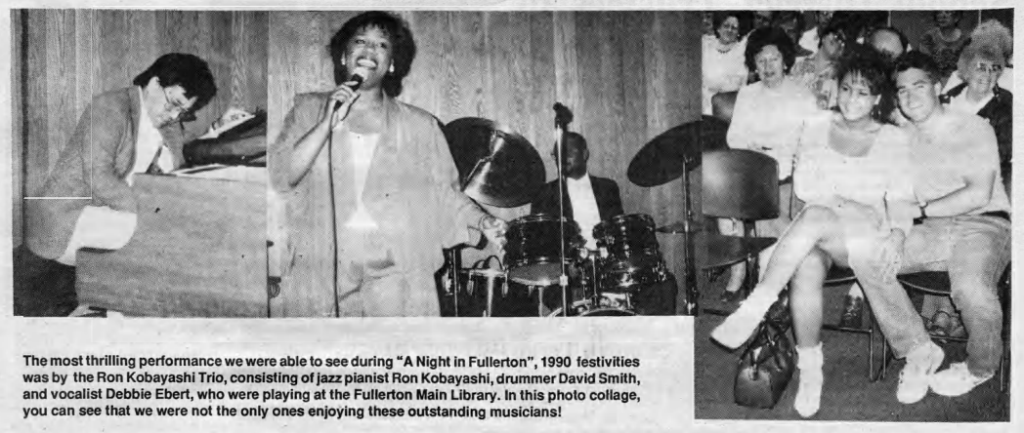
And the City celebrated its annual Founder’s Day Parade.


An art exhibit at The Muckenthaler Cultural Center drew controversy when some parents expressed their disapproval of their children seeing two art pieces on a field trip there.
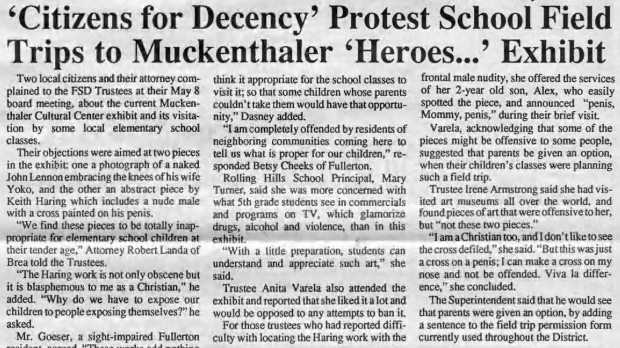
One was a photograph of a naked John Lennon embracing the knees of his wife Yoko Ono, and the other an abstract piece by Keith Haring which included a nude male with a cross painted on his penis.
“We find these pieces to be totally inappropriate for elementary school children at their tender age,” Attorney Robert Landa of Brea told the Trustees. “The Haring work is not only obscene but it is blasphemous to me as a Christian.”
For many years, from the 1970s to the 1990s, there was an annual “Lively Arts Festival” at Hillcrest Park.

Education
The debate over whether and how to re-open Maple School continued.

“It was evident that members of the Maple Area are split on whether or not reopening Maple School as a pre-school through 6th grade program is the right thing to do,” the Observer reported. “Several longtime residents in the Maple neighborhood expressed their fears that a reopened Maple School would put their grandchildren right back where their children had been 20 years ago when the Fullerton School District closed the school for being almost totally segregated.”
A Maple Task Force was created to study the issue and make recommendations. Ultimately, their idea was to reopen Maple as a “magnet school” offering special programs that would draw students from across the district, so as to prevent the school being majority Latino and thus de facto segregated.
However, an Observer editorial stated, “As much as we would like to believe this, we are not aware of any examples where magnet schools located in minority neighborhoods have been successful in drawing enough Anglo student to achieve an integrated student body.
The school district hired a professional consultant to help develop a Maple Reopening Plan
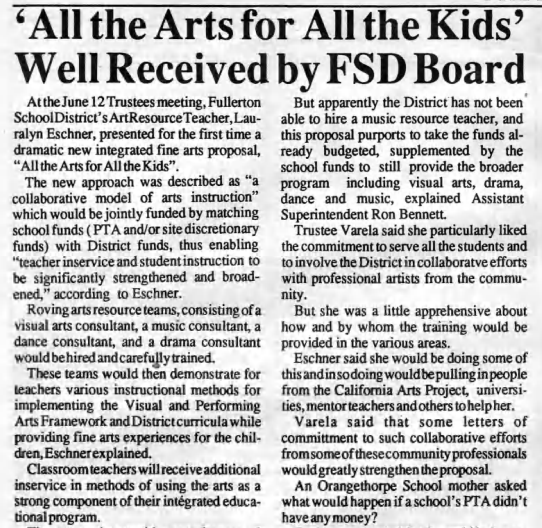
All the Arts for All the Kids, a popular and innovate program to provide arts instruction in local schools, was first proposed in 1990 by its long time director Lauralyn Eschner.
Following the retirement of Jewel Plummer Cobb, Milton Gordon began his tenure as president of CSUF.


Fullerton City Librarian Carolyn Johnson, who worked for the library for nearly 50 years, retired.

“Carolyn Johnson started work in the old Fullerton Public Library on Pomona Avenue, now the Fullerton Museum Center,” the Observer stated. “Then, Fullerton was a community of 11,000 persons; as Johnson nears retirement, the population has grown to 112,000. In 1959, Johnson was named coordinator of children’s services for the library, and was appointed City Librarian in 1981…Of her many accomplishments, Johnson takes particular pride in her role in designing the Children’s Room of the Main Library, which was built in 1973.”
To replace her, Al Milo was promoted.

McColl Toxic Dump…The Saga Continues
In the ongoing saga of the McColl Toxic Waste Superfund Site, the EPA announced that groundwater sampling from monitoring wells near the site found the toxic chemical tetrahydrothiophene (THT). The EPA concluded that the THT was moving through the soils into the groundwater from waste at the McColl site.
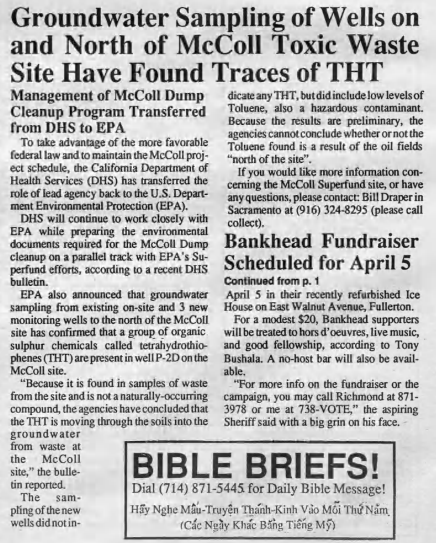
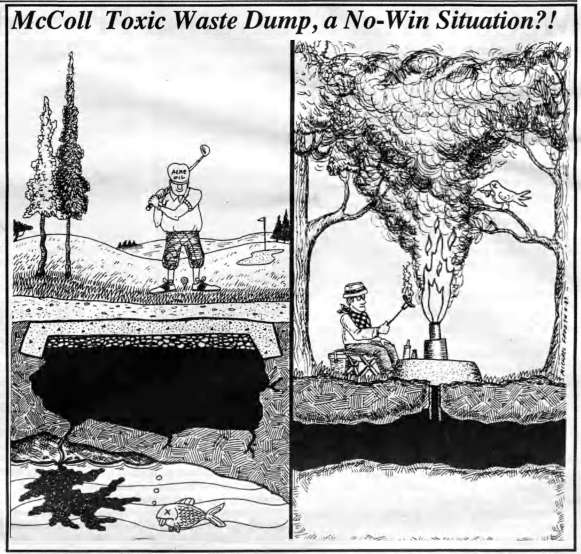
The solution proposed by the oil companies responsible for the waste was to “cap” and monitor the site, leaving the waste buried there indefinitely–with some walls around (but not underneath) the 200,000 cubic yards of sludge.
Both the EPA and the local community rejected this plan.
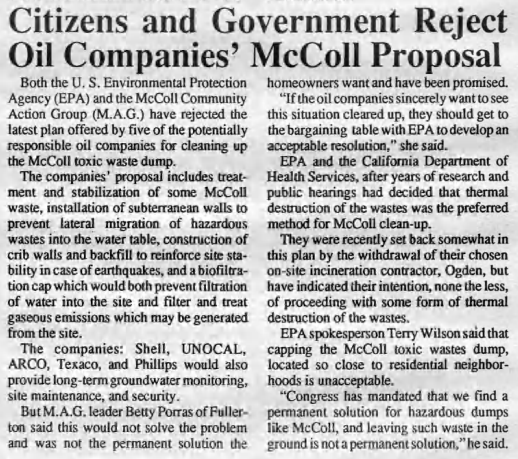
EPA spokesperson Terry Wilson said that capping the McColl toxic wastes dump was unacceptable. “Congress has mandated that we find a permanent solution for hazardous dumps like McColl, and leaving such waste in the ground is not a permanent solution,” he said.
The preferred plan by the EPA and the California Department of Health Services, after years of research and public hearings, was to burn the waste either on-site or elsewhere. These plans, unfortunately, were delayed when the company doing burn tests quit the job.
Meanwhile, the oil companies were doing their best to win over public opinion to their preferred “solution” by holding neighborhood meetings.
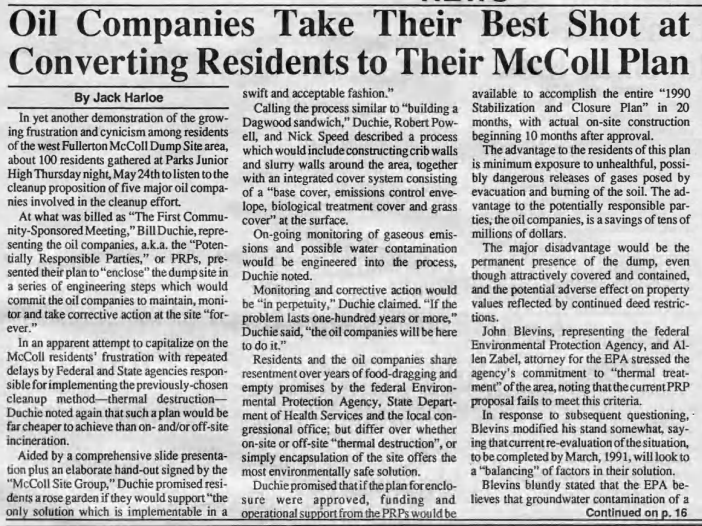
“In an apparent attempt to capitalize on the McColl residents’ frustration with repeated delays by Federal and State agencies responsible for implementing the previously-chosen cleanup method—thermal destruction— Bill Duchie [representing the oil companies] noted again that such a plan [capping the site] would be far cheaper to achieve than on- and/or off-site incineration,” the Observer reported.
“In a free-form and lively discussion following testimony of the ‘experts,’ residents of the McColl area appeared divided between the permanent enclosure plan and thermal treatment,” the Observer stated. “Distrust of both EPA and the oil companies was voiced, with an underlying tone of despair among residents that, after years of fighting, they appear no closer to a solution now than when the problem first became apparent.”
Later in the year, the EPA and DHS invited to public to a “Visitor’s Day” at the Superfund site to learn about a trial excavation (removal) of the waste.

To Spray or not to Spray?
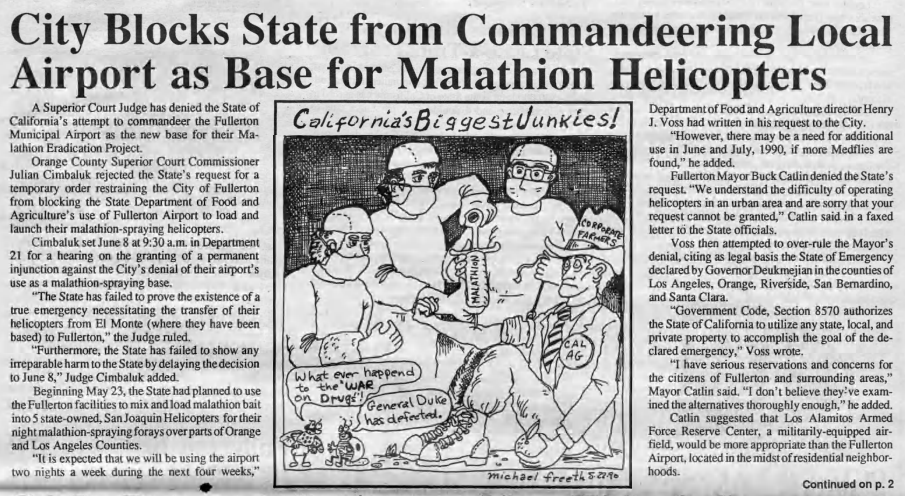
As some Fullertonians worried about toxic chemicals underground, others worried about toxic chemicals being sprayed from the sky–specifically the pesticide malathion, used by government agencies to control the fruit fly population.

A number of articles, letters, and cartoons appeared in the Observer, mostly protesting the spraying of malathion, citing negative human health effects.

State Senator John Seymour wrote a couple of letters to the Observer, defending the spraying of malathion.
“I have not found any concrete evidence which leads me to believe that the spraying of Malathion in the dosages proposed presents a health risk to our citizens,” Seymour wrote. “And, since this method of control has proved to be most effective in eradicating the Med Fly, I am comfortable with the decision that the Department of Food and Agriculture has made to stop the spread of this pest which has the potential of inflicting serious economic and environmental damage within our county and throughout the state.”
Facing concerned residents, City Council held a hearing on malathion spraying, and ultimately voted to prevent the state from using our local airport for malathion helicopters.
Housing & Homelessness
Today, California and the nation are facing an undeniable housing crisis. For long-time homeowners with low or no mortgages, it may be easy to ignore the struggle of renters or those trying to get into the market. In 2024, the median home price in Orange County is $1.1 million. This means you have to make $349,000 a year to afford a home. The median income in Orange County is about $45,000.
How did we get here? What is the cause? Put simply, as with all commodities, price is governed by laws of supply and demand. California since the 1970s has experienced an intensifying housing shortage, as fewer housing units have been built than people entering the state, thus driving up cost. Simple.
Throughout most of its existence, the Fullerton City Council was dominated by conservatives who consistently refused to support affordable housing.

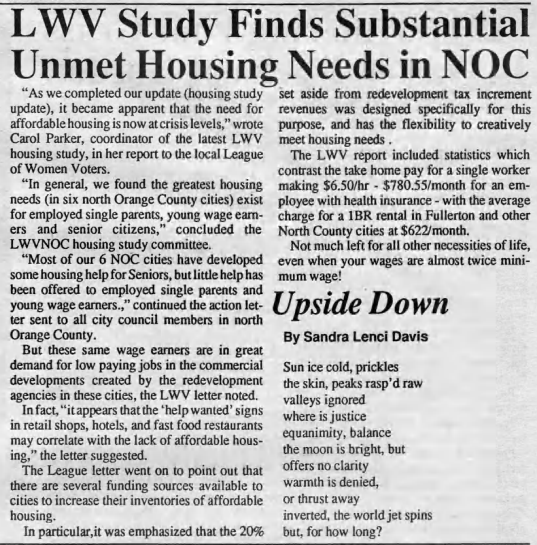
But liberals were also to blame. If high housing costs are created by a shortage of housing, the most obvious solution is to build more housing. In Fullerton, a standard liberal position is to support affordable (i.e. government subsidized) housing, while generally opposing market-rate, private sector housing, despite the fact that the vast majority of people do not live in “affordable” housing.
One example in 1990 was the local opposition to a development on East Coyote Hills of 112 condominium/townhouses and 111 single family homes.
Former mayor Bob Ward, an early advocate for “open space” such as West Coyote Hills, opposed the project, saying that the developer had “made no real attempt to meet the Greenbelt Concept of the General Plan.”
Facing such opposition, the Planning Commission sent the project back to the developer with the instruction that he reduce the number of housing units.

Ultimately, the conservative majority city council approved the project, but not before much opposition from neighbors who wanted fewer housing units built.
An editorial in the Observer stated, “Most of those who testified at the March 6th Council meeting opposed the development as being too crowded, too dense, and too severe in its grading.”
Both liberals and conservatives are also guilty of opposing new housing on the grounds that it would disrupt the “character” of their neighborhoods.
This situation is, of course, not unique to Fullerton. It is the story of the escalating housing crisis in California and the United States.
Meanwhile, Fullerton’s homeless shelter, run by Fullerton Interfaith Emergency Services (now Pathways of Hope) expanded to try to help the increasing unhoused population.
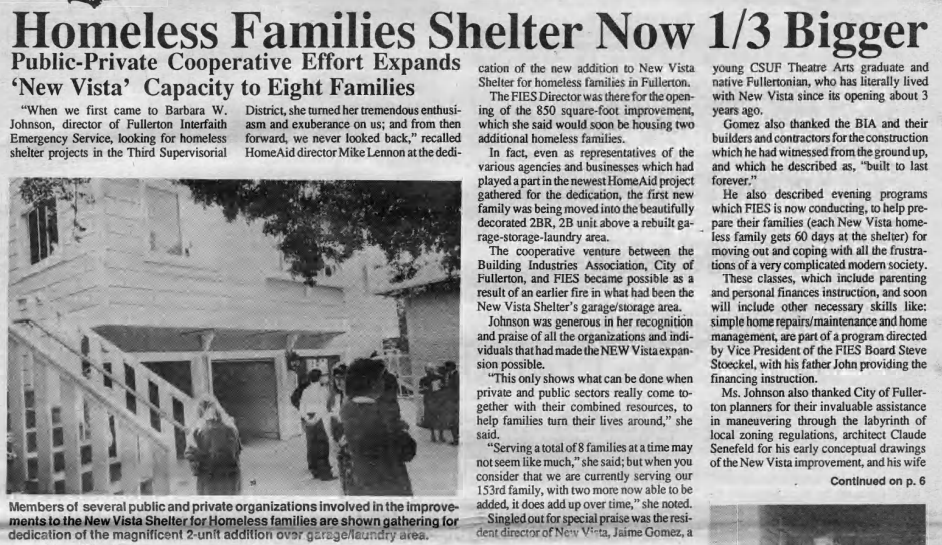
“Serving a total of 8 families at a time may not seem like much,” Barbara Johnson, director of FIES said. “But when you consider that we are currently serving our 153rd family, with two more now able to be added, it does add up over time.”
Another new program was created called Project HOPE, which aimed to help provide jobs for the homeless. Interestingly, the city of Fullerton recently created a separate program called Project HOPE.

Transportation
Fullerton established a Bicycle Task Force to study and advocate for improved bicycle accessibility.

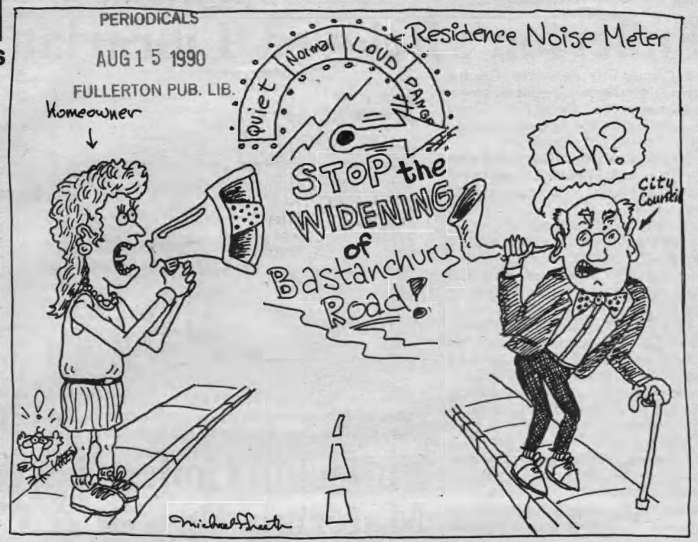
Local residents attempted unsuccessfully to stop the widening of Bastanchury Road.
In public transit news, there was interest in establishing a local monorail system. This, of course, never happened.

In 1990, commuter train service to Los Angeles was established. This would eventually become the Metrolink.
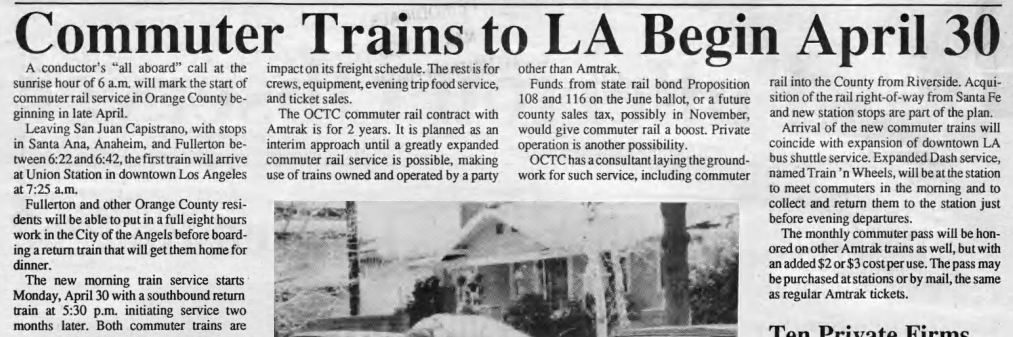
The city was in the process of improving its train platform and creating a pedestrian overpass, which was ultimately built.
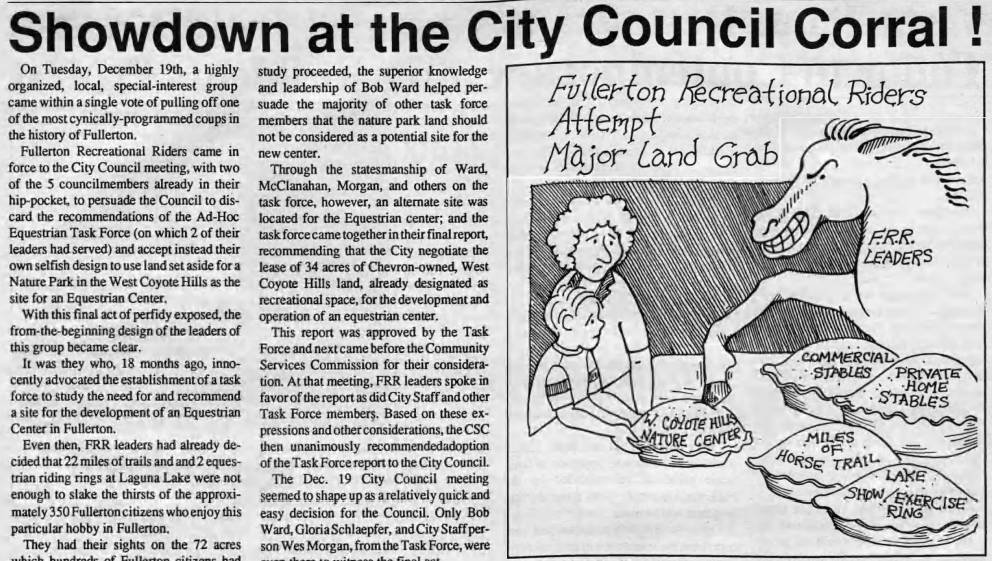
Showdown at the City Council Corral
The Fullerton Recreational Riders attempted to take over City-owned land in Coyote Hills that is now part of the Robert E. Ward Nature Preserve, facing off against local environmentalists who wanted the land as an educational open space. Ultimately, the riders lost; however, they still have quite a good equestrian facility across Euclid near Laguna Lake.
Downtown
Rather than using funds to build needed affordable housing, the City of Fullerton’s Redevelopment Agency (which no longer exists) allocated funds to help replace the 100-year old building at the southeast corner of Harbor and Commonwealth that was destroyed by a fire in 1989.

The Council, in its alternate role of City Redevelopment Agency, authorized the City to execute an exclusive 90-day agreement with the Stein/Nicholas family, owners of the property, and the developer, the J. Ray Construction Company.
Strangely, a proliferation of antique businesses downtown was seen as something that would “spark rebirth.” I’m not knocking antique stores, but they are not exactly signs of economic revitalization.

Racism/Bigotry
Facing a recent spate of hate crimes, the FPC began to track and investigate these incidents.


These hate crimes included “the distribution and posting of anti-Semitic and racist literature, and the harassing, threatening phone calls, which seem to be the principal tactic of groups variously referring to themselves as skinheads, White Aryan Resistance, etc.”
“To get a handle on such crimes and groups, the FPD has for about the last year been assigning a special “hate crime” code to any reported crime that could conceivably have any connection to such behavior,” the Observer reported.
Law Enforcement
Recently-elected City Councilmember Don Bankhead, a former Fullerton Police Captain, planned to run for Orange County sheriff, after a scandal surrounding the most recent sheriff Brad Gates, and the publication of an expose book entitled The Twisted Badge, about the negative influence of politics in law enforcement.
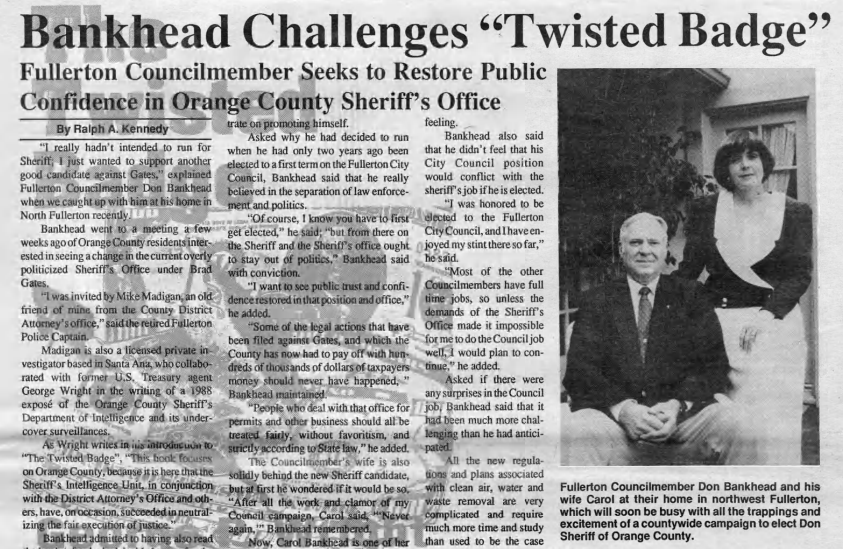
“Some of the legal actions that have been filed against Gates, and which the County has now had to pay off with hundreds of thousands of dollars of taxpayers money should never have happened,” Bankhead said.
Bankhead was hoping to raise money for his campaign at an upcoming “fundraiser the Bushala Brothers Inc. of Fullerton have scheduled for April 5 in their recently refurbished Ice House on East Walnut Avenue, Fullerton. For a modest $20, Bankhead supporters will be treated to hors d’oeuvres, live music, and good fellowship, according to Tony Bushala.”
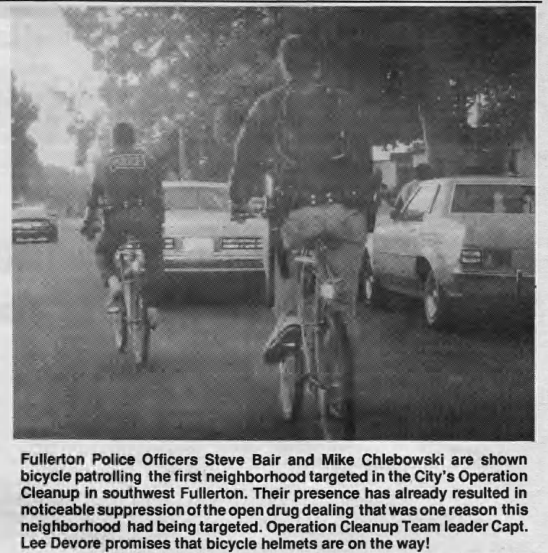
In 1990, Fullerton had bike cops.
Miscellaneous
Here are some miscellaneous clippings from the Observer in 1990:



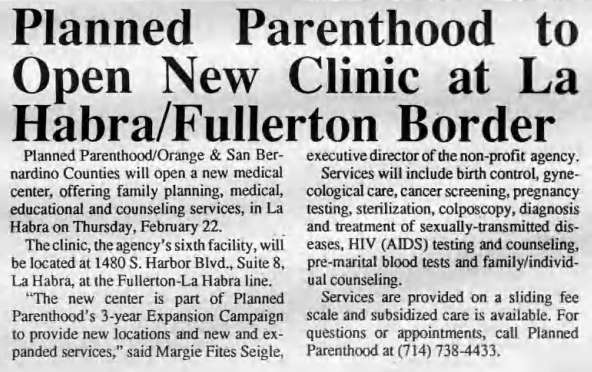
National and International News
Farmworker labor leader Cesar Chavez came to CSUF to encourage consumers to boycott table grapes until growers stopped using certain pesticides that were harmful to farm workers.

Some American doctors were advocating for universal health care in America.
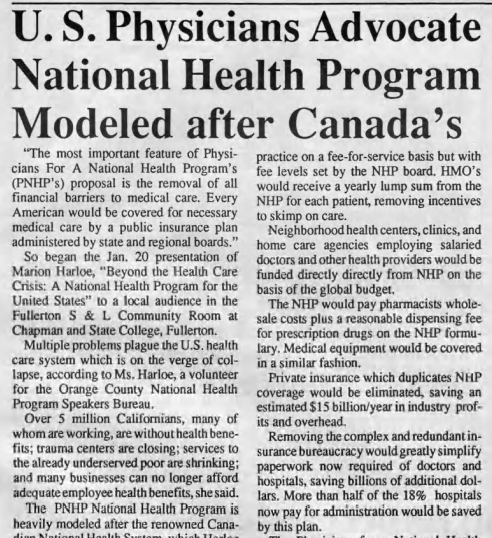
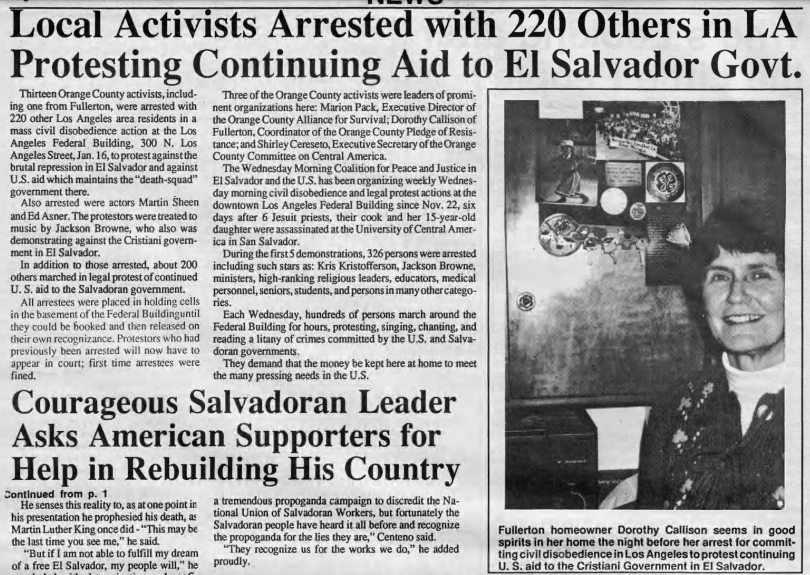
Locals protested the US government’s support of the brutal regime in El Salvador.
By the middle of 1990, the first phase of the Persian Gulf War (Operation Desert Shield) was underway. As with the Iraq War in 2003, the Persian Gulf War was seen by some as being about protecting the interests of US oil companies (not democracy), as the graphic below suggests.

Deaths
And here are some notable local deaths from 1990:

Dorothy Anderson died at age 69.
“Dorothy Anderson’s life as an activist for peace and justice began in 1964 when she became a member of ‘Another Mother for Peace’- their son Donald, was in the Air Force in Vietnam,” the Observer stated. “She followed that by getting heavily involved in her first ever political campaign – McGovern for President – in 1968…Then came her north Orange County leadership of Common Cause and most recently her charter involvement in the formation of the ‘Beyond War’ movement in 1983.”
In addition to its large conservative evangelical churches like EV Free, Fullerton has also had a number of mainline protestant churches that were much more politically liberal, such as Dorothy’s church, the Congregational Church.
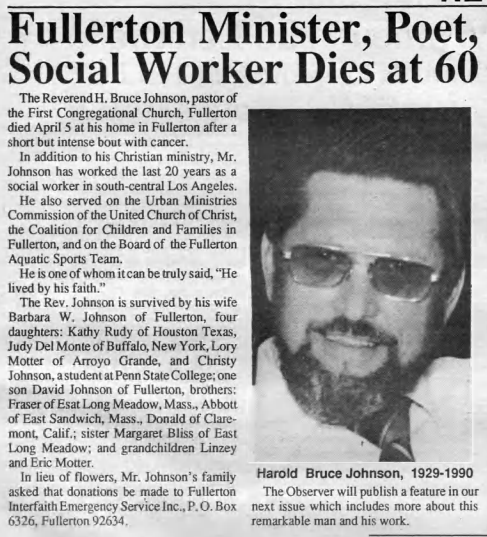
The Reverend H. Bruce Johnson, pastor of the First Congregational Church, Fullerton died.
“In addition to his Christian ministry, Mr. Johnson has worked the last 20 years as a social worker in south-central Los Angeles. He also served on the Urban Ministries Commission of the United Church of Christ, the Coalition for Children and Families in Fullerton, and on the Board of the Fullerton Aquatic Sports Team,” the Observer stated.
Johnson was survived by his wife Barbara W. Johnson, who was involved with Fullerton Interfaith Emergency Services, which ran the city’s homeless shelter.

Dr. Russell D. Parks died at age 82. Dr. Parks, after whom Parks Junior High School was named. He first served the Fullerton School District in 1938, when he was hired as the principal of Maple School.
He left the FSD in 1944 to become Asst. Superintendent of the Orange County Department of Education. When he returned to the FSD in 1945, he then served 25 years as its Superintendent.

Fullerton Police Department undercover narcotic detective Tommy De La Rosa was fatally wounded during an undercover narcotic transaction in Downey.
There is now a street in Fullerton named after De La Rosa.
Stay tuned for headlines from 1991!
 Fullerton History