The following is from a work-in-progress about the history of Fullerton. You can support my ongoing research and writing on Patreon.
The Fullerton Observer newspaper was formed in 1978 by Ralph and Natalie Kennedy and friends to provide a more progressive counterbalance to the more conservative Fullerton News-Tribune and Orange County Register. The Fullerton Public Library has digital archives of the Observer stretching back to 1979. Here are some top news stories from 1989.
Local Politics
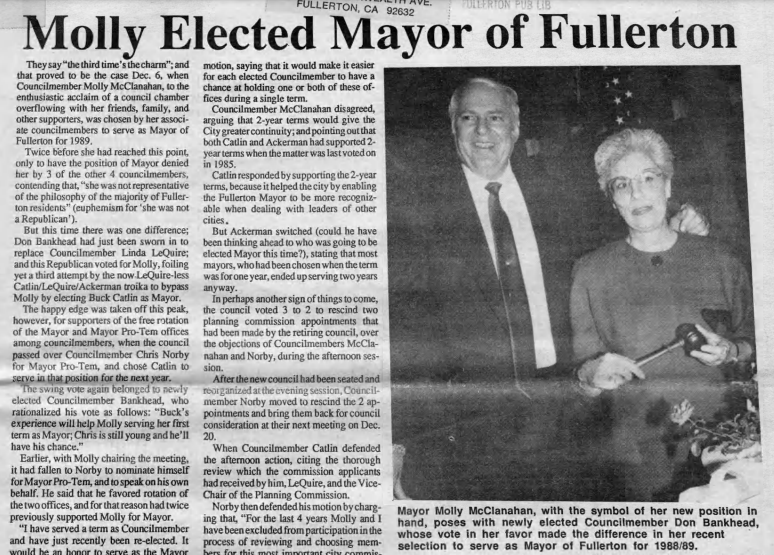
Molly McClanahan, the lone liberal on Council, was finally chosen as mayor.
Housing
Fullerton City Council’s Redevelopment Agency had a very poor track record of supporting affordable housing.

“Fullerton’s agency reported a loss of affordable units and displacement of 17 poor households,” the Observer stated. “During this reporting period, no units affordable to very low or low income households were either built or rehabbed by the agency.”
Fullerton’s Housing Element was out of compliance with state standards, particularly regarding affordable housing.

Meanwhile, California’s affordable housing shortage was getting worse.
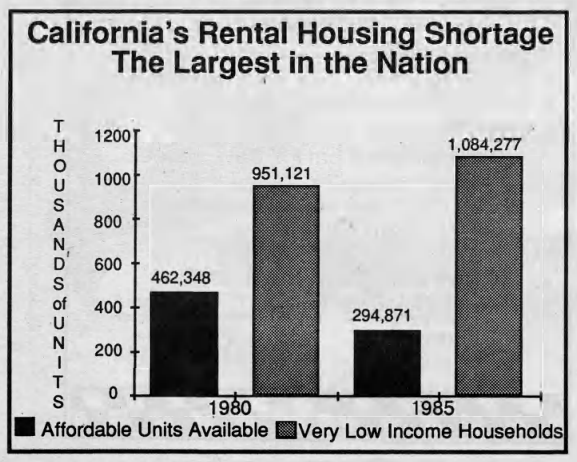
Cities’ lack of affordable housing directly led to an increase in homelessness.
“A May 1987 survey of 444 California cities, conducted by the League of California Cities, found that over the past five years the number of homeless increased in 49% of our cities,” the Observer stated. “Homelessness is the most visible and pernicious sign of a larger affordable housing crisis that makes it difficult for the elderly, the handicapped, young families and many other Californians to obtain decent, affordable housing.”
This low prioritization of affordable housing was also happening at the national level during the Reagan administration.
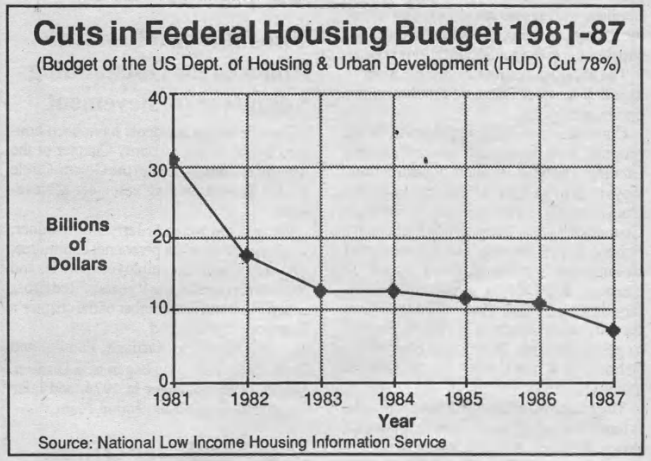
“In six years, 1981-87, the federal Department of Housing and Urban Development (HUD), previously a key player in providing affordable housing, sustained budget cuts totaling over 78%,” the Observer stated. “The number of new federally assisted units has plummeted from above 200,000 per year to about 25,000, and annual appropriations for HUD have shrunk from 4 percent of the total federal budget to less than .01 percent for the current fiscal year.”
Instead of providing shelter and affordable housing, county officials responded to a homeless encampment along the Santa Ana River trail by making the area “uninhabitable with large, heavy rocks on the ground and space under the bridge…closed with cement.”
There were an estimated 10,000 homeless people in Orange County – but only about 600 shelter beds.
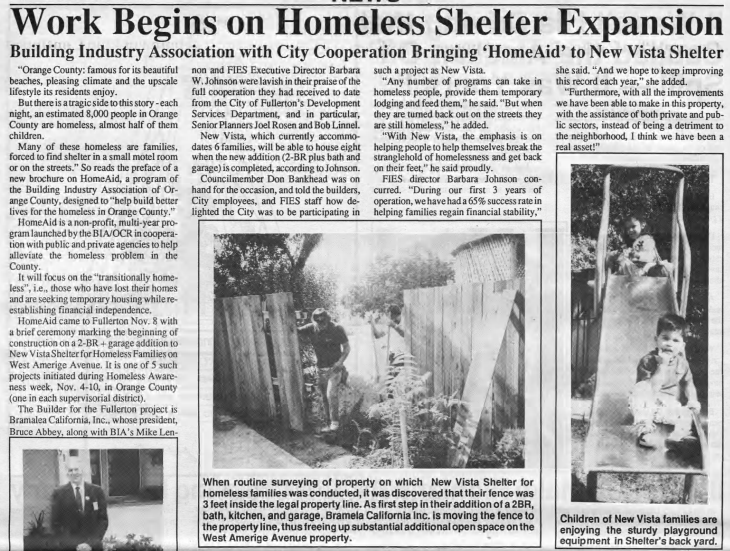
Meanwhile, local nonprofit Fullerton Interfaith Emergency Services (now Pathways of Hope) expanded their shelter to help meet a fraction of the need.
The National Guard Armory in West Fullerton also served as a temporary shelter during cold weather months. It was staffed by local volunteers.

Also, Council approved (but did not fund) a shelter for up to 20 homeless, mentally ill women in downtown Fullerton, to be run by Western Youth Services.
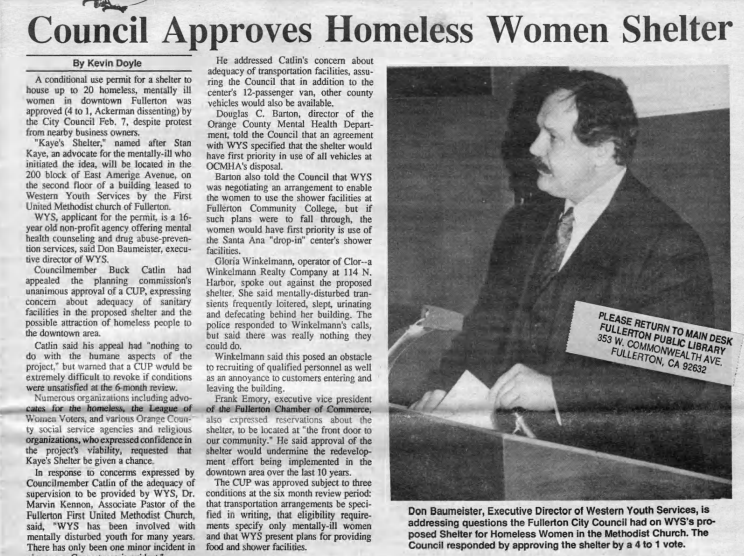
Councilmember Dick Ackerman, along with the local Chamber of Commerce were against allowing the shelter.
City Council also assisted the Southern California College of Optometry and a developer in their attempts to obtain low cost financing from the County for an East Fullerton apartment project, which will reserve 20% of its units for “very-low” income households.

And a young developer named Tony Bushala, who would later become a major player in local politics, was seeking approval of a major multi-family residential development called Fullerton Towne Terrace on the 100/200 blocks of East Truslow.

Bushala was asking the City/Redevelopment Agency for an investment in the project of about $2.5 million.
The Bushalas claimed that they were planning to include between 10 and 20% of the apartments at rents which are affordable to very-low income households. Stay tuned for how that all worked out.
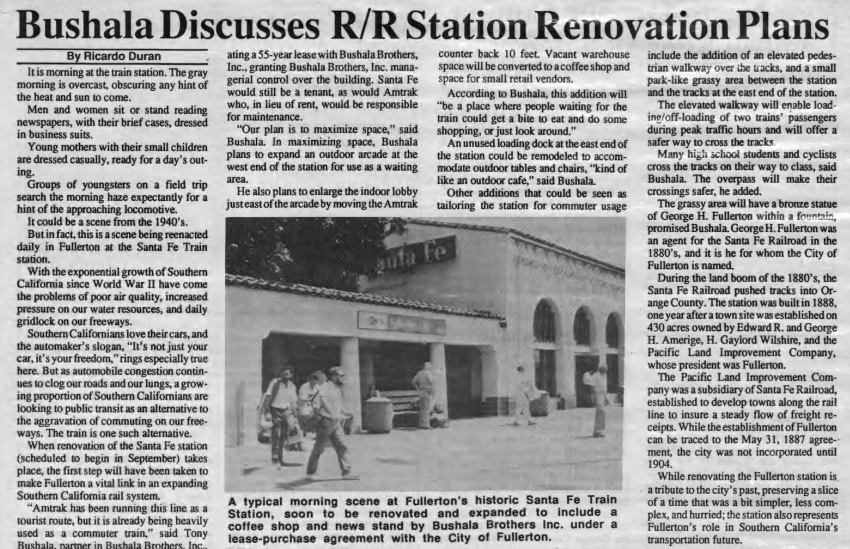
Bushala also made a deal to renovate the old Train Station, adding a cafe and other amenities, including “a bronze statue of George H. Fullerton.” The renovation happened, but where is the bronze statue, Tony?!
Redevelopment
Rather than use redevelopment funds on affordable housing, the conservative city council majority preferred to use these funds on other things, like a massive sports complex at Cal State Fullerton.

Fullerton Rejects Welfare Office
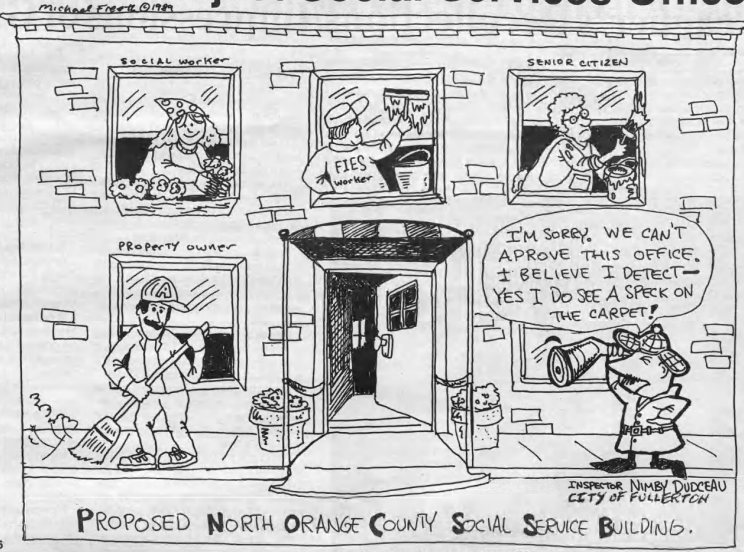
Continuing their denial of poor people in their midst, city planners and council also denied a permit for a county welfare office to locate in Fullerton.

“Mr. Ralph Nielsen…expressed the well-known not-in-my-backyard [NIMBY] sentiment when he said, ‘This is a great use but the wrong place,’” the Observer stated.
The Ongoing McColl Toxic Waste Dump Saga
On the subject of unwanted things, we turn now to the ongoing saga of the toxic McColl Superfund Dump site in West Fullerton. This was an area next to what is now Ralph Clark Park where oil companies had dumped their waste in the 1940s–81 Olympic-sized swimming pools of toxic waste. The area had been declared a Superfund site. Federal and state regulators were working with the oil companies and the community to come up with the best solution to protect local health, groundwater, etc. Unfortunately, this process was very slow, taking years to complete.
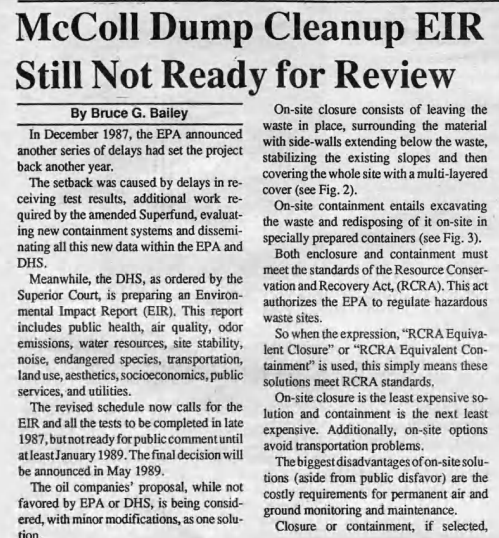
Proposed solutions for the McColl waste were either to cover it up or to destroy it (either on site or somewhere else).

EPA and DHS announced that they favored burning the toxic waste. This, however, posed additional problems like: Could the stuff be safely burned? Would the smoke create another toxic problem for the neighborhood? As usual, more tests needed to be done.

The oil companies responsible for the dumping and waste preferred to “cap” the site, rather than burn it, mainly because it was a lot cheaper.

Unfortunately, leaving the waste in place increased the likelihood that it could contaminate the local aquifer and groundwater. “John Blevins, a member of the EPA’s hazardous waste division, said recent tests indicated McColl contaminants have seeped into the aquifer,” the Observer stated. “However, he said that drinking water has not been contaminated.”
Betty Porras, a neighborhood leader, expressed a cautious optimism about the incineration option, writing: “For over a decade now, we have been asking the agencies to clean up McColl. Now, they say they have identified a viable option, and I believe that the least we can do for our own sakes is to give them an opportunity to prove it.”
On-site incineration tests were planned for early 1990.
Education
Back in 1972, facing desegregation orders, the Fullerton School District had closed its predominantly-Latino Maple School in south Fullerton and bussed all its students to other schools in north Fullerton. Their solution to segregation was to close the segregated school. This unfair solution was by no means the only option.
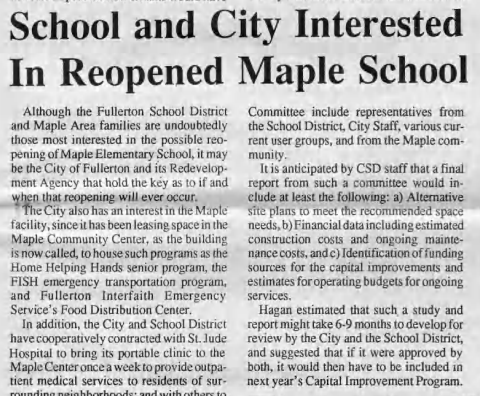
Fast forward to 1989 and the district was facing overcrowding in schools and was therefore considering re-opening Maple, thus potentially re-creating a segregated school as the demographics of the Maple neighborhood were virtually unchanged since the 1960s.
A committee formed to study this issue recommended re-opening Maple.
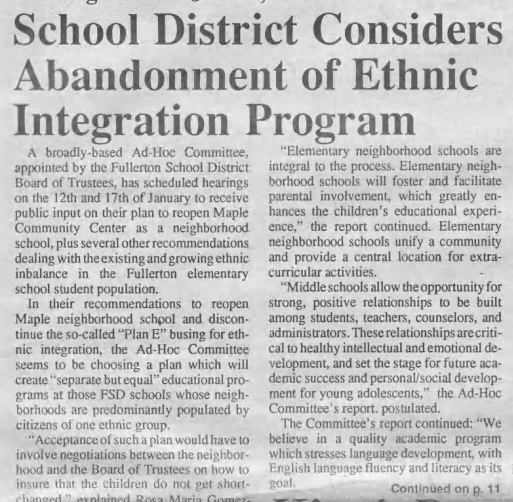
“In their recommendations to reopen Maple neighborhood school and discontinue busing for ethnic integration, the Committee seems to be choosing a plan which will create ‘separate but equal’ educational programs,” the Observer stated. “Asked how reopening Maple School would relieve ethnic segregation, committee chair Ellen Ballard said that after much discussion and study, the committee had concluded, that providing quality programs at every school was better than moving children around to achieve ethnic balance.”

“Persuaded by the Hispanic members of the Committee and Maple Area residents with whom they met over the last few months, the Ad-Hoc Committee came to the conclusion that it was now more important to restore a neighborhood school to the Maple area than to continue busing their children to other neighborhoods’ schools in order to maintain a level of ethnic integration,” the Observer stated.
Racism
Here are a couple of local instances of racism in 1989:


Disasters
In local disaster news, Tony’s Melody Inn in downtown Fullerton (located in a historic building near the corner of Harbor and Commonwealth), burned to the ground.
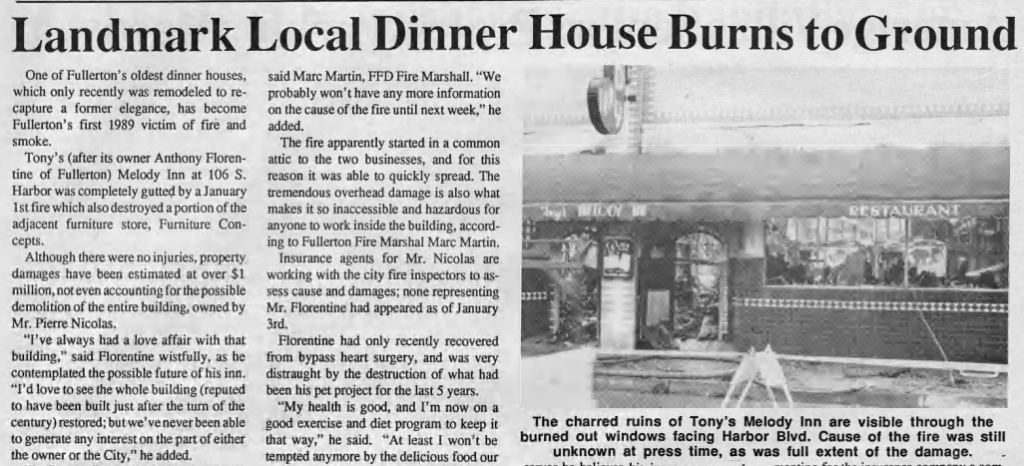
No one was injured in the fire, but the loss of such an historic building was tragic. The building was owned by Pierre Nicolas, whose family were early settlers in the area. The tenant was Anthony Florentine, who would go on to establish Florentine’s Tuscany Club downtown, which is now Mickey’s Irish Pub.
In recent years, a Youtube video was posted featuring Pete Schindler (an associate of Florentine), who says he helped Florentine intentionally burn the building down for the insurance money.
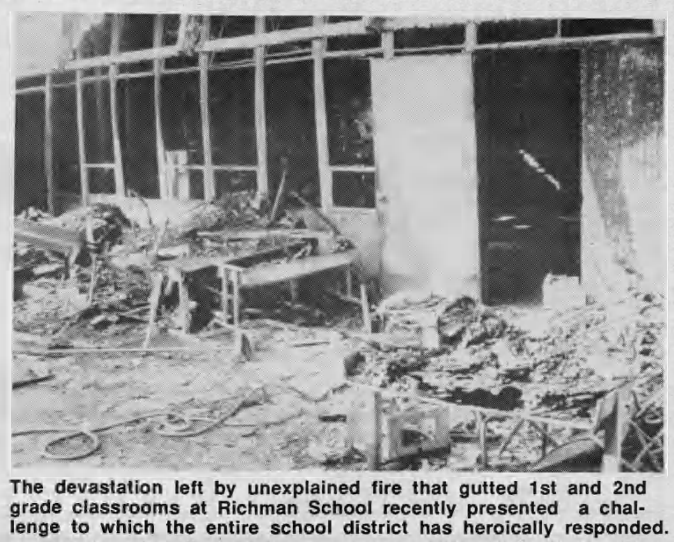
Another fire broke out at Richman School. Thankfully, no one was hurt.
Culture
The historic Fox Theater, which closed in 1987, languished in “bureaucratic limbo” where it would continue to languish for decades.
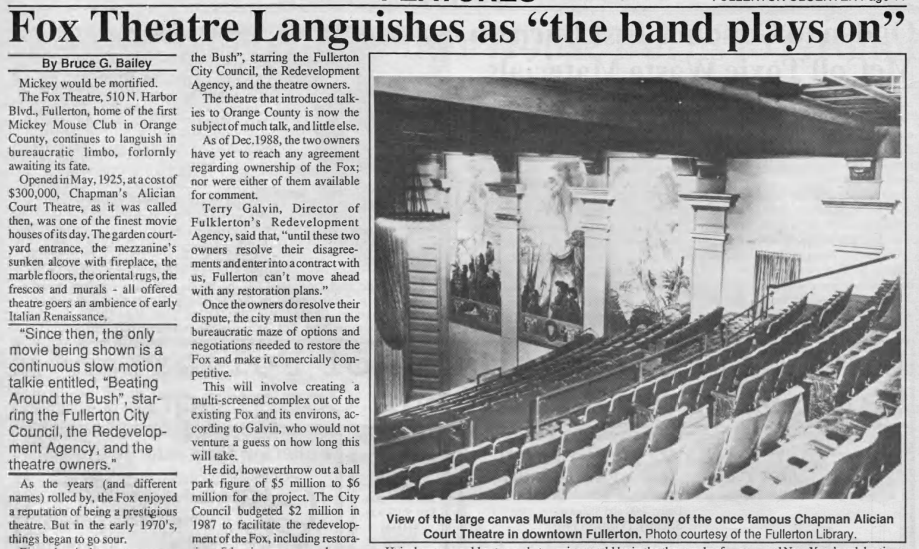
“The Fox Theatre continues to languish in bureaucratic limbo, forlornly awaiting its fate,” The Observer stated. “The only movie being shown is a continuous slow motion talkie entitled, ‘Beating Around the Bush,’ starring the Fullerton City Council, the Redevelopment Agency, and the theatre owners.”
The theatre that introduced talkies to Orange County is now the subject of much talk, and little else.
The City Council budgeted $2 million in 1987 to facilitate the redevelopment of the Fox, including restoration of the six canvas murals, although nothing much was happening on that.
Local historian Warren Bowen wrote a brief history of Hillcrest Park.
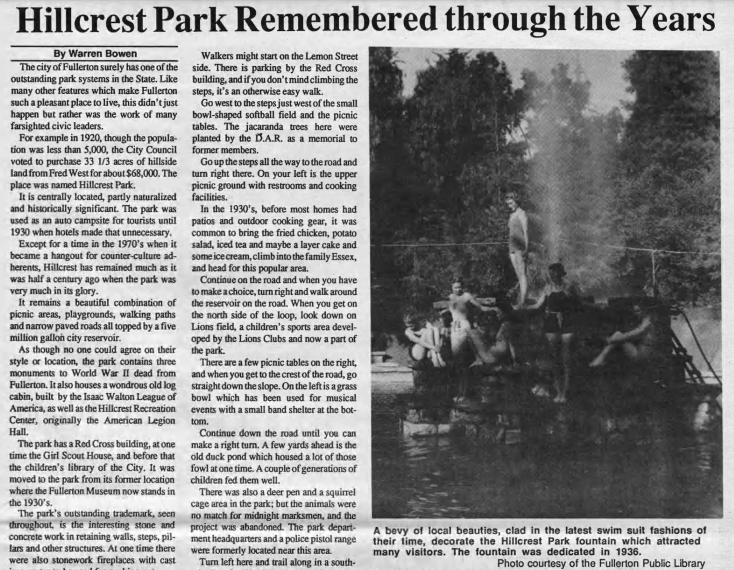
Here are a few excerpts from Bowen’s piece:
“In 1920, though the population was less than 5,000, the City Council voted to purchase 33 acres of hillside land from Fred West for about $68,000. The place was named Hillcrest Park.
“The park was used as an auto campsite for tourists until 1930 when hotels made that unnecessary. Except for a time in the 1970’s when it became a hangout for counter-culture adherents, Hillcrest has remained much as it was half a century ago when the park was very much in its glory.
“The park contains three monuments to World War II dead from Fullerton, a wondrous old log cabin, built by the Isaac Walton League of America, as well as the Hillcrest Recreation Center, originally the American Legion Hall. The park has a Red Cross building, at one time the Girl Scout House, and before that the children’s library of the City. It was moved to the park from its former location where the Fullerton Museum now stands in the 1930’s.
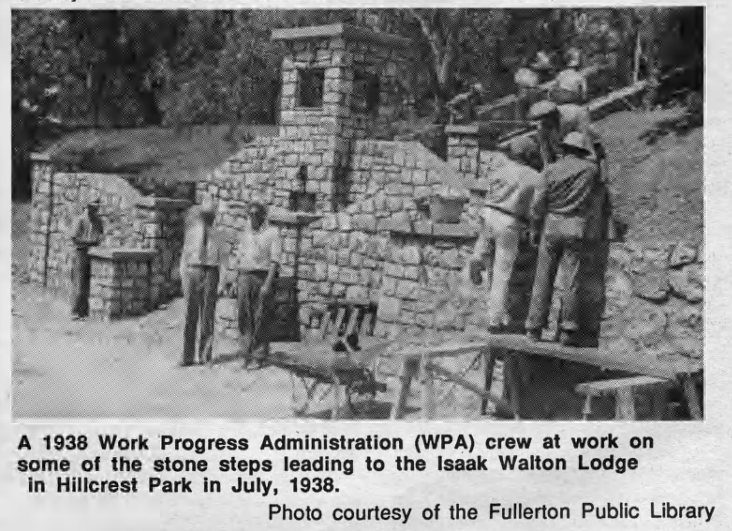
“This stone work was a WPA project in the 1930’s. The workers came from locally unemployed men.
“There was also a deer pen and a squirrel cage area in the park; but the animals were no match for midnight marksmen, and the project was abandoned. The park department headquarters and a police pistol range were formerly located near this area.
“The lawn in front is the site of the annual lively arts festival.”
To commemorate the renovation of the baseball field in Amerige Park, Bowen wrote a piece on this slice of local baseball history, where minor league teams used to play, especially in the 1930s.

“Probably the favorite Coast League club to train here was the Portland Beavers… [who] stayed at the Fullerton Hotel, Malden and Wilshire, and ate their meals at Kibel’s Cafe or Hughes’ Restaurant, sometimes sneaking in a lunch at the Brown Mug,” Bowen wrote. “The Beavers charged 40 cents to get into the exhibition games when the Indians or Angels were bussed into town. Weekday games would draw a few over a hundred fans but on Sundays the place was full. Fullerton continued to be a Mecca for aspiring minor leaguers.”
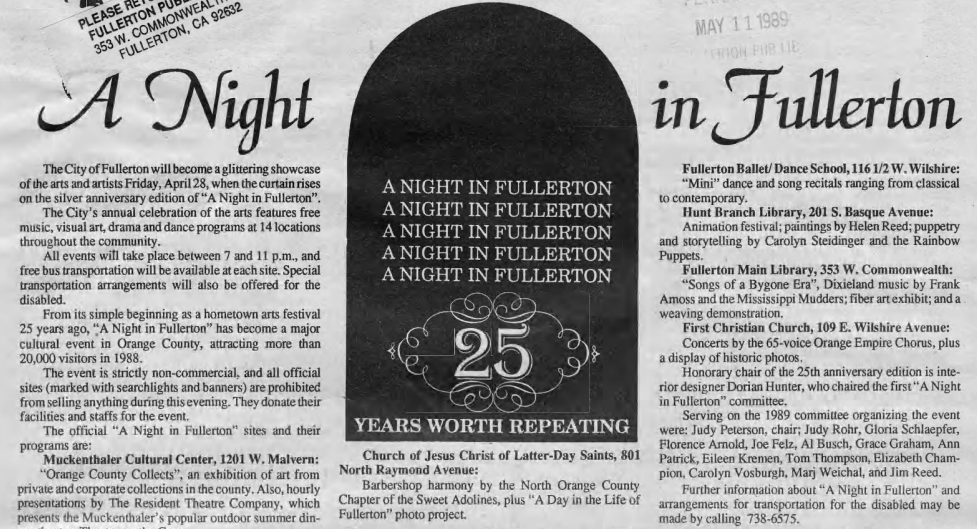
Another popular cultural event was the annual “A Night in Fullerton,” during which numerous arts venues would showcase local creativity. This event, which started in the 1960s, continued until 2009, when it was succeeded by the monthly Downtown Fullerton Art Walk. The Art Walk was largely decimated by the COVID-19 pandemic, although a handful of art venues still exist downtown.
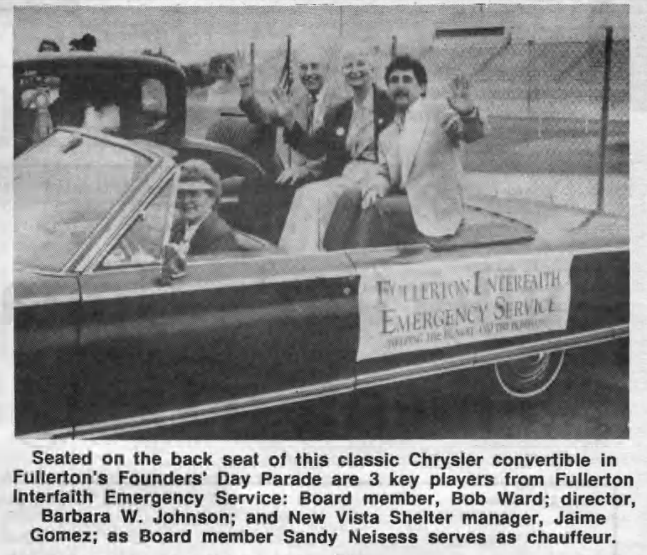
Another popular cultural event in 1989 that no longer exists today was the Founder’s Day Parade.
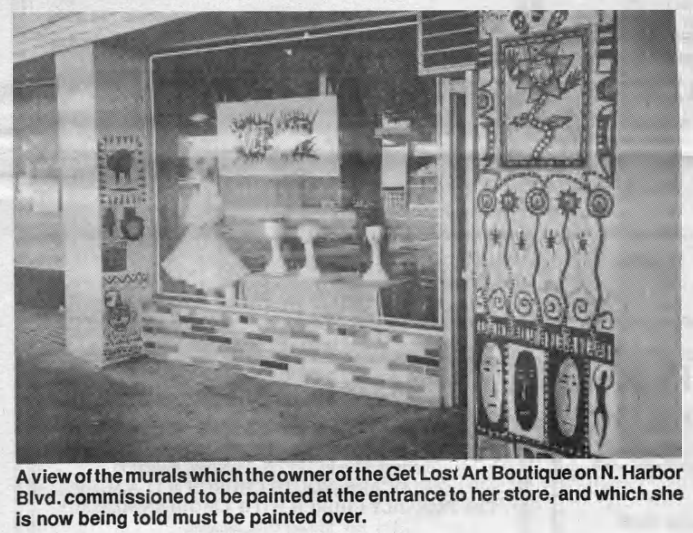
A young woman named Terri Wright opened a small arts store called “Get Lost” downtown across the street from the Fox Theater. She commissioned three local artists to paint murals on the front of her store.
“We got a lot of compliments on this decor from people who participated in the recent Downtown Dinner and Art Walk sponsored by the Fullerton Museum Center,” Wright told the Observer. “But then the City stepped in and declared our murals not to be art but grafitti.”
Fullerton Redevelopment Director Terry Galvin told the landlord and Wright that the murals had no historical value and would have to be painted over.
Fullerton has a sister city program which is meant to encourage cultural exchange with other communities around the world.

Transportation
Orange County voters debated whether to pass Measure M, a 30-year one half cent sales tax increase to fund transportation improvements. Ultimately, the measure passed.

“Orange County is facing a massive traffic crisis and passage of Measure M will put us on the road to a solution,” Republican OC Supervisor Bruce Nestande wrote in an opinion piece arguing for passage of the measure. “Since 1966, only two miles of new freeway have been built and only six miles of existing freeway have been widened. During this time Orange County’s population has soared nearly 78% and more than one million more cars have been added to our streets and freeways.”
Guns
In 1989 (unlike today) mass shootings were a relatively rare occurrence, so the nation was shocked when a gunman shot and killed five students and wounded 32 others at Cleveland Elementary School in Stockton, California.
Back then, lawmakers responded to the tragedy with legislation to ban assault weapons. In California, this took the form of the Roberti–Roos Assault Weapons Control Act of 1989, which stood until 2021, when it was overturned by a judge as unconstitutional.
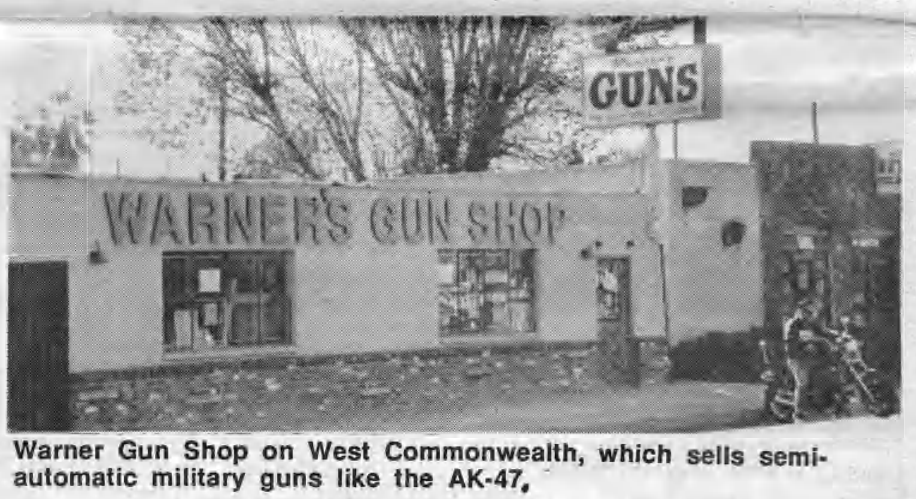
“Two Fullerton gun dealers disagree with the legislators,” the Observer wrote. “An employee of Warner’s Gun Shop, 1108 W. Commonwealth Ave., said banning the sale of weapons like the AK-47 will not solve the problem of criminals or mentally ill people getting these guns.”
“A lot of people like shooting military guns,” he said. The AK-47 is much cheaper than the American made version; the AR-15, made by Colt, costs about three times that of the Chinese AK-47, which costs about $350.”
George Di Leo, owner of The Gunsight, 1712 N. Placentia Avenue, had a different view. “I never have and never will carry guns such as the AK-47,” he said. They are ‘paramilitary’ weapons, not sport guns,” he added. “I do carry many fine semiautomatic rifles and shotguns, however,” he said.
Activism/Protests
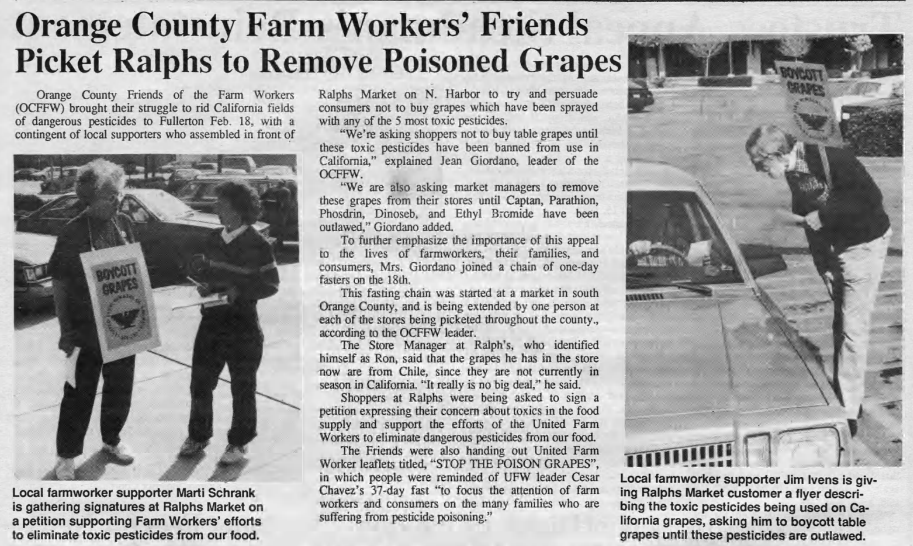
Friends of the United Farmworkers picketed Ralphs grocery store, urging them to stop carrying grapes that were grown with pesticides.
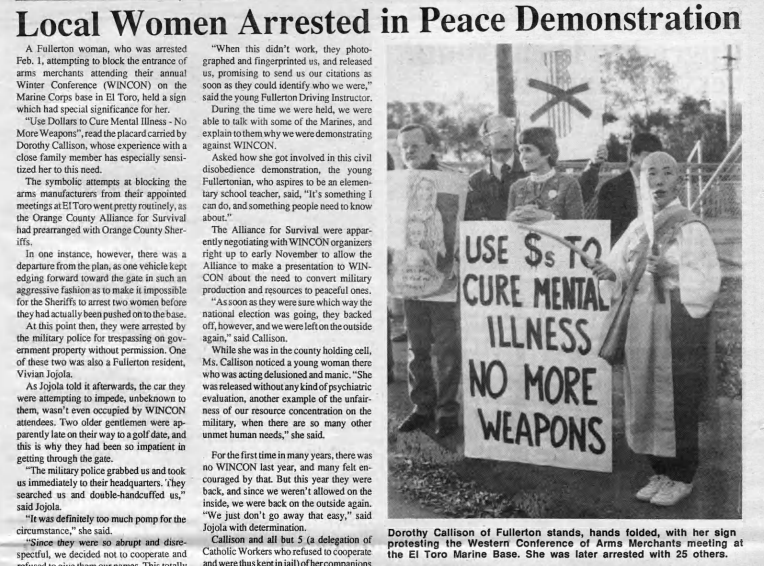
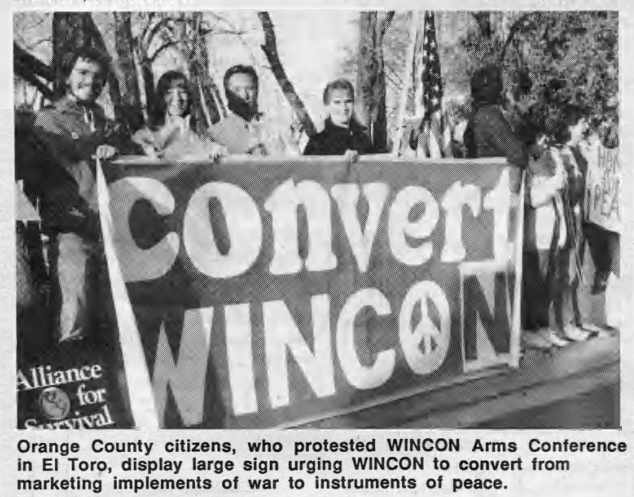
Fullerton resident Dorothy Callison was arrested while protesting the Winter Conference (an annual gathering of arms dealers) at the El Toro Marine Corps base.
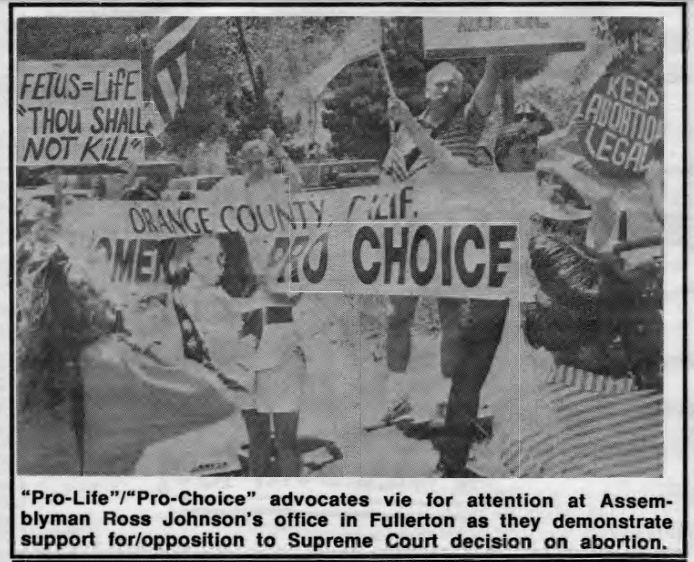
Those for and against abortion rights made their voices heard at the office of local state assemblymember Ross Johnson. This was in response to the Supreme Court decision Webster v. Reproductive Health Services, which a upheld a Missouri law that imposed restrictions on the use of state funds, facilities, and employees in performing, assisting with, or counseling an abortion.
LGBTQ Rights
In 1989, Fullerton was represented by ultra conservative congressman William Dannemeyer, a vocal opponent of gay rights.
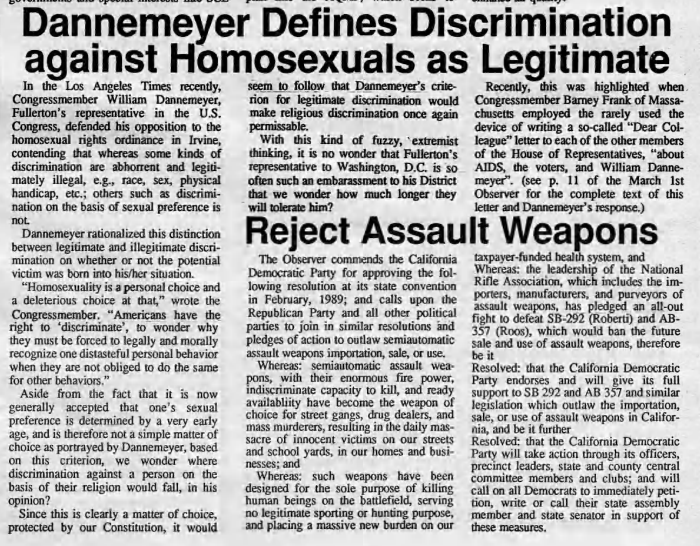
Here are some excerpts from an Observer article on this:
“Congressmember William Dannemeyer, Fullerton’s representative in the U.S. Congress, defended his opposition to the homosexual rights ordinance in Irvine, contending that whereas some kinds of discrimination are abhorrent and legitimately illegal, e.g., race, sex, physical handicap, etc.; others such as discrimination on the basis of sexual preference is not.
“Dannemeyer rationalized this distinction between legitimate and illegitimate discrimination on whether or not the potential victim was bom into his/her situation. “Homosexuality is a personal choice and a deleterious choice at that,” wrote the Congressmember. “Americans have the right to ‘discriminate’, to wonder why they must be forced to legally and morally recognize one distasteful personal behavior when they are not obliged to do the same for other behaviors.”
“Aside from the fact that it is now generally accepted that one’s sexual preference is determined by a very early age, and is therefore not a simple matter of choice as portrayed by Dannemeyer, based on this criterion, we wonder where discrimination against a person on the basis of their religion would fall, in his opinion? Since this is clearly a matter of choice, protected by our Constitution, it would seem to follow that Dannemeyer’s criterion for legitimate discrimination would make religious discrimination once again permissible.”
National and International News
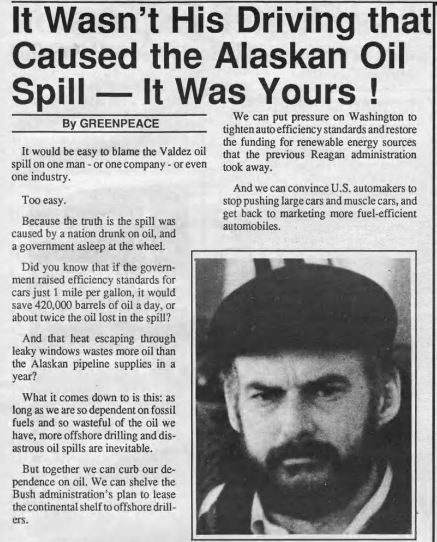
In national news, the massive Exxon Valdez oil spill occurred, causing much environmental damage. A clever op-ed in the Observer by Greenpeace pointed out the way in which most Americans are complicit in such tragedies as a result of our reliance on fossil fuels.
In international news, the Tianamen Square Protests and Massacre happened in China, resulting in the deaths of protestors and severe government crackdown on dissent.

Miscellaneous
Here are a few miscellaneous articles from 1989:
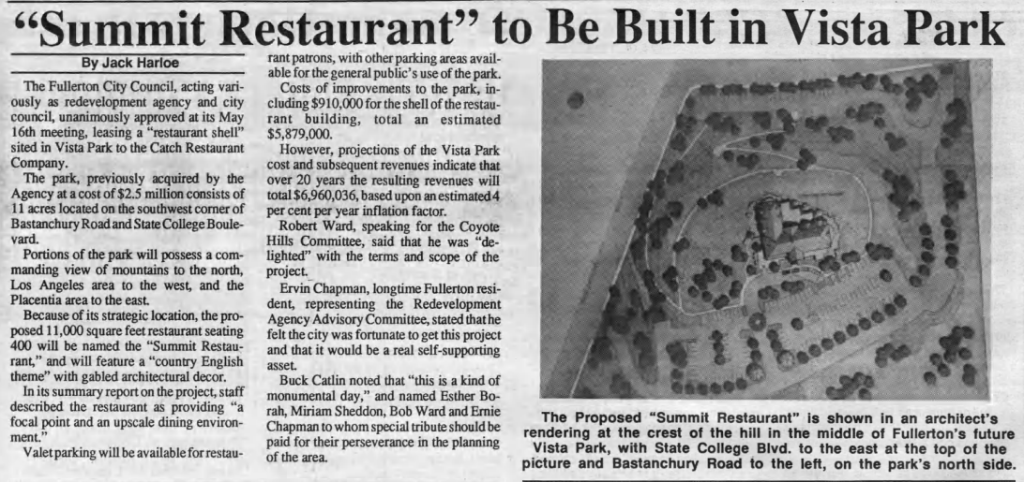
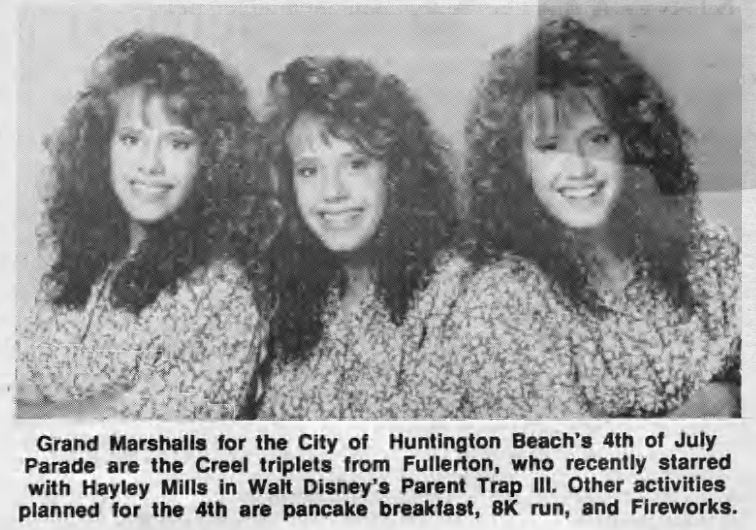

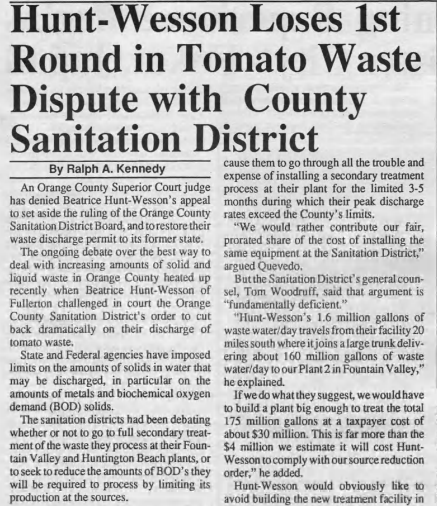
“Dr. Jewel Plummer Cobb, 65, who as president has guided the advancement of California State University, Fullerton since October 1981, announced today (Oct. 26) that she plans to retire July 31, 1990,” the Observer stated. “Known for her promotion of the advancement of women in science and activities on behalf of minorities, the 65-year-old cell physiologist was dean of Douglass College and professor of biological sciences at Rutgers, The State University of New Jersey, for five years before joining Cal State Fullerton.”
Deaths
Below are a few notable local deaths. A few excerpts from the Observer follows each.

“Former Fullerton Councilmember and Orange County Supervisor Ralph Diedrich died December 23 at age 64 in San Diego.
“From his election to the Board of Supervisors in 1973 until he resigned in 1979, Diedrich, known in county political circles as “Big D”, was the most influential political figure in Orange County.
“Although his political career ended ignominiously in 1979 when he was convicted of soliciting a bribe and hiding a campaign contribution, Diedrich left another kind of imprint on Fullerton and Orange County which could only be envied by some of his most persistent detractors.
“In 1973, when the Federal government started sharing millions of dollars in federal revenues with local governments, Diedrich was instrumental in getting the county to accept a unique and precedent-setting distribution formula of 25% for social programs, 25% for parks and recreation, and 50 % for other county expenses.

“Roxie Lee Owens of Fullerton died January 19 at age 74 at the Anaheim Memorial Hospital…A resident of Fullerton since 1943, Mrs. Owens and her husband Alfred Lee Owens raised 13 children.
“Perhaps the most famous of Roxie and Alfred’s children several of whom were well known local athletes, is Brig Owens, All-Pro wide receiver for the Washington Redskins. Roxie Lee Owens is survived by: her husband of 60 years, Alfred Lee, daughters: Dorothy Whitehurst and Larence Jeffries of Fullerton, Shirley McClanahan of Corona, and Audrey Mae Gardner of Dallas; sons Leon, David, and Alfred – all of Fullerton – Brig of Virginia, Ted and Marvin of Walnut, and Jessie of Arrowhead; 23 grandchildren and 2 great-grandchildren. Mrs. Owens was preceded in death by daughters Lamerie and Louise.”
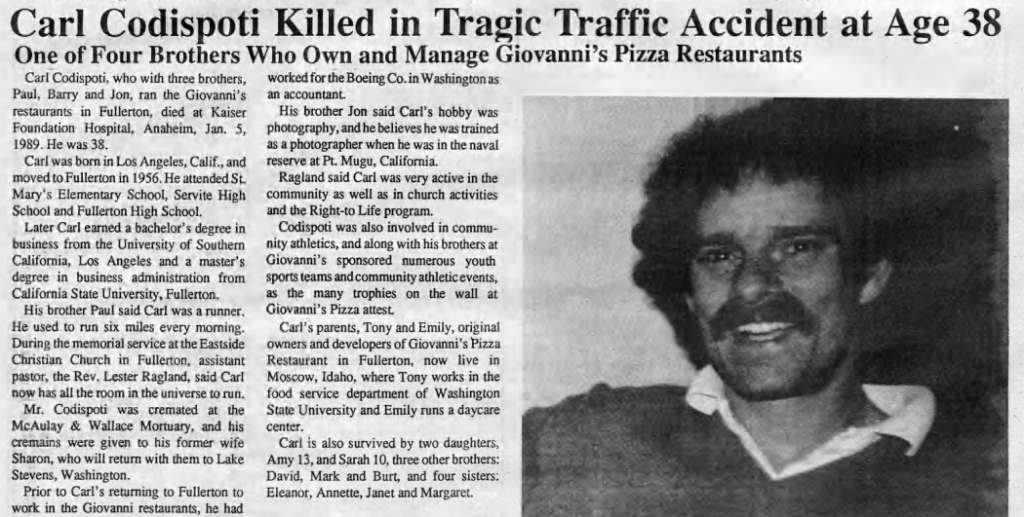
“Carl Codispoti, who with three brothers, Paul, Barry and Jon, ran the Giovanni’s restaurants in Fullerton, died at Kaiser Foundation Hospital, Anaheim, Jan. 5, 1989. He was 38…Prior to Carl’s returning to Fullerton to work in the Giovanni restaurants, he had worked for the Boeing Co. in Washington as an accountant.”
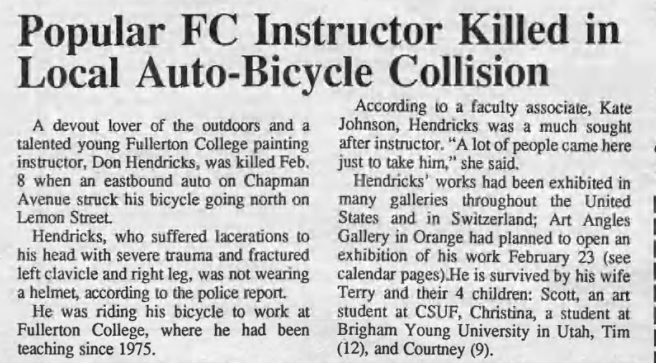
“A devout lover of the outdoors and a talented young Fullerton College painting instructor, Don Hendricks, was killed Feb. 8 when an eastbound auto on Chapman Avenue struck his bicycle going north on Lemon street…Hendricks was a much sought after instructor…Hendricks’ works had been exhibited in many galleries throughout the United States and Switzerland.”
Don’s son Tim is a famous tattoo artist and owns Classic Tattoo in downtown Fullerton.
 Fullerton History