The following is from a work-in-progress about the history of Fullerton. You can support my ongoing research and writing on Patreon.
The Fullerton Observer newspaper was formed in 1978 by Ralph and Natalie Kennedy and friends to provide a more progressive counterbalance to the more conservative Fullerton News-Tribune and Orange County Register. The Fullerton Public Library has digital archives of the Observer stretching back to 1979. Here are some top news stories from 1987.
Culture
The historic Fox Theater in downtown Fullerton, built in 1925, sadly closed its doors.

A proposal to build an IMAX theater at the downtown Fullerton Museum Plaza fell through.

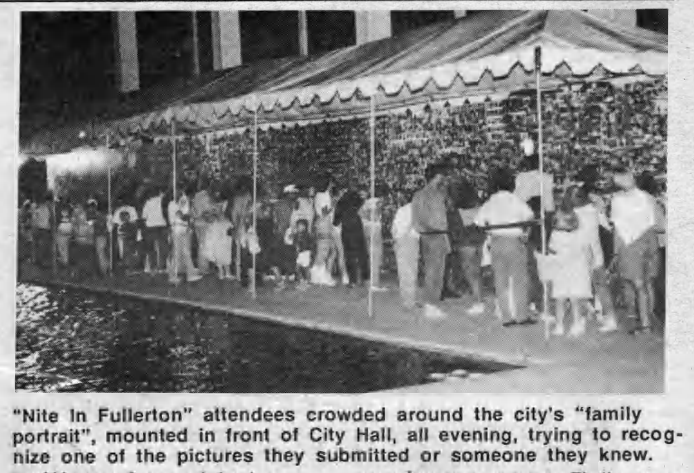
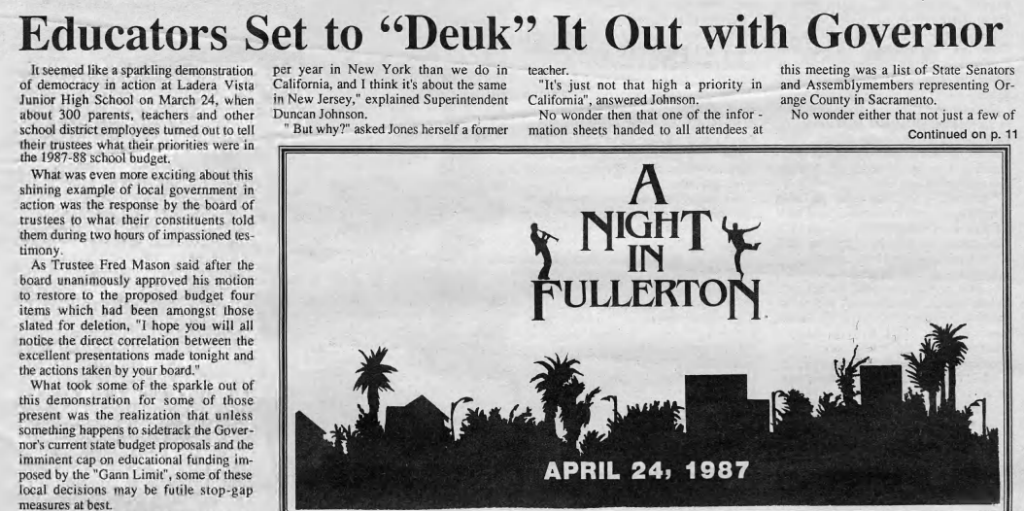
On a more positive note, Fullerton held its annual “Night in Fullerton” event.
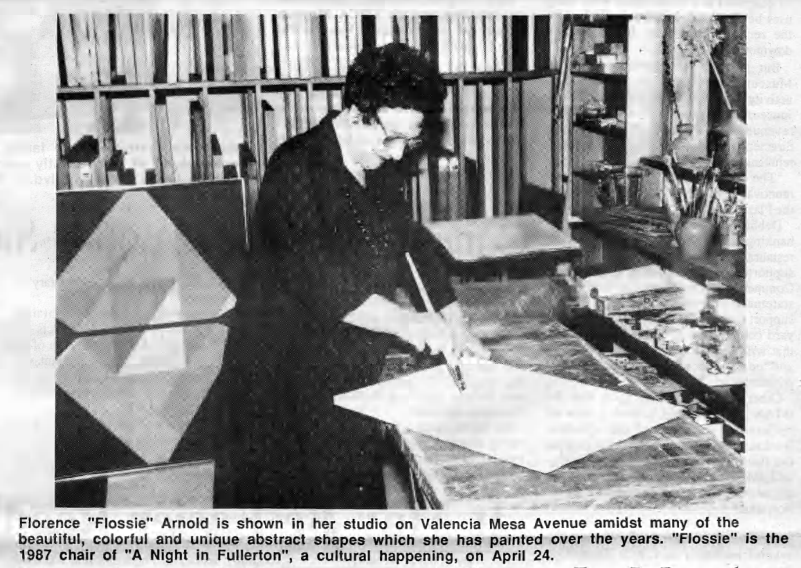
The Observer includes a nice feature on local artist Florence Arnold, who was one of the original organizers of A Night in Fullerton back in the 1960s.
“It was her desire to give the public, both children and adults, a broad-base exposure to the arts through the festival atmosphere,” the Observer states. “The annual program has since grown into a popular attraction on the Southland art scene, and last year alone drew more than 10,000 visitors.”

Participating venues in A Night in Fullerton included: Patrick’s Music, Eileen Kremen Gallery, the Muckenthaler Cultural Center, John Thomas Gallery, Enfant Terrible Gallery, Hunt Branch Library, Fullerton Public Library, City Hall, Cal State Fullerton, Pacific Christian College, Fullerton College, Plummer Auditorium, First Christian Church, The Edge Gallery, Gallery 57, and Zarbano Gallery.
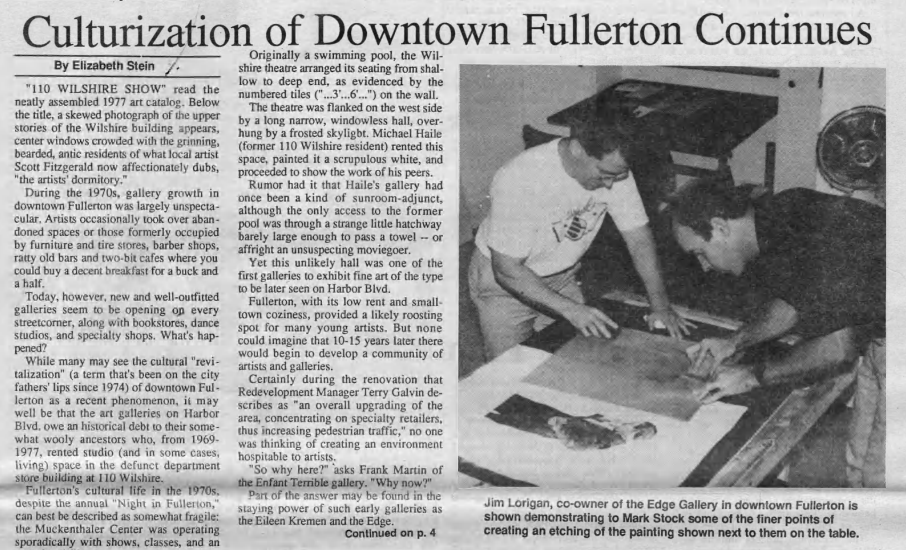
The Observer featured an excellent and in-depth article on the ups and downs of Downtown Fullerton’s art scene.
From 1969- 1977, several artists rented studio (and in some cases, living) space in the Chapman building downtown, which had previously been a department store.
A 1977 flyer tells of the “110 WILSHIRE SHOW” featuring work by these artists, showing “the grinning, bearded, antic residents of what local artist Scott Fitzgerald now affectionately dubs, ‘the artists’ dormitory.’”

Other downtown cultural spots in the 1970s included Rutabegorz, “replete with Egyptian frescoes, candlelight, and bad poetry,” the Eileen Kremen and Common Ground galleries, the 309 Malden gallery and Michael Haile’s “Art Directives” which were in the same building that housed, among other things, the Wilshire Theatre, which was sadly destroyed to make room for boring apartments.
At the Wilshire Theater, “on a good night you could catch a film adaptation of such novels as Thomas Mann’s Death in Venice or James Joyce’s (x-rated) Ulysses.”
“Originally a swimming pool, the Wilshire Theatre arranged its seating from shallow to deep end…The theatre was flanked on the west side by a long narrow, windowless hall, overhung by a frosted skylight. Michael Haile (former 110 Wilshire resident) rented this space, painted it a scrupulous white, and proceeded to show the work of his peers.”
By the 1980s, other galleries popped up, such as Enfant Terrible, the Edge, Mary Zarbano, Vision Art, and John Thomas galleries.
In addition to galleries, downtown Fullerton in the 1980s had a handful of independent bookstores, such as the Book Bazaar, Lorson’s [children’s] Books, Book Harbor, Aladdin Books, and the Blue Wolf, which was run by Melissa Mack in “the downstairs storage space of her studio apartment in the alley behind the Mulberry Street restaurant.” There she would host poetry readings.

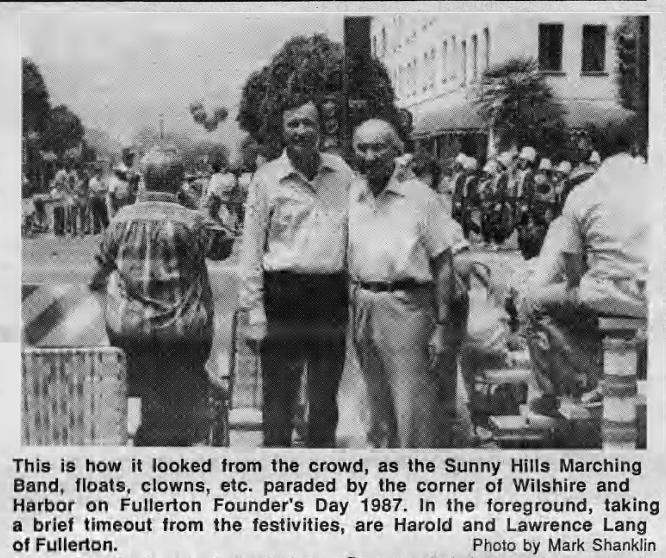
Another annual cultural event was the Founder’s Day Parade.
Environment
The oil companies who had caused the toxic McColl Superfund site proposed as a solution to cover up, rather than remove, the toxic materials.

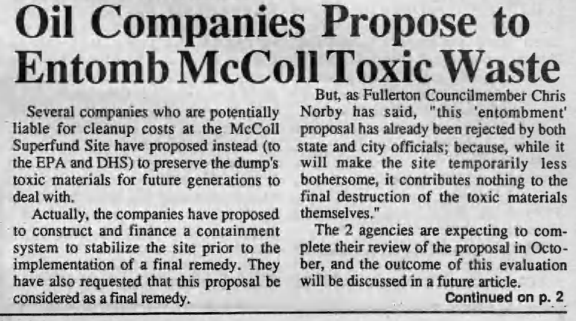
“Several companies who are potentially liable for cleanup costs at the McColl Superfund Site have proposed instead (to the EPA and DHS) to preserve the dump’s toxic materials for future generations to deal with,” the Observer stated. “Actually, the companies have proposed to construct and finance a containment system to stabilize the site prior to the implementation of a final remedy. They have also requested that this proposal be considered as a final remedy.”
Councilmember Chris Norby said that this ‘entombment’ proposal had been rejected by both state and city officials; because, “while it will make the site temporarily less bothersome, it contributes nothing to the final destruction of the toxic materials themselves.”
Ultimately, unfortunately for future generations, this proposal was accepted by state and federal authorities.
The oil companies who submitted the proposal were Shell Oil Company, ARCO, Texaco, Unocal and Phillips Petroleum. The estimated cost of “capping” the toxic materials was $12.5 million.
Presidential candidate Al Gore visited the site and gave a speech calling the proposal “Totally outrageous.”
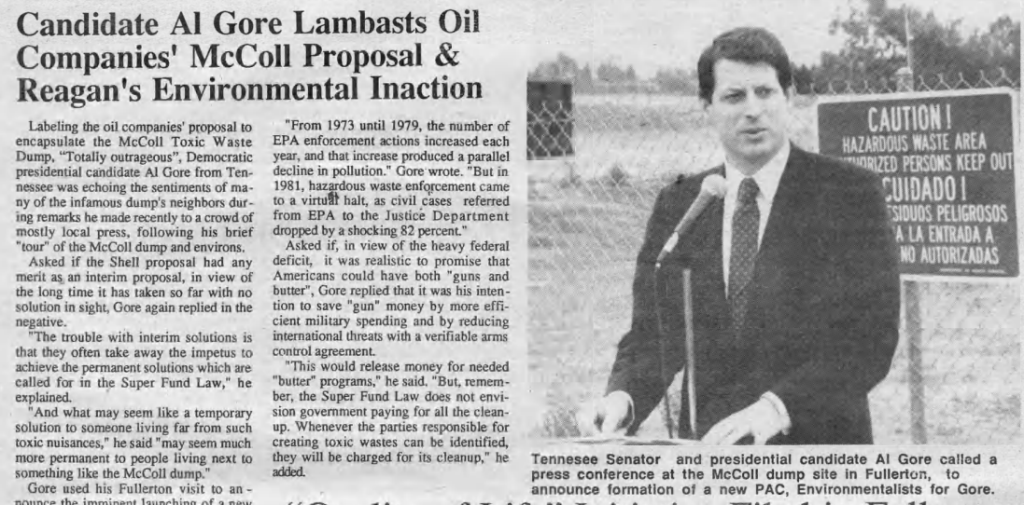
“What may seem like a temporary solution to someone living far from such toxic nuisances,” he said “may seem much more permanent to people living next to something like the McColl dump,” Gore said. “I will guarantee the appointment of an EPA Administrator who will vigorously pursue the cleanup of toxic waste dumps like McColl all across the country.”
Gore took the opportunity to criticize the EPA under President Reagan.
“From 1973 until 1979, the number of EPA enforcement actions increased each year, and that increase produced a parallel decline in pollution,” Gore said. “But in 1981 [when Reagan came to power], hazardous waste enforcement came to a virtual halt, as civil cases referred from EPA to the Justice Department dropped by a shocking 82 percent.”
Housing
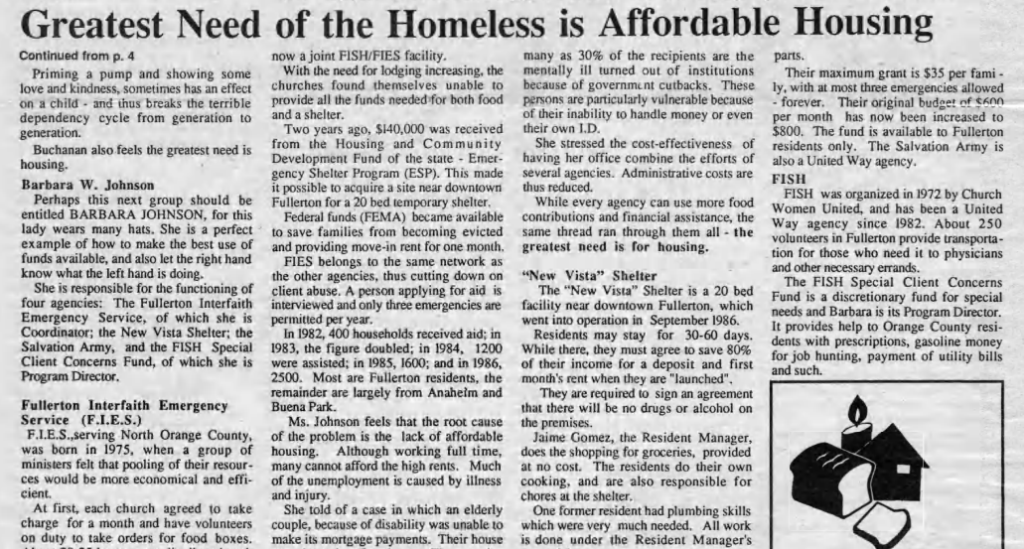
In housing news, the conservative city council majority continued to refuse to use redevelopment funds for affordable housing.

Racism/Bigotry
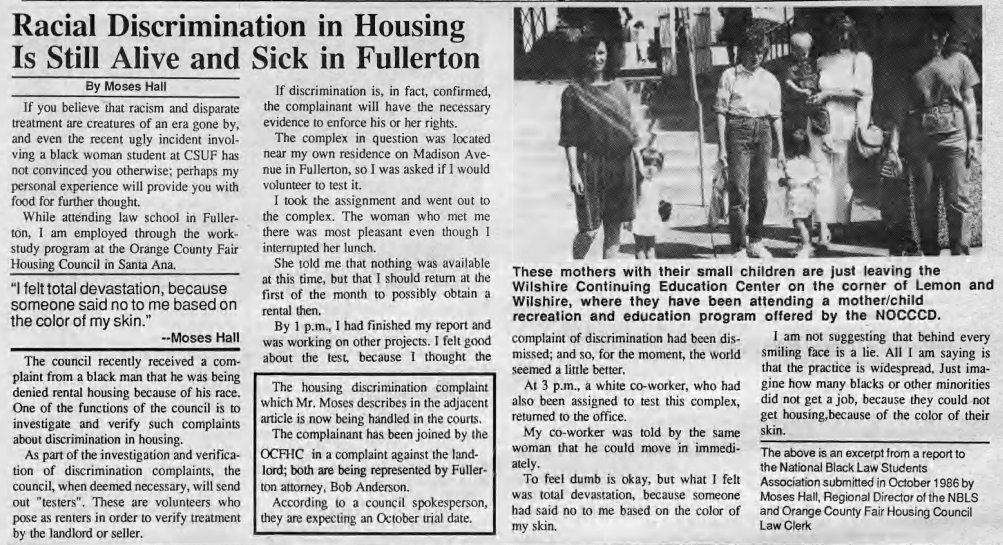
While housing discrimination was technically illegal, it still existed in the 1980s. The Fair Housing Council would hear complaints of racial discrimination in housing, and send Black and white “tester” renters or buyers to investigate.
A local Black man named Moses Hall chronicled his experience of being denied housing based on his race, while the white “tester” was offered the apartment.
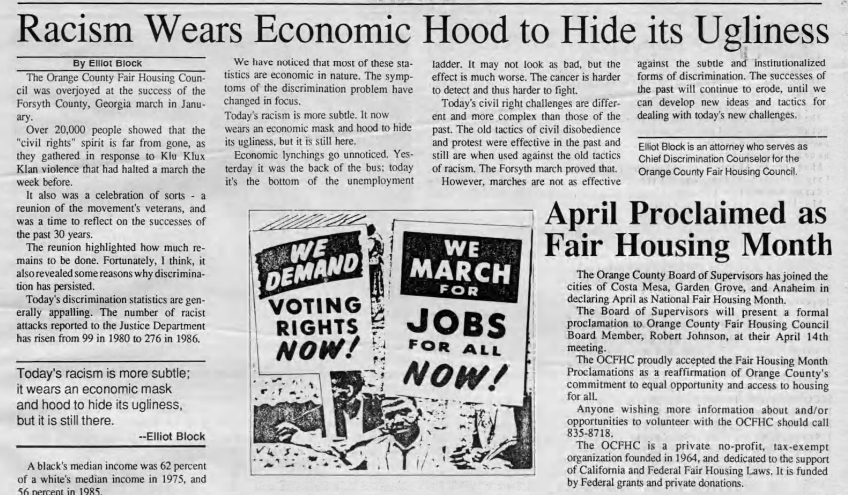
A Korean church and a Jewish Temple in Fullerton were vandalized by local racists.

AIDS
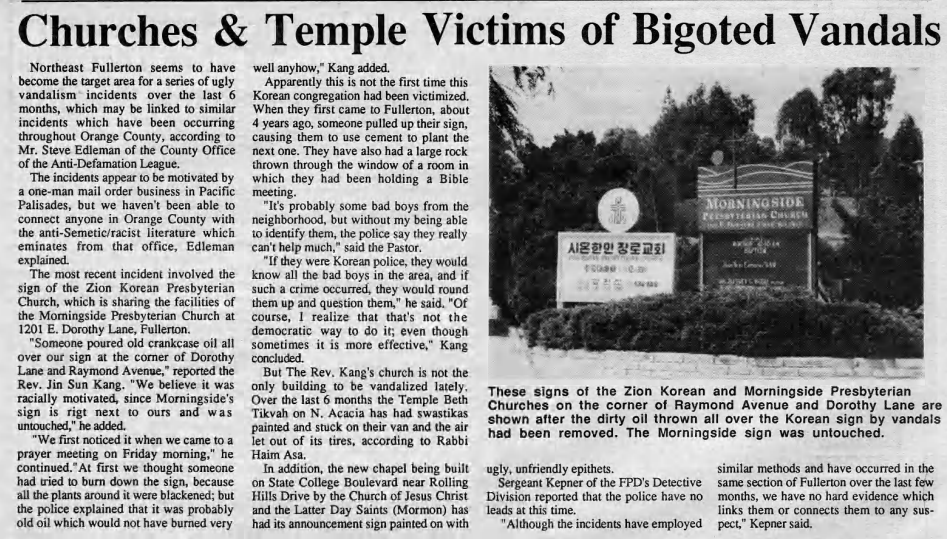
In the 1980s, AIDS had become a national crisis, prompting a local forum and the Fullerton School District to adopt AIDS curriculum.

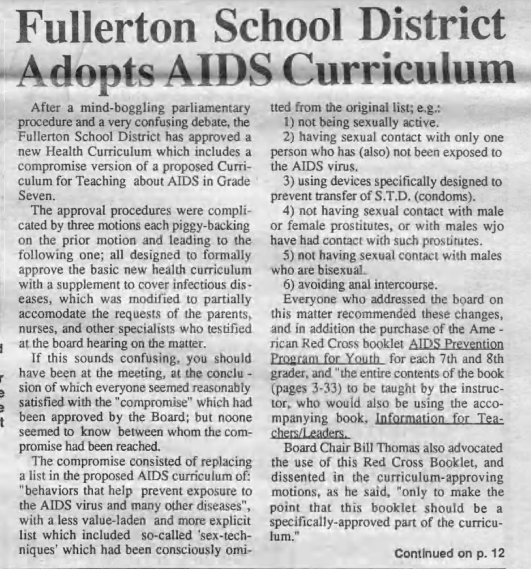
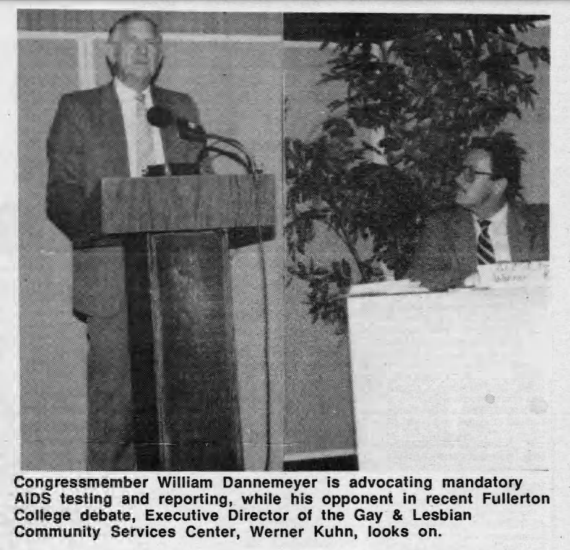
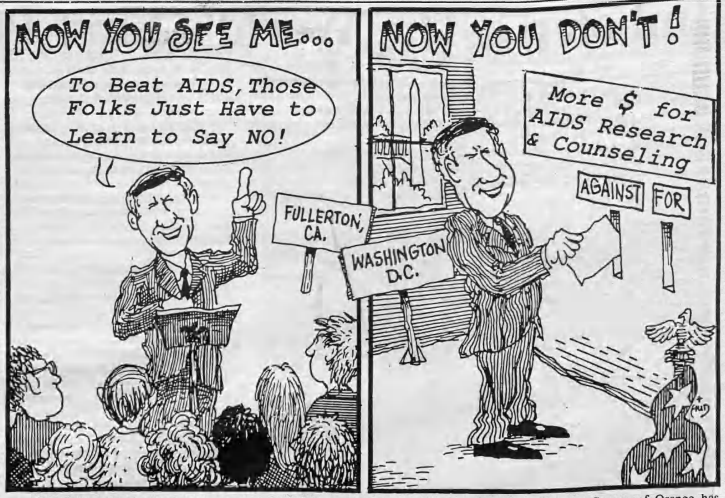
In the 1980s, Fullerton was represented in Congress by arch conservative William Dannemeyer, a vocal opponent of gay rights who made many offensive and homophobic statements during his tenure.
Fullerton College hosted a debate between Dannemeyer and Werner Kuhn, director of the local Gay and Lesbian Community Services Center, on ways to deal with AIDS.

The Observer had pretty good political cartoonists in the 80s. The one below pokes fun at the hypocrisy of Congressmembers like Dannemeyer who consistently voted against funding for AIDS research and counseling.
The 1987 Earthquake
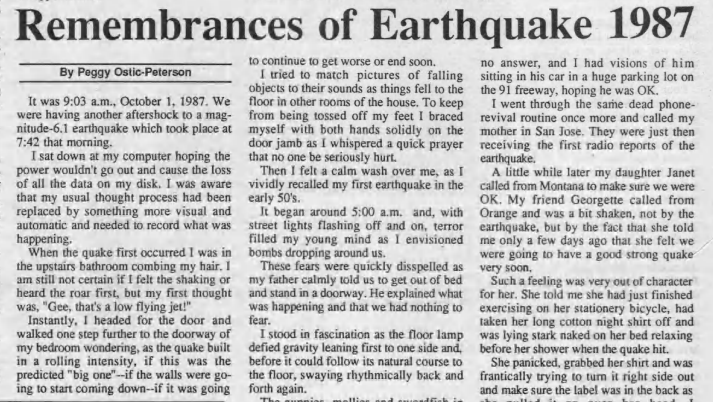
In 1987, the Whittier Narrows Earthquake rocked Fullerton and surrounding areas. I vividly remember this quake, as I had recently moved to Fullerton. I was seven years old.
Education
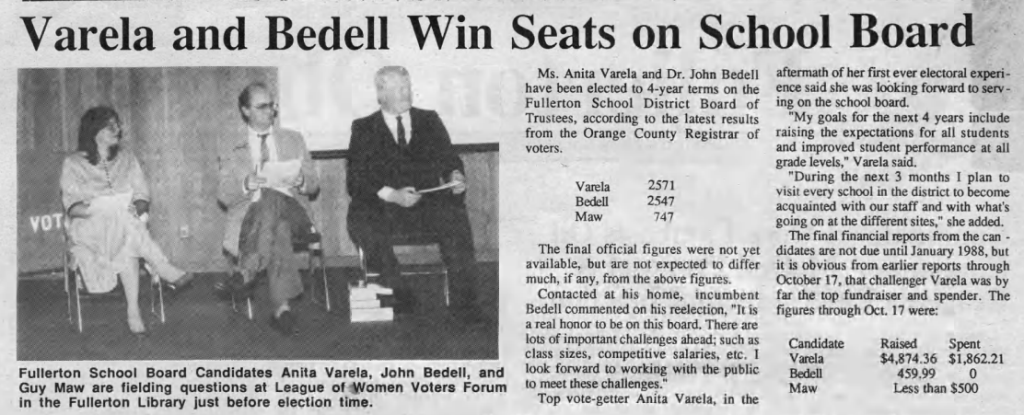
Anita Varela and John Bedell were elected to the Elemetary School Board.
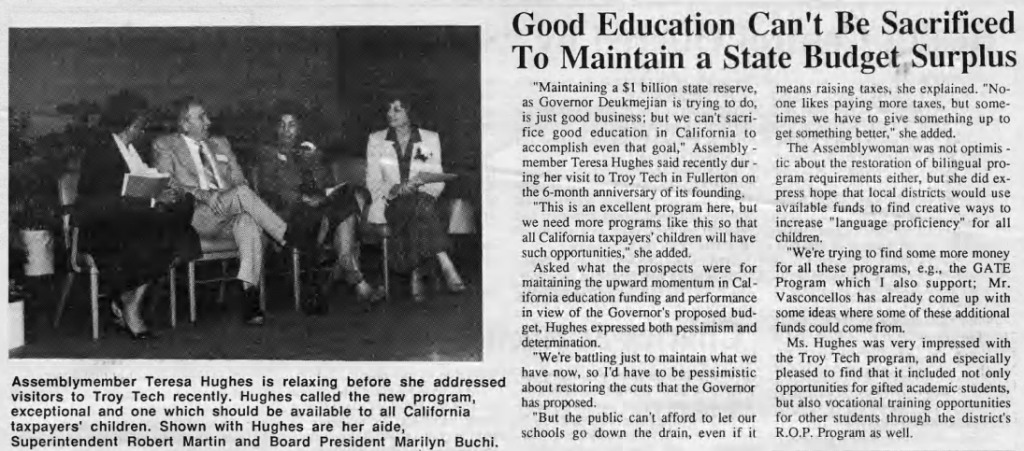
Adequate school funding was a point of debate between liberals and conservatives. In 1987, California’s governor was Republican George Deukmejian.
In the 1980s, Nancy Reagan’s solution to drug use was to “Just Say No.” This was a bit reductive and simplistic.
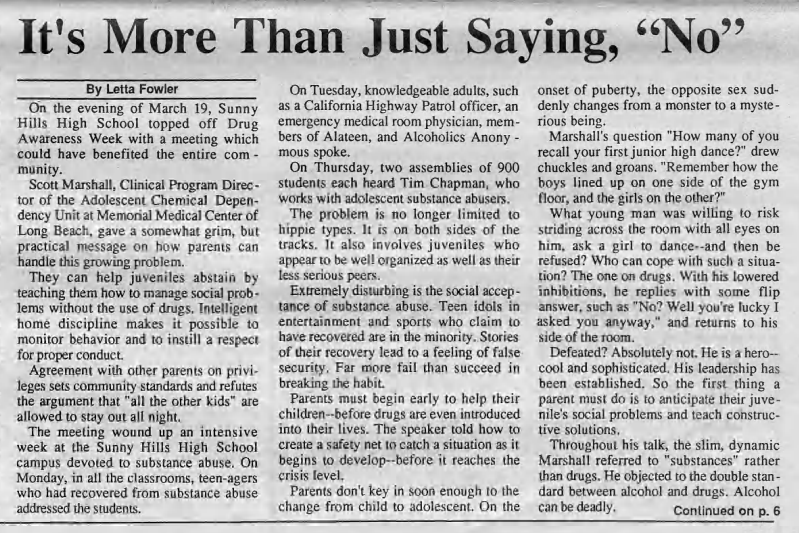
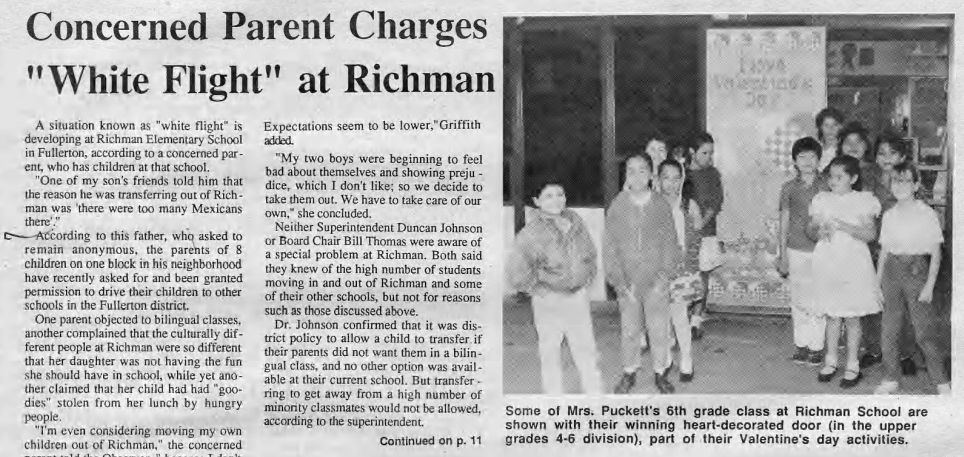
Facing state desegregation orders in 1972, the Fullerton School Board voted to close Maple School in south Fullerton and bus all of its mostly Latino and Black students to other schools. By the mid-1980s, nearby Richman School (also south of the tracks) was experiencing the same “white flight” that had contributed to Maple’s segregated status.
When Maple School was closed, it became a community center that housed a preschool for local families. In 1987, the preschool was facing cuts, and Maple parents organized to fight them.

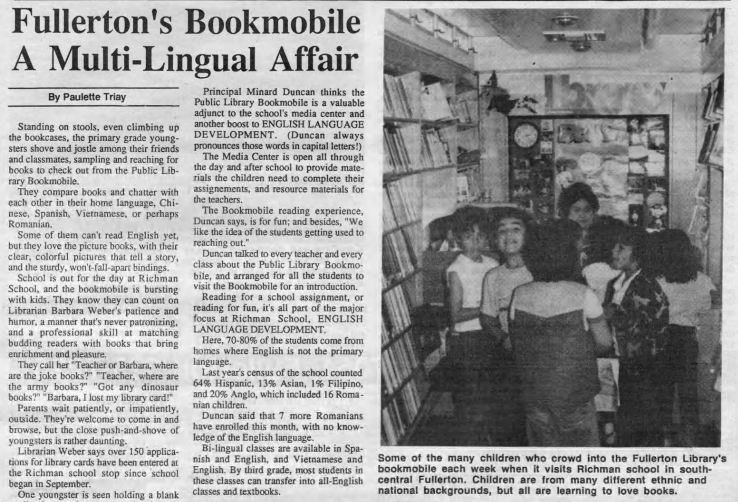
Fullerton Public Library had a Bookmobile that served Fullerton children.
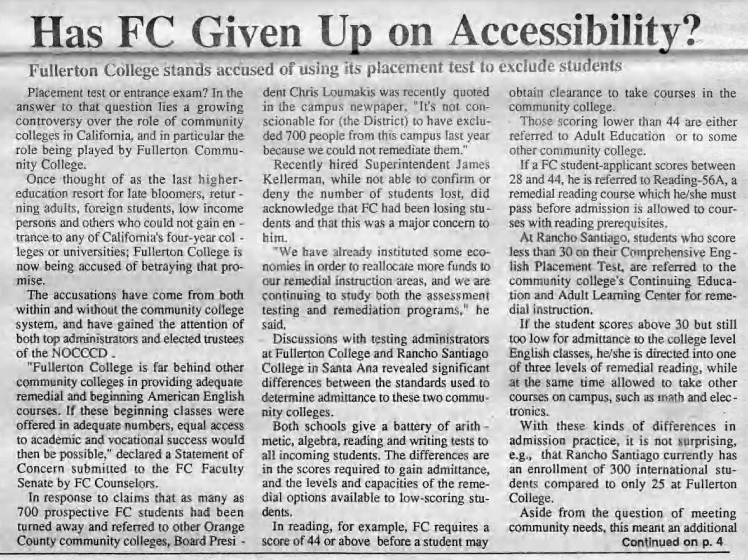
Fullerton College came under fire for having entrance exams that excluded those who needed remedial help.
Meanwhile, CSUF fraternities and sororities were being cited under Fullerton’s newly created Conditional Use Permit ordinance. They fought back with protests at City Hall.

Local Activism & Protests
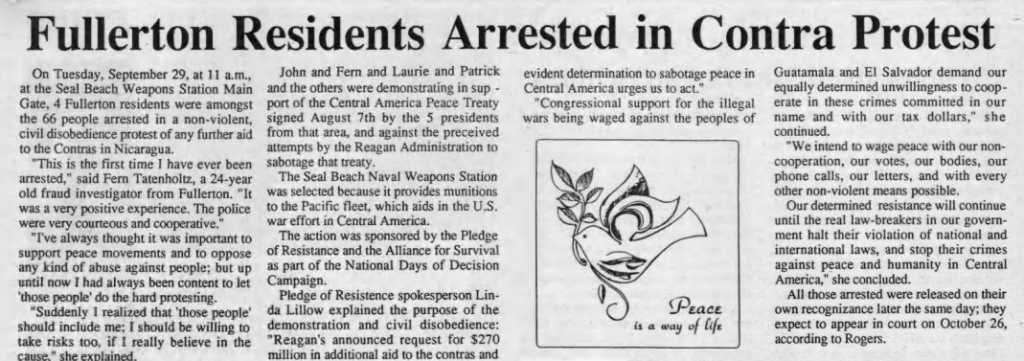
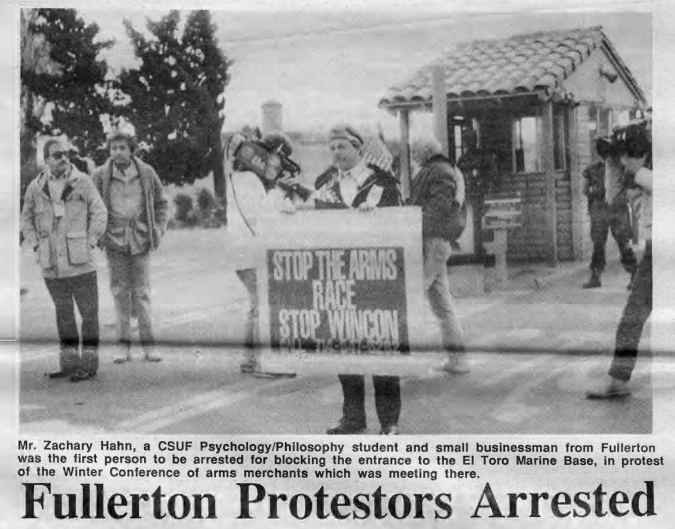
The Fullerton Observer, being a progressive publication, has always done a good job of spotlighting local activists and protesters, as the following stories demonstrate.


Law & Order
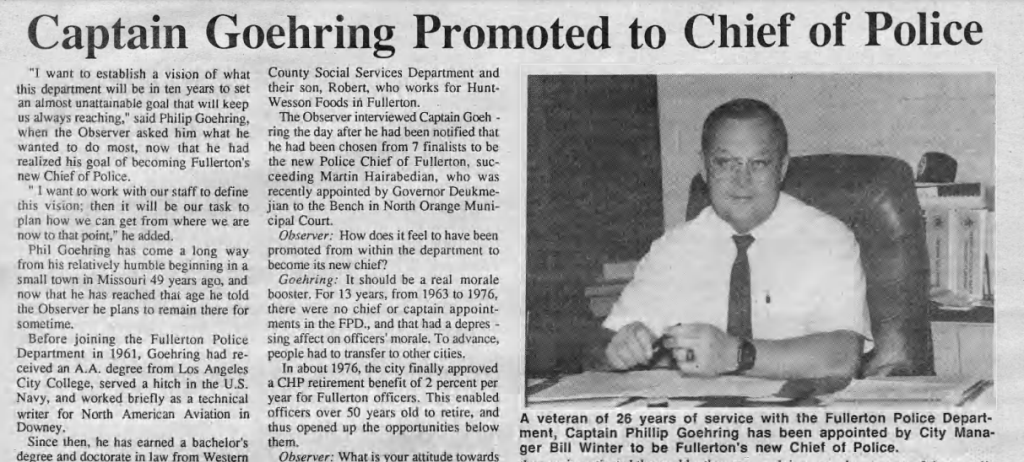
Following the departure of Martin Garibedian, captain Philip Goering was promoted to be the new Police Chief.
Local Champion
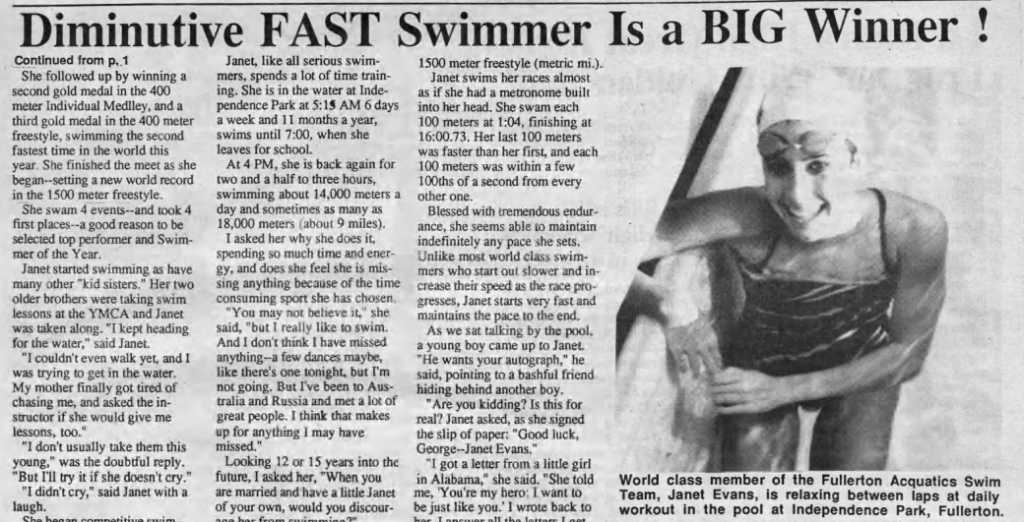
US Swimming Champion Janet Evans, who grew up swimming in Fullerton, was featured in the Observer. Today, the sports complex at Independence Park is named after Evans.
History
1987 was the hundred-year anniversary of the founding of Fullerton, as well as the two hundred year anniversary of the U.S. Constitution. To commemorate these, the city held a celebration.

Local historian Warren Bowen wrote a few articles about various aspects of Fullerton’s history.
Part of the centennial celebration involved the restoration of the WPA mural in the police station (formerly City Hall). Bowen took this opportunity to write a brief history of City Hall.
When City Hall was built in 1941, it contained not only the police department and City jail but also the water, engineering, building and welfare offices; and those of the elected treasurer and clerk; the justice of the peace; and, of course, the City Council.
Bowen also included an article about the popularity of baseball in Fullerton in the 1930s.
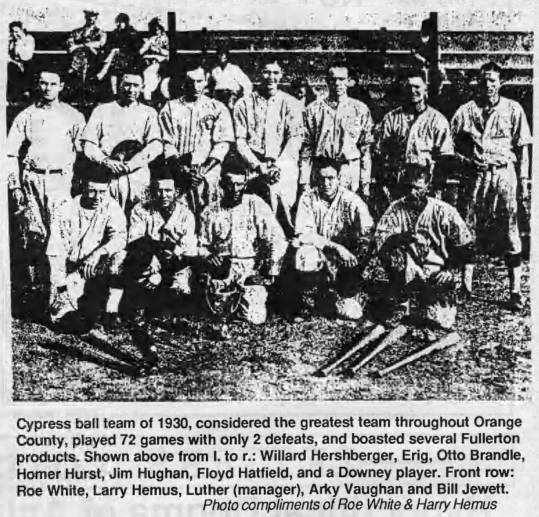
Famous baseball players from Fullerton included Walter Johnson, (Washington Senators’ pitcher), Willard Hershberger (Cincinnati Reds catcher), Bus Callan (N.Y. Giants catcher), Arky Vaughan (Pittsburg Pirates shortstop), Del Crandall (Milwaukee Braves catcher), and Steve Busby (K.C. Athletics catcher).
“In the heyday of Arky, and the despair of the depression years, baseball was…the local great escape,” Bowen writes.
John Francis “Pep” Lemon was a popular and influential local coach and baseball booster.
“He was a one man recreation department when no one thought to call it that,” Bowen writes. “His domain was the ball park at Commonwealth (now Amerige Park) at Malden and W. Commonwealth Avenues.”
The ball park is now known as Duane Winters Field in honor of the long time City Councilmember.
In the 1930s, Amerige Park was “in many ways, a community center with daytime baseball and evening softball leagues.” Girls softball was very popular there during WWII.
Fullerton’s local baseball team was known as the Fullerton Merchants and (later) the Fullerton Firemen. Players were recruited by Lemon and included high school and junior college players, oil field workers, police officers, firefighters, the local pharmacist, and others who loved the game.
Players for these popular Sunday afternoon games included Bucky Walters, Vern Wilkinson, Roe White, Pershing “Puss” Hodgson, Del Jones, Bud Dawson, Otto Brandle, Clifford Perry, Lou and Wade Blose, Wee Willie Jones, “Frenchy” Loumagne and Dick Joyce as well as Pep Lemon himself who frequently caught the games.
“Each Saturday the local newspaper would set forth the expected lineup, and then recap the game on Monday for those who couldn’t make it,” Bowen writes. “The Firemen were part of a league which also featured teams from Collbom Brokers, 20th Century Fox Films, Standard Oil, Cuccio Winery, RKO Radio and the Chili Bowl.”
“It was a place to see and be seen,” Bowen writes. “Families often attended….The games started about 1:00 p.m. You paid 25 cents for an adult admission…You brought an old blanket to soften the wooden, backless benches, and lots of those were army blankets which the vets of WWI were trying to wear out.
Bowen also includes a story about when Fullerton celebrated its 50th anniversary in 1937 with a massive pageant that drew thousands.
Here are some excerpts from the article:
“The event was an all-community effort, which included a queen contest and coronation ball, dedication of plaques by the DAR and others, renaming of Commonwealth Park as Amerige Park, a childrens’ play day at the park, historical exhibits, a ladies card party in the high school gym, a banquet by the 20-30 club; all topped off by three performances of a pageant, with a cast of over 1000, portraying the development of the area. “The Conquest of the Years” featured details of the early Spanish explorations and settlement through growth of the citrus and oil industries of the 20th century.
“So momentous was the event that the local schools were closed for an entire day and businesses from 1pm Mayor Harry Maxwell and co-founder George Amerige took part in the park rededication, which was followed by a childrens’ play day and two baseball games, one of these featuring the Fullerton Jr. College Hornets vs. Long Beach Jr. College.
“In observance of the event, the Daily News Tribune published the largest edition of a newspaper in the history of the County with feature stories about local people and businesses and over 300 advertisements.
“Flags and bunting were being hung in Fullerton, while 33 candidates for Queen (later to swell to 52) sold tickets to the pageant and gathered in votes. As the campaign heated up, it became a two way race between Mrs. Pearl McAulay Phillips and Miss Mary Catherine Morgan; the young matron vs. the student. In the final analysis Mrs. Phillips carried the day, and Morgan was “Miss Columbia.”
“The pageant shaped up under the direction of Miss Hazel Anderson, an imported director from Ohio. Dozens of local business people accepted roles, and students from the high school were enlisted by the hundreds. The simulated wedding of Don Bernardo Yorba and his bride was a part of the event with a younger Bernardo Yorba in the role, and Rosemary Kraemer, also a direct descendant of the Yorbas, as the bride. Other segments showed the Ameriges, a group of Basque sheepherders, an early hotel dance, music, oxcarts, stage coaches and the like. Over 10,000 people attended the performances at the high school stadium.”
 Fullerton History