The following is from a work-in-progress about the history of Fullerton. You can support my ongoing research and writing on Patreon.
The Fullerton Observer newspaper was formed in 1978 by Ralph and Natalie Kennedy and friends to provide a more progressive counterbalance to the more conservative Fullerton News-Tribune and Orange County Register. The Fullerton Public Library has digital archives of the Observer stretching back to 1979. Here are some top news stories from 1985.

Local Politics
In 1985, the Fullerton City Council was Dick Ackerman, Buck Catlin, Linda LeQuire, Molly McClanahan, and Chris Norby.
Once again, the conservative majority passed over the regular rotation to deny Molly McClanahan the chance to serve as mayor.

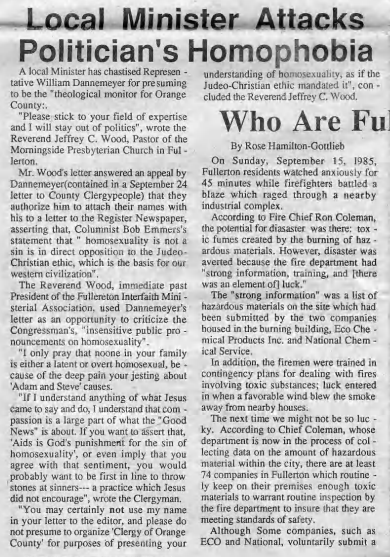
In congress, Fullerton was represented by arch conservative William Dannemeyer, who was a vocal opponent of gay rights.
Housing and Homelessness
For years, the conservative city council majority opposed using government subsidies for affordable housing.

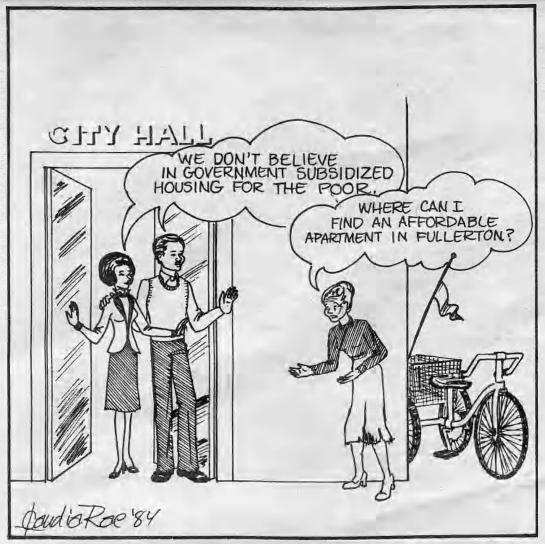
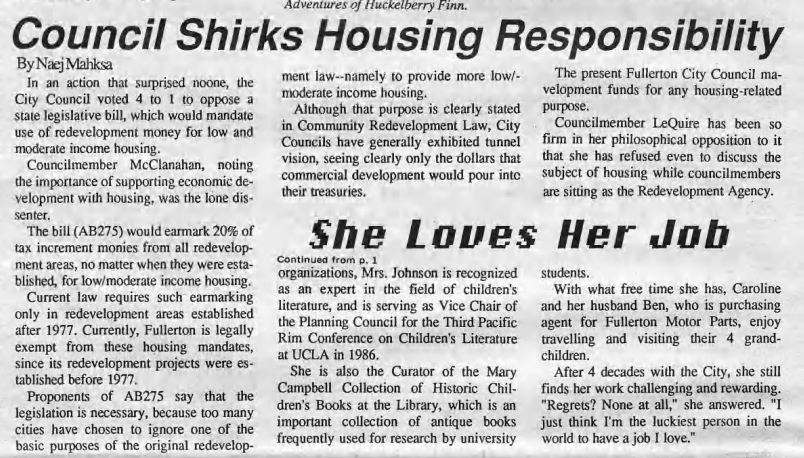
This had the predictable effect of exacerbating Fullerton’s homeless problem, and thus the need for local shelters. Here, again, the council majority was reluctant to offer help.
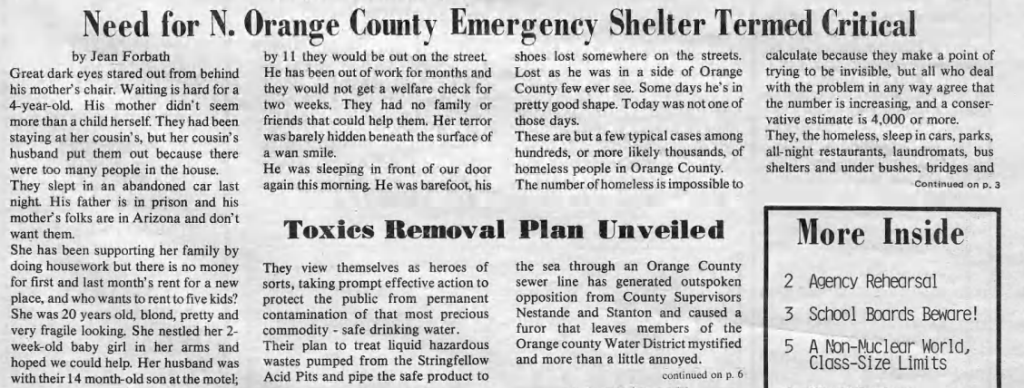
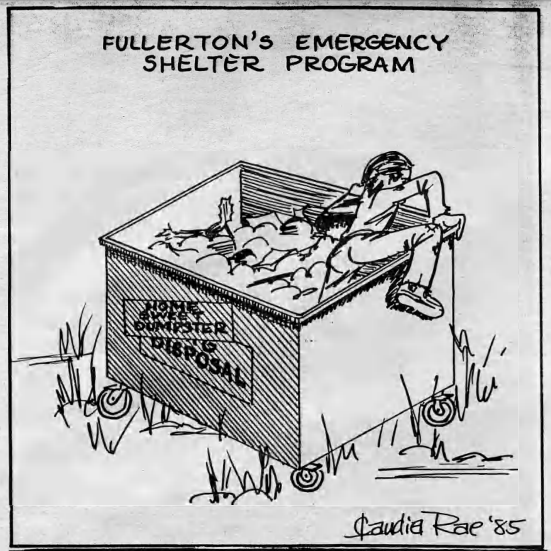
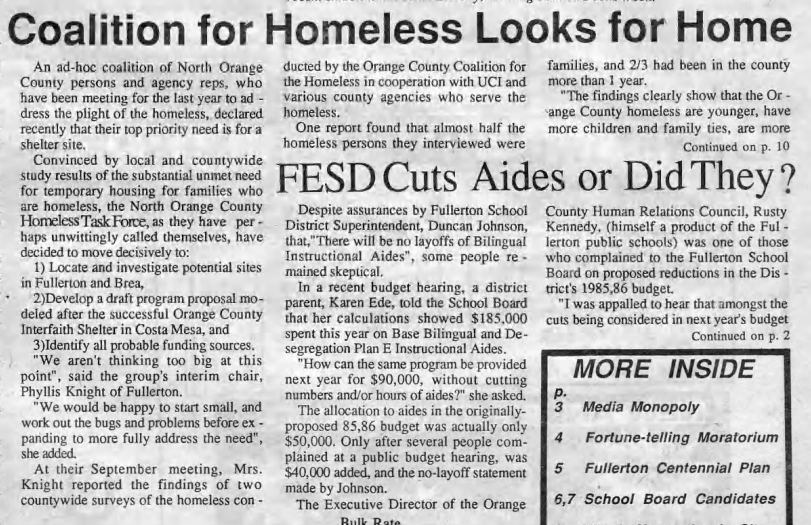
Despite City Council’s reluctance to deal with homelessness, other local leaders sought to step in to fill the need, creating the first of many regional Homeless Task Forces.
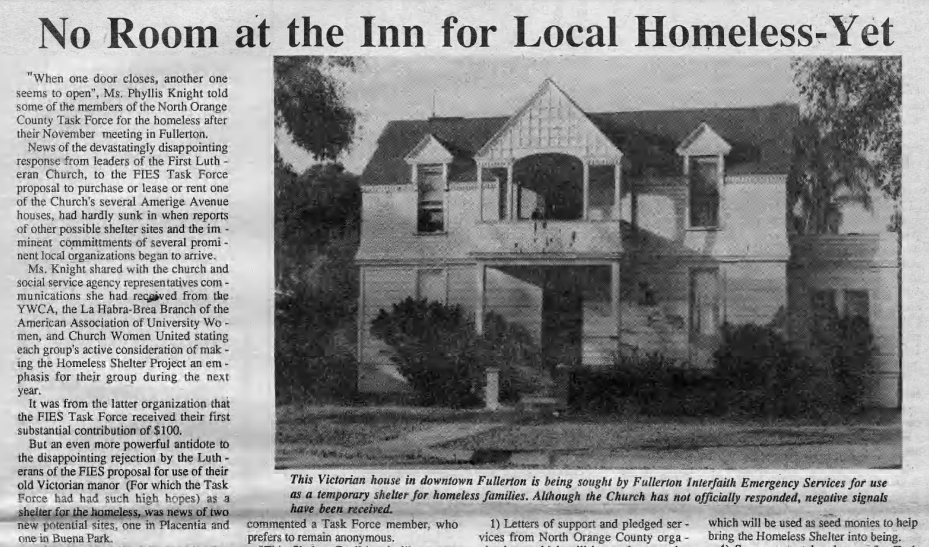
Fullerton Interfaith Emergency Services (now called Pathways of Hope) was seeking to refurbish an old house into the City’s first shelter.
Redevelopment
Back in the 80s, Fullerton had a Redevelopment Agency which had funding to “halt blight or conditions that may lead to blight, and to enhance the economic climate of cities.” While cities had the authority and mandate to use at least some of redevelopment funds for construction of much-needed affordable housing, the council preferred to use it for things like parking structures, rehabilitating shopping centers, parking lots, and sports complexes.
Councilman Dick Ackerman, who served for twelve years, said he was “strongly opposed to governmentally subsidized housing for low-income people.”
“Not everyone can live here in Fullerton, and we shouldn’t expect government to make it happen,” Ackerman said. “We shouldn’t tinker with the natural flow of free enterprise.”
Meanwhile, Ackerman and the council majority preferred to tinker with other markets by using redevelopment money “to reimburse private developers of the Orangefair [mall] project area.”
Here, the local reflects the national. During the Reagan era, government subsidies for the poor were cut, while big corporations got tax cuts and subsidies.
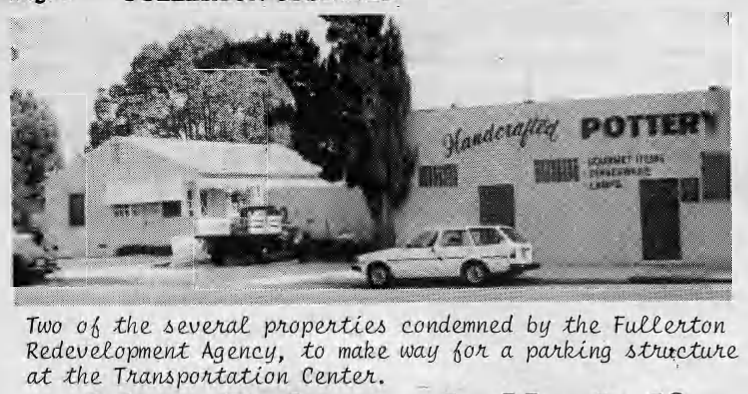
The City of Fullerton’s Redevelopment Agency also had the power of “eminent domain”–meaning it could take over a private property owner’s land, as long as they were paid a “fair market value.” In a blow to local history, council approved the demolition of the original Fender Guitar factory to make way for a parking structure.
Culture
For a number of years, Fullerton held an annual Founder’s Day Parade and Street Faire.
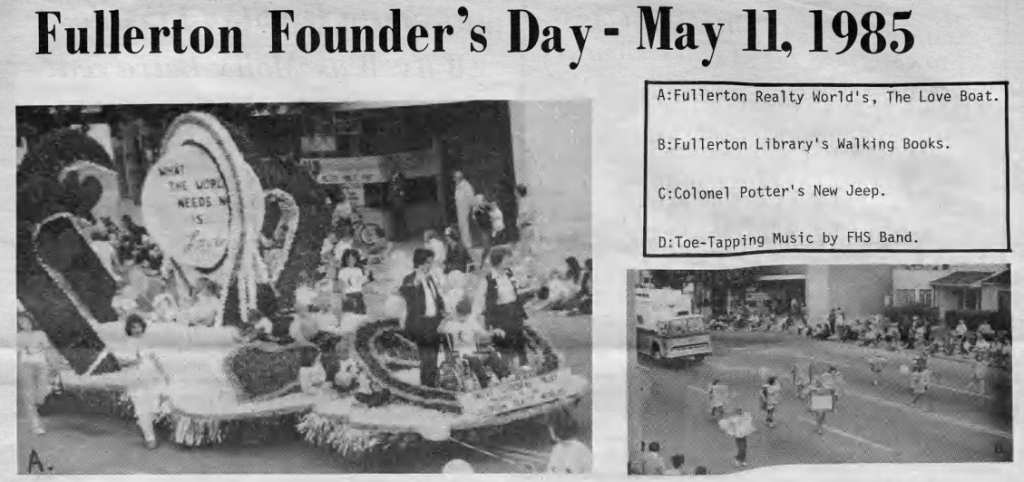
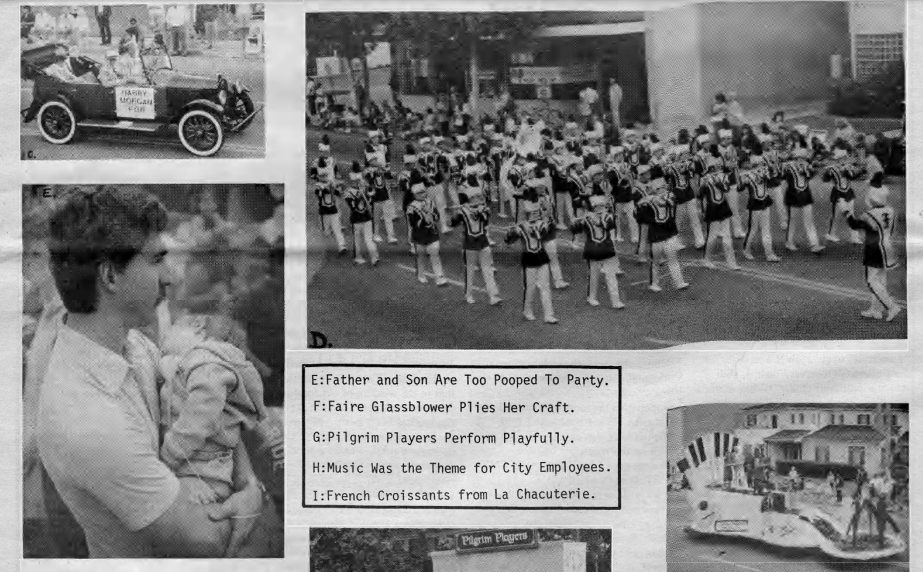
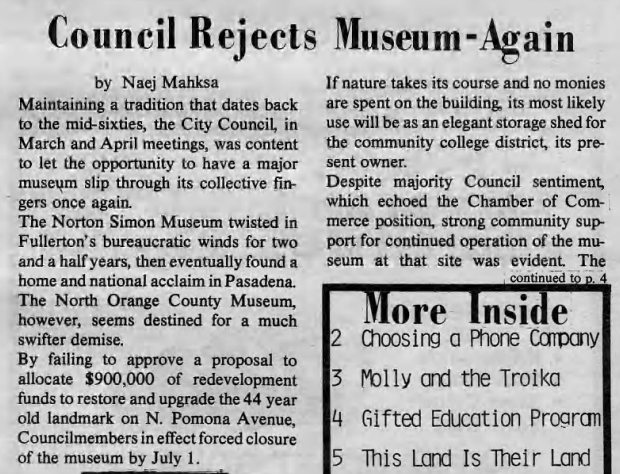
The Fullerton Museum Center was at first denied redevelopment funding, but then got some.

In the 1980s, downtown Fullerton had a number of book stores and art galleries.



Business
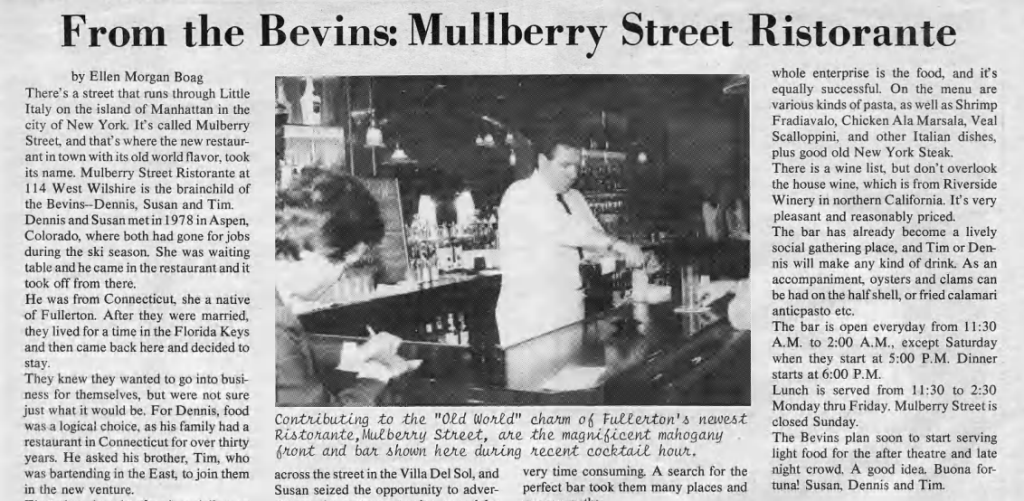
Mulberry Street Ristorante, one of the longest-running and most popular spots downtown, was opened by the Bevins family.
Environment
In environment news, some residents were alarmed by the decision to run toxic waste through the local sewer system.
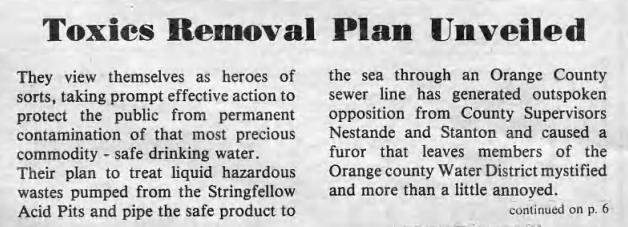

And plans were still being formulated to deal with Fullerton’s first Superfund site, the McColl dump site.

Transportation
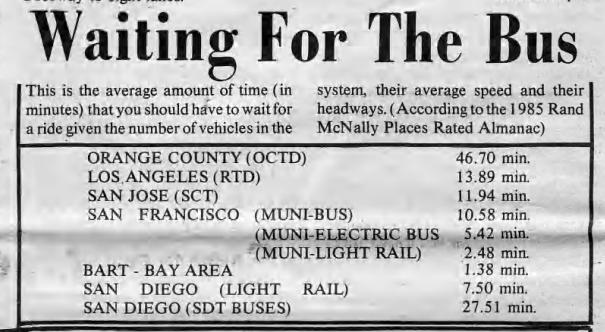
In keeping with its progressive values, the Observer had many articles advocating for bicycles, pedestrians, and better public transit.

Education
In 1985, new members were elected to the High School and Elementary School Boards.


International Issues
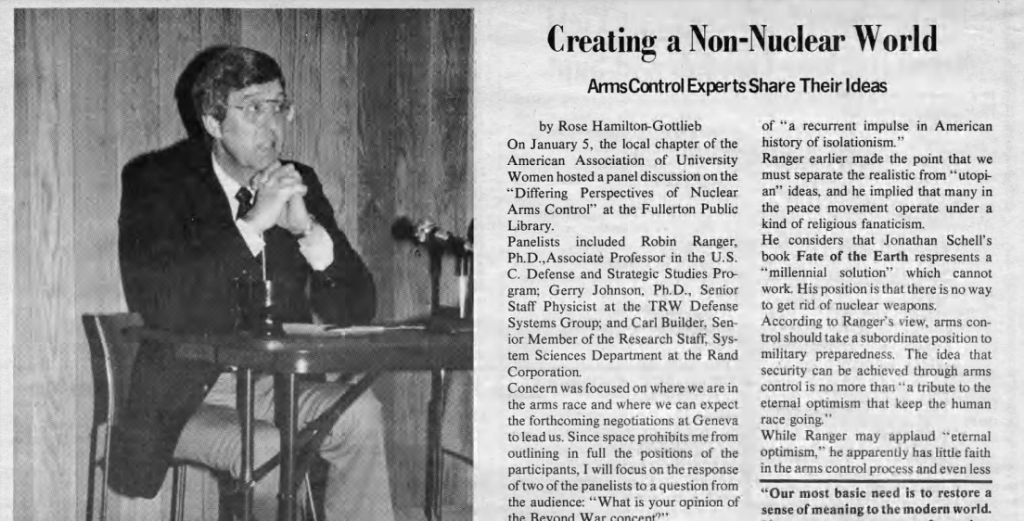
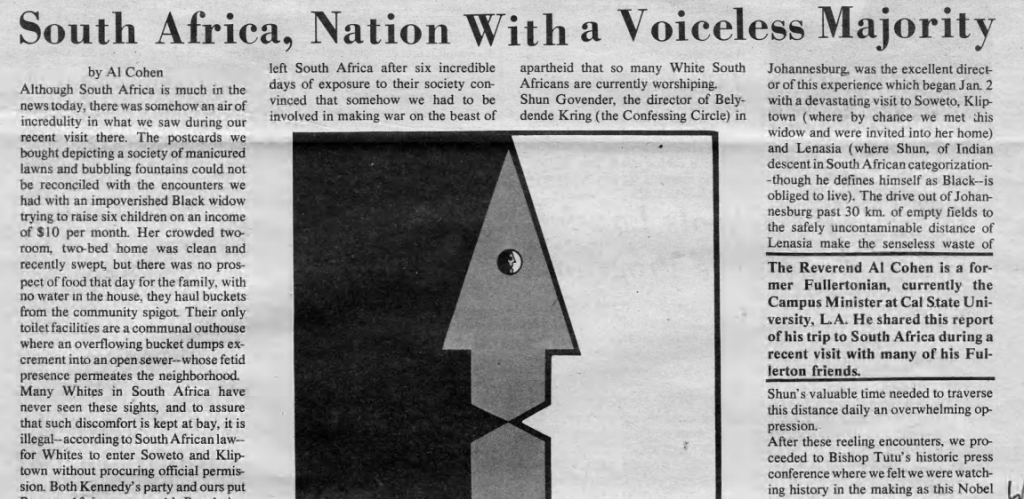
Some international issues in 1985 were nuclear proliferation in the context of the Cold War, the revolution in Nicaragua (which the U.S. involved itself in), and apartheid in South Africa.

Immigration
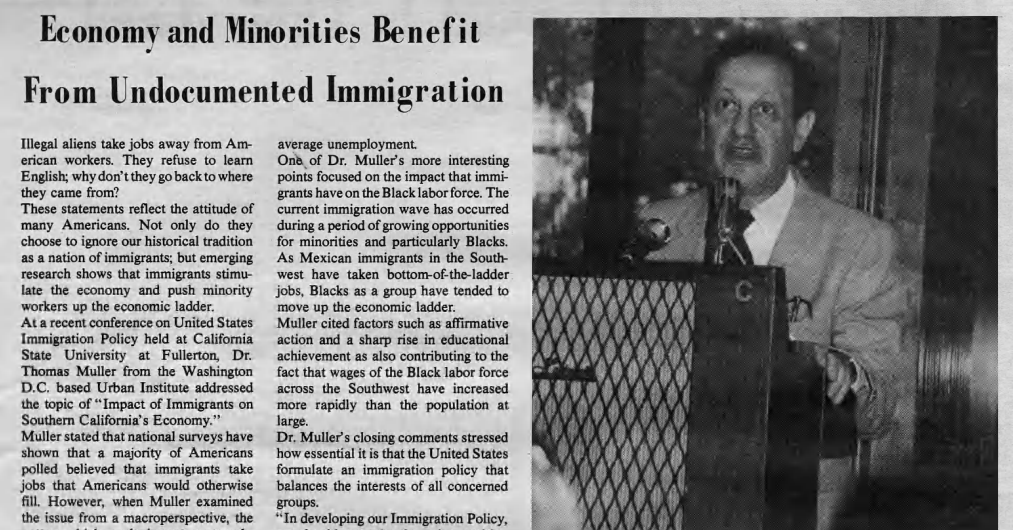
While illegal immigration was not quite the hot-button issue it is today, it was a growing concern. Interestingly, it was the Republican president Reagan who signed a significant Amnesty law for undocumented immigrants in 1986. The Republican party seems to have moved away from that approach.
Labor
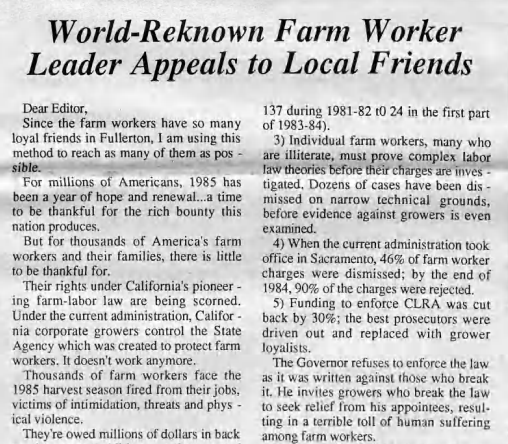
In labor news, workers urged the public to boycott Alpha Beta grocery stores in solidarity with the United Farm Workers.

United Farmworker leader Cesar Chavez came to Fullerton to plead the case for better treatment of farmworkers, and even wrote a letter to the Observer on the topic.

Crime
In 1984, CSUF physics professor Edward Cooperman was killed in his office by Vietnamese student Lam Van Minh, allegedly as a result of Cooperman’s efforts to assist the communist government in Vietnam. Some believed that it was an assassination with possible CIA involvement.

Prosecutors argued that Minh shot Cooperman in his office in cold blood.
The trial against Minh took place in 1985, and resulted in a hung jury, and therefore a mistrial. Assistant District Attorney Mel Jensen said he would be refiling a new set of charges against Minh.
 Fullerton History