The following is from a work-in-progress about the history of Fullerton. You can support my ongoing research and writing on Patreon.
Sue Tsuda was interviewed by Scherly Virgill in 2016 for a CSUF Oral History Program project entitled “Women, Politics, and Activism since Suffrage.” Here is a brief bio of Tsuda, based on this interview.
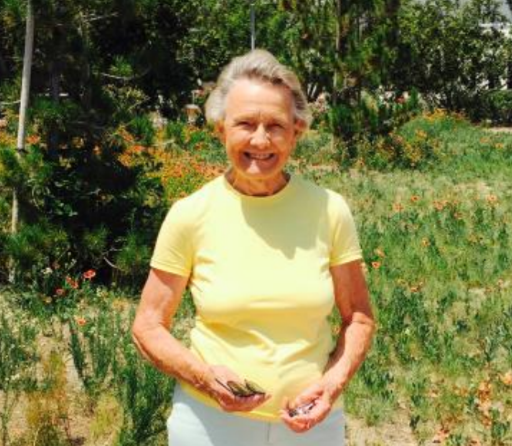
She was born in Clinton, Illinois in 1936 to Ruth Edwards and Virgil Hoff. Her dad worked for the Illinois Central Railroad as a machinist. She had one brother, Virgil Hoff.
When she was growing up, her dad served on the school board, and her mom was active in the League of Women Voters. The whole family was interested in politics. When she was 16 and had gotten her drivers license, she was driving voters to the polls in their rural county.
After high school, she got a scholarship to go to the University of Illinois, where she met her husband. They married in June of 1955 and had three children: Ken, Kesa, and Naomi.
When she was a freshman in college, she got involved in civil rights by picketing the barbers in Champagne-Urbana, Illinois who “would not cut the hair of black students…they said the reason was they didn’t know how to cut Negro hair.” She says they weren’t physically attacked, but were verbally attacked.
Before getting a job at the Hughes plant in Fullerton, her husband was reluctant to move to California “because there was too much prejudice against Japanese.” But, drawn by the good pay, the family moved out west.
Sue graduated from CSUF in 1978 with a degree in political science. She then got a masters in public administration from Cal State Long Beach.
While living in Orange County, she (like her mother) got involved in the League of Women Voters.
She liked working for the League because she “they were an organization that provides a great deal of information that’s valid and not biased.”
Part of her involvement in the League included going to city council and planning commission meetings as an observer. She served as head of a League committee on education and helped put together a report entitled The State’s Role in Education. She also served on the state board of the League.
When the Kent State massacre happened in 1970, she went to Washington D.C. with the League and helped marching students to write and file petitions to the government.
“One of the more moving experiences of my life was to be on the steps at the Lincoln Memorial when they (student protesters) were there,” she recalls. “A crowd of young people dismayed at their government.”
While working with the League, she befriended Molly McClanahan, who would later be elected to City Council.
She worked on the 1972 campaign for Frances Wood, the first woman elected to city council.
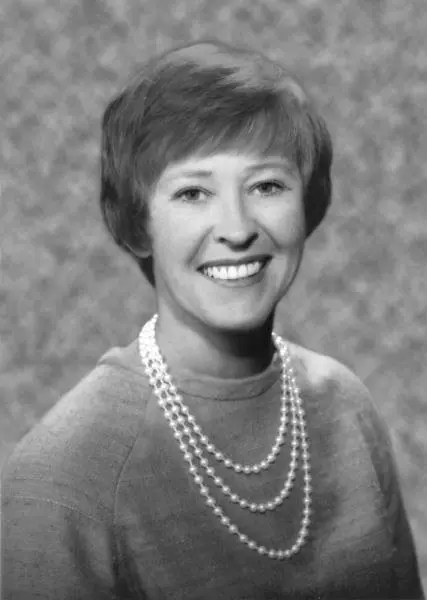
“Frances was a real kick in the head,” she recalls. “She had a marvelous but unconventional sense of humor, and was friends with everybody. She found something to like in everyone that she met. I really loved her a great deal.”
Sue got a job working for the county of Orange, then for the city of Westminster as an administrative assistant. She also served as chair of the Fullerton planning commission and as chair of the school board.
In 1978, she ran for City Council and was elected. Because she didn’t have a lot of money, “Some of my friends who were on the campaign committee arranged teas. And people opened their homes and invited their friends and I went and made my presentation to them. We did that all over town.” Her kids’ friends helped by knocking on doors for her campaign.
During her campaign, the biggest state and local issue was Proposition 13, which restricted increases in property taxes.
“I campaigned vigorously against it, telling people what was going to happen,” she recalls. “And it came to pass unhappily. Now cities and towns are more reliant on state government for funding than they used to be.”
One of the biggest challenges she faced while on council was the decreased city revenue as a result of the passage of Prop 13.
“We used to slurry seal the streets in Fullerton every three years. After Prop 13, it slipped to every seven years,” she said. “There were things in terms of routine maintenance that were pushed back that needed to be done.”
Prior to the passage of Prop 13, the League of Women Voters got the Council to add five cents to property taxes, to support the Library; however, “After Prop 13 you couldn’t do that anymore,” she said.
She also faced opposition from the conservative Republican council majority, who retaliated by not letting her serve as mayor when the time came.
“They wouldn’t let me do it. I was never mayor,” she said. “Served four years on the council. Usually it’s a rotating seat.”
Another big issue in the 1970s was school integration. In 1972, the Fullerton School Board voted to close Maple School because it was a de facto segregated school, with a 98% Black and Latino enrollment.
“We were trying to figure out the best way of integrating them. It involved busing, which was not happy. We didn’t want to do that because it disrupted kids and bus schedules and all of that,” Tsuda recalls. “We managed to get the school integrated. But we had to take the kids out of their neighborhood. The real key is to desegregate the neighborhoods.”
To read more about the Maple desegregation story, check out my recently-published article “The Limits of Desegregation: a Story of Maple School.”
Tsuda said that feminism, to her, means “that women have equal rights and equal opportunities as everybody else.”
When asked about the makeup of the League of Women Voters in the 1970s, she said, “In Fullerton it was all white women. All middle or upper class, I’d say. People who had the time to indulge.”
Tsuda left Fullerton in 1982 to take a job in Yucca Valley.
When asked what advice she would give to young women who want to be involved in politics, she said, “Start at the bottom. Get involved where it’s easiest, and most important to you personally to get involved…go to school board meetings and Planning Commission meetings and participate in organizations locally that support the community. Make yourself informed on what’s going on.”
When asked how she felt about Donald Trump, who was running for president in 2016, she said, “I think he would be a disaster.”
 Fullerton History