The following is from a work-in-progress about the history of Fullerton. You can support my ongoing research and writing on Patreon.
This mini-biography is based on various articles appearing in the Fullerton News-Tribune from 1893-1944.
Dr. George C. Clark was born in Chambersburg, Ohio in 1863. After completing his studies in homeopathic medicine at Hahnemann Medical College in Chicago in 1884, he worked in private practice in Danville, Ill, and Morris County, Kansas. He also served as house surgeon for the Santa Fe Railroad in New Mexico.
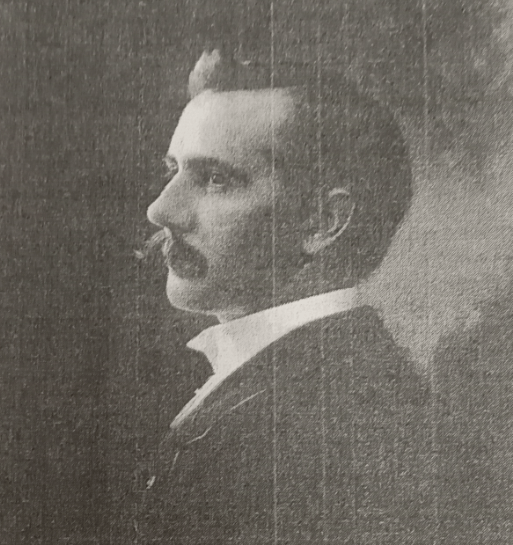
In 1891, he moved to Fullerton, and opened a medical practice. He charged $1 for house calls, 50 cents for office visits and $5 for baby deliveries ($7.50 if “difficult”).
His first office was in the Chadbourne Building at the northwest corner of Spadra (now Harbor) and Commonwealth. Between patients, he played the flute, prompting Fullerton Tribune editor Edgar Johnson, his downstairs neighbor, to write in his newspaper: “If any of our readers have an idea that they could write a brilliant and brainy editorial in our sanctum, with Dr. Clark with his flute right over head tooting ‘Down Went McGinty’ to the tune of the ‘Dead March,’ they are welcome to it.”
In 1894, he married Edith Johnson of Norwalk, and built a house at the corner of Harvard Avenue (now Lemon Street) and Amerige Avenue. The house also served as his medical office. Edith raised pigeons and rabbits in pens beside their house.
“The house hummed with visitors, music and activity,” according to the Tribune.
That same year, Clark was elected county coroner.
“His activities in the county took him from Capistrano to Whittier in the days when the horse and buggy was the best available means of transportation,” the Tribune states.
Clark was very active in Fullerton’s civic life. A Republican, he was elected to the school board and to Fullerton’s first City Council (then the Board of Trustees) in 1904. He served as president of the city’s Board of Health.
“George and Edith Clark enjoyed a busy social life,” the Tribune states. He joined Fullerton’s first Chamber of Commerce, served on the Board of Directors of Fullerton’s first hospital, and was a member of numerous fraternal organizations, including the Independent Order of Foresters, the Fraternal Aid Association, and the Masonic Lodge. He played his flute in the Fullerton Orchestra, mainly at ice cream socials.
He was a member of the first telephone exchange in Fullerton, which was installed by William Starbuck in his drug store.
In 1903, he gave up his horses and bought one of the first automobiles in town.
While on City Council, Clark “became embroiled in a political controversy over the proposed incorporation of Fullerton as a municipality. The issue was muddied by a battle between prohibitionists (drys) and their opponents (wets), and it was not until 1904 that the incorporation finally was approved. Dr. Clark was among those elected Fullerton’s first trustees Charles Chapman was named its first mayor. With saloon licensing still an issue, Clark voted first with the wets, then the drys, until in April the following year the sale of liquor was approved in the city.”
The first city council got to work laying out the first sidewalks, purchasing a sprinkling machine to water down the dusty unpaved roads, establishing lighting for city streets, and installing the city’s first bicycle path on Chapman Avenue.
George and Edith had three children: George DeWitt (born 1896), Eudolpha (1899), and Joshua Martin (1901).
Dr. Clark and his family left Fullerton in 1905, but returned six years later and the family settled in a different home on North Spadra. Clark joined the medical firm of Johnston, Beebe, Clark, Davis and, later, Wickett.
In the 1920s, the Clarks again moved away from Fullerton, returned for a while in the 1930s, before retiring to their beach home in Balboa.
Around 1940, Dr. Clark retired after almost 60 years in the medical profession. He succumbed to heart disease on Sept. 3, 1948 at the age of 85.
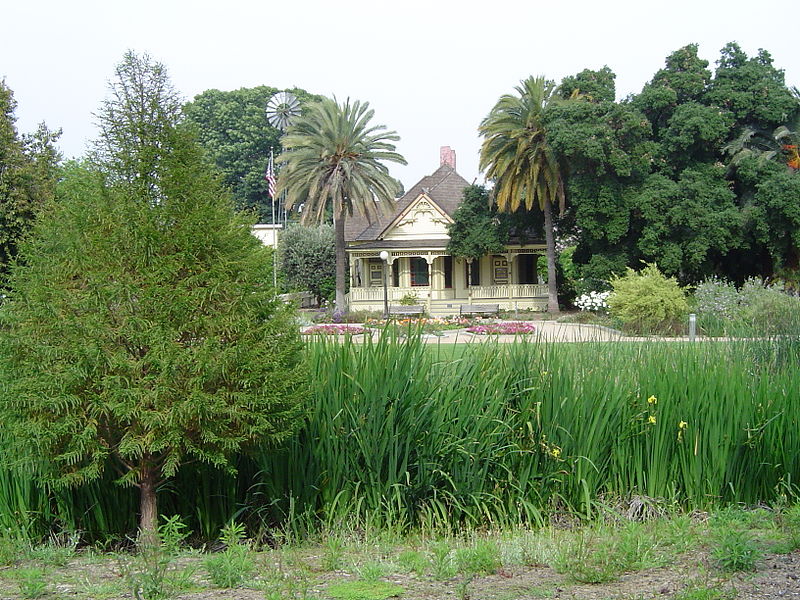
According to the Tribune, “The doctor’s legacy lives on in the form of Heritage House at the Fullerton Arboretum on the Cal State Fullerton campus…The house was moved to the arboretum, where it was authentically restored and furnished and dedicated in May of 1976.”
 Fullerton History