The following is from a work-in-progress about the history of Fullerton. You can support my ongoing research and writing on Patreon.
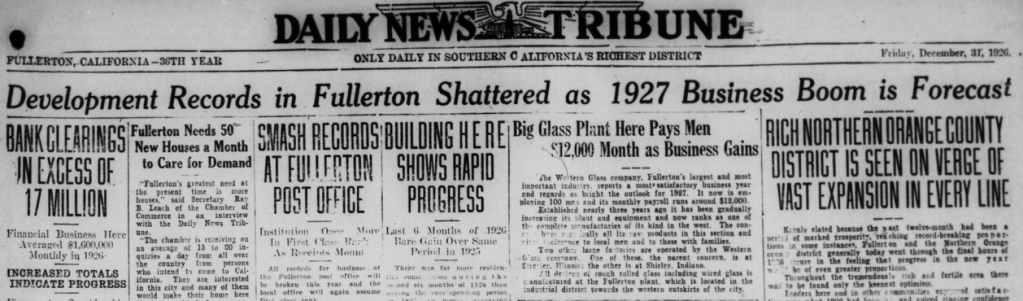
The Local History Room of the Fullerton Public Library has microfilm from the Fullerton Tribune newspaper stretching back to 1893. I am in the process of reading over the microfilm, year by year, to get a sense of what was happening in the town over the years, and creating a mini archive. Below are some news stories from 1926.
In 1926, the Fullerton Tribune bought the town’s competing newspaper, the Fullerton News, to become the Fullerton News-Tribune.

In national news, Republicans controlled both houses of congress and the presidency, under Calvin Coolidge. Infamous con-man Charles Ponzi was convicted of defrauding investors, wealthy Native Americans in Oklahoma were being murdered for their oil lands, Major League Baseball faced a huge scandal when Ty Cobb and Tris Speaker were accused of fixing and betting on games, and famous evangelist Aimee Temple McPherson disappeared and then re-appeared under mysterious circumstances.
In international news, fascists under Benito Mussolini had gained control of Italy, Theodoros Pangalos declared himself dictator in Greece, the army of Chinese warlord Zhang Zuolin captured Beijing, the Cristero War broke out in Mexico, the United States intervened to end the Nicaraguan Civil War, and Gertrude Ederle became the first woman to swim the English Channel.
Growth
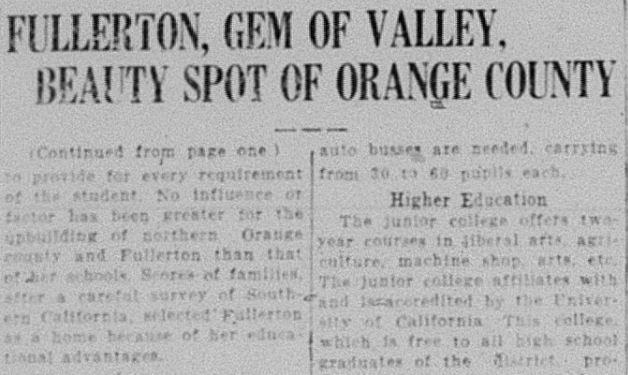
Fullerton continued to grow relatively rapidly. In 1926, the city comprised an area of 19 square miles, had a population of 11,250, 20 miles of paved streets, 17 miles of sewage lines, 35 miles of water mains, one fire station, three parks, 10 public schools, three banks, nine churches, one hospital, two theaters, 1676 telephones, and 16 manufacturing and packing plants.
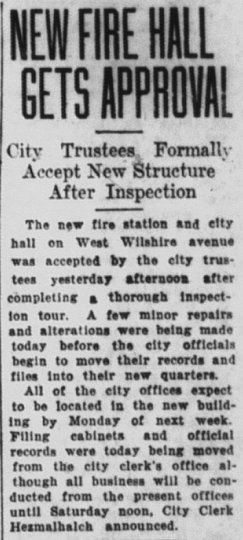
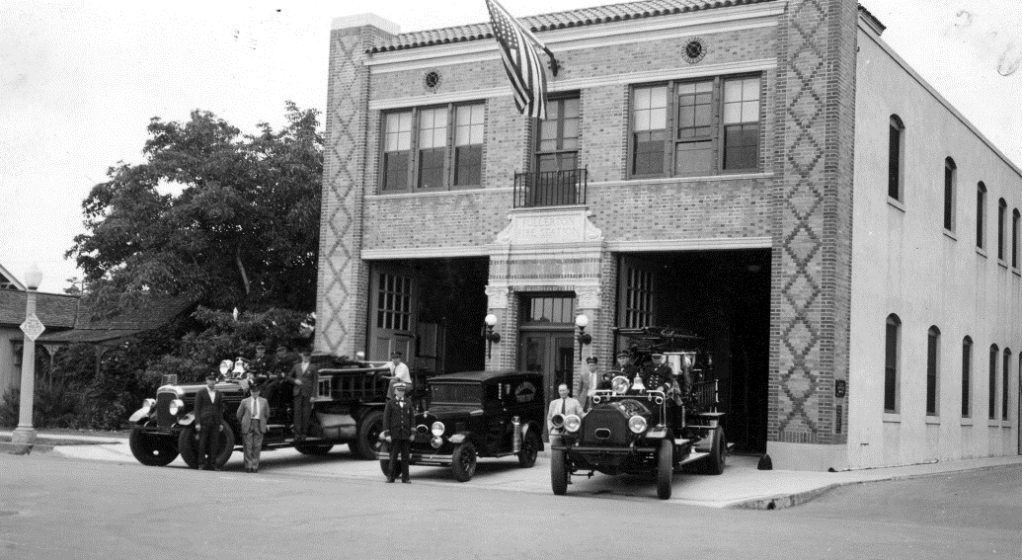
A new fire hall on west Wilshire Avenue was built. It stood on what is now Half Off Books in the Wilshire Promenade building.
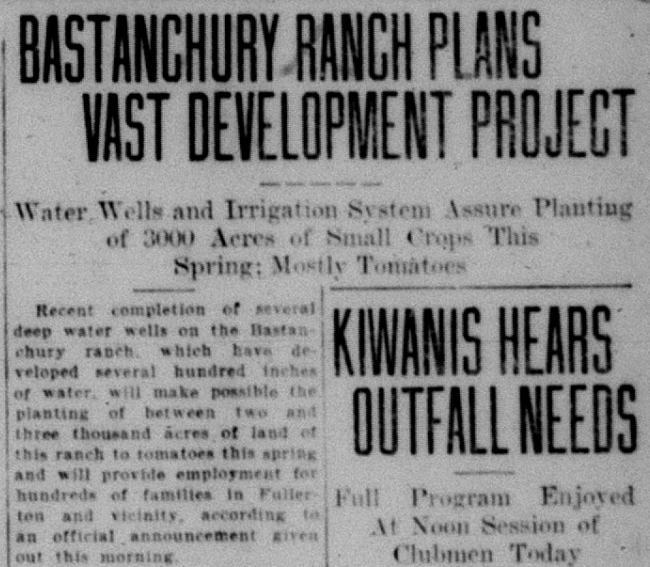
The Bastanchury Ranch laid out plans for massive citrus and tomato orchards.

In business news, Alpha Beta market opened downtown at the southwest corner of Wilshire and Spadra (now Harbor).


The Orange County Ice Company opened a new plant at the corner of Truslow and Harvard (now Lemon).

New housing subdivisions were built, most of them with racially restrictive covenants that prevented non-whites from living there.

In regional infrastructure news, a bond was placed before the voters of Orange County to improve Newport Harbor, to make it a major shipping point, but the bond failed.

Plans were in the works to build a dam on the Colorado River that would generate power and divert water to Southern California.

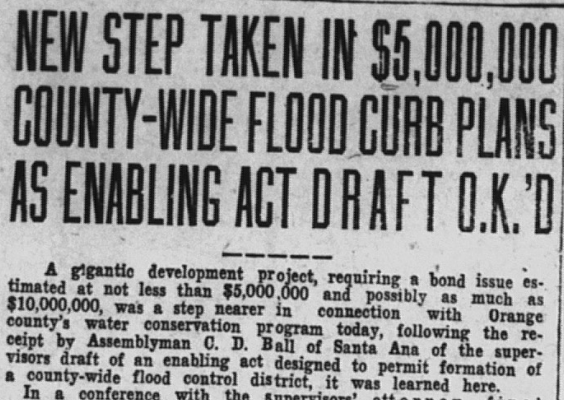
Plans were also in the works for a county-wide flood control plan. This would ultimately result in the concrete channelization of the Santa Ana river.
Politics
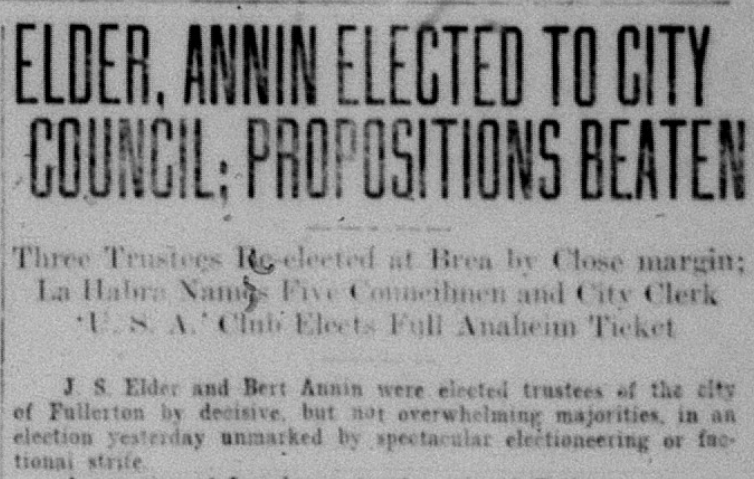
In local politics, J.S. Elder and Bert Annin were elected to the City Council.
Harry Crooke was again chosen as Mayor.

Less than a year into his tenure, Elder resigned and Emmanuel Smith was appointed to replace him.

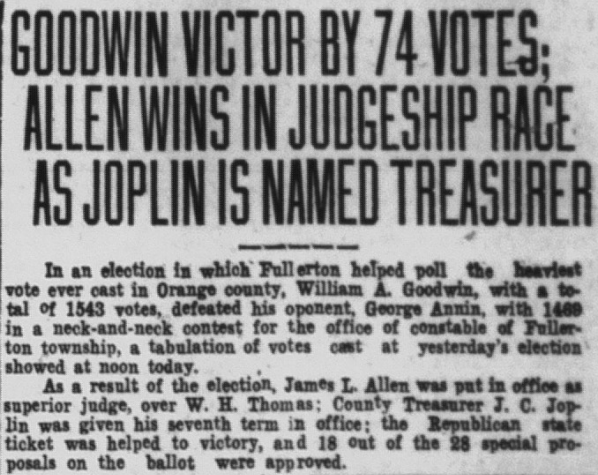
William A. Goodwin was elected town constable.
In La Habra, things got heated during the local election, resulting in a police officer getting shot.

Republican Clement C. Young defeated fellow Republican Friend Richardson for his party’s nomination for governor, and then defeated Democrat Justus S. Wardell in the general election.

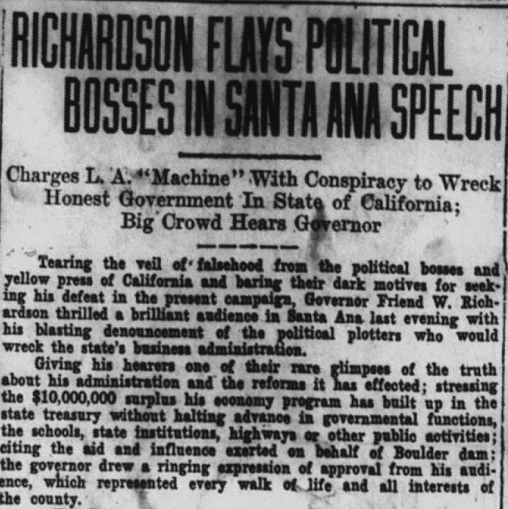
Richardson came to Orange County, and gave a speech in which he “flayed political bosses.”
The Great Oil Fire
Perhaps the biggest news story of 1926 was the great Brea Oil Fire.

Lightning struck two 500,000 barrel underground oil reserves of the Union Oil Company a half mile west of Brea, creating a huge blast and igniting a massive oil fire.
“Plate glass windows in Brea stores were shattered by this blast which was felt slightly in Fullerton,” the Tribune reported. “Flames shot 500 feet in the air as the lightning struck eyewitnesses declared and burning fragments of the wooden roofs which covered the reservoirs were blown directly over the town of Brea by a strong westerly wind.”
Four hundred men were rushed to the scene to try to put out the fire and remove oil from the reservoirs. The fire threatened to spread to 10 other large tanks in the field.
Dikes were erected to halt the spread of the oil fire.
“Huge clouds of smoke billowed into the air throughout the day attracting thousands of persons from surrounding districts,” the Tribune wrote. “Brea fire department apparatus has been called out to protect homes near the scene of the flames and Union oil workers are moving out of their houses on the lease surrounding the tank farm as a precautionary measure.”
And then, the next day, a fourth tank caught fire.
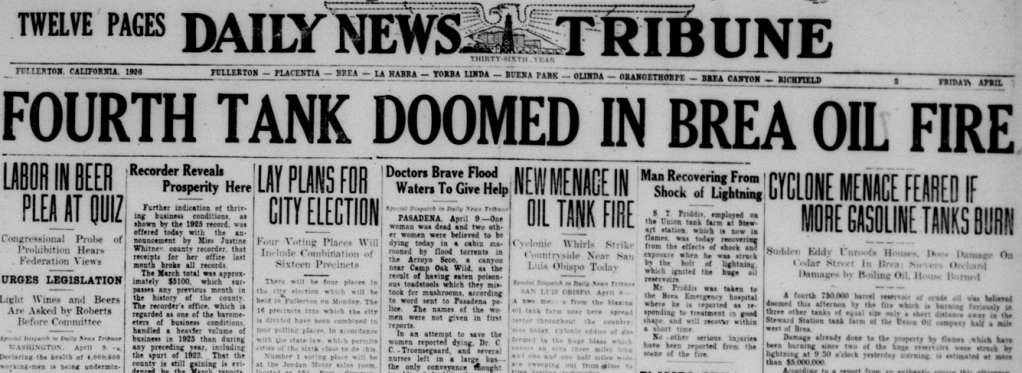
Damage was estimated at over $5,000,000.
Fire fighters from Long Beach and Wilmington were rushed to the fire, “and workers from practically every oil field and oil company in Southern California were aiding the fight.”


To make matters worse, a cyclone struck sections of Brea causing more damage.

Finally, after a couple days of burning, the fire was gotten under control.

Prohibition
In 1926, Prohibition was in full effect, and local law enforcement struggled to control bootlegging.
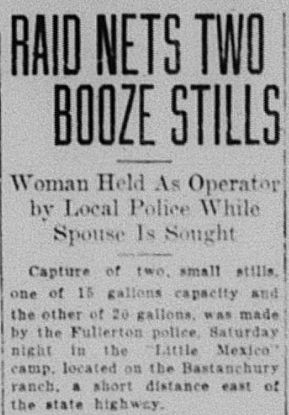
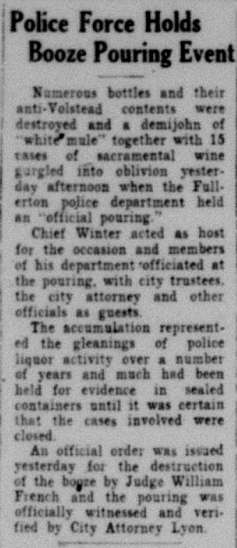
The Fullerton police department held a public “booze pouring” event in which they dumped out hundreds of gallons of illegal booze they had seized.
And then, something embarrassing happened. Some Fullerton police officers were accused by another officer of stealing wine from the department’s stock of seized liquor for personal use.
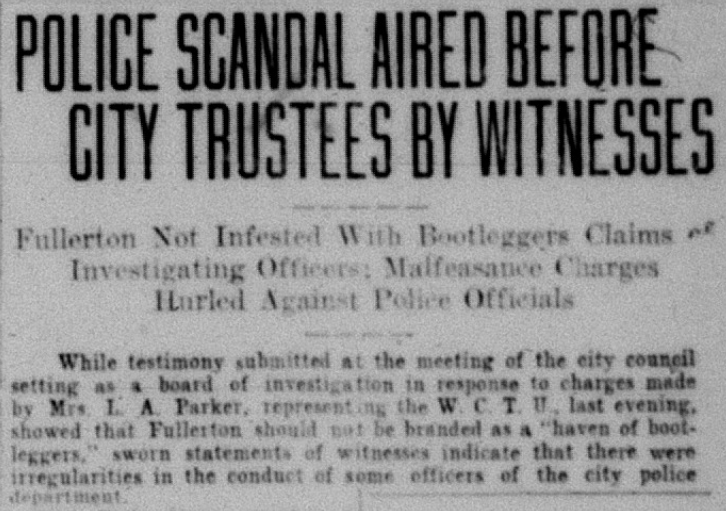

After a few public hearings before City Council, the accused officers denied any wrongdoing and were not convicted of any crimes. The whole ordeal, however, caused a shake-up in the department, in which some officers were forced to resign.

Adding to the embarrassment, Fullerton City Councilmember Emmanuel Smith and beloved football coach “Shorty” Smith were both arrested and fined on liquor charges. Neither lost their jobs.

Culture and Entertainment
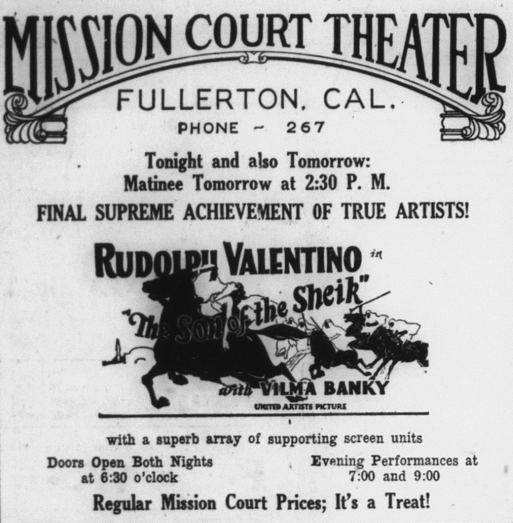
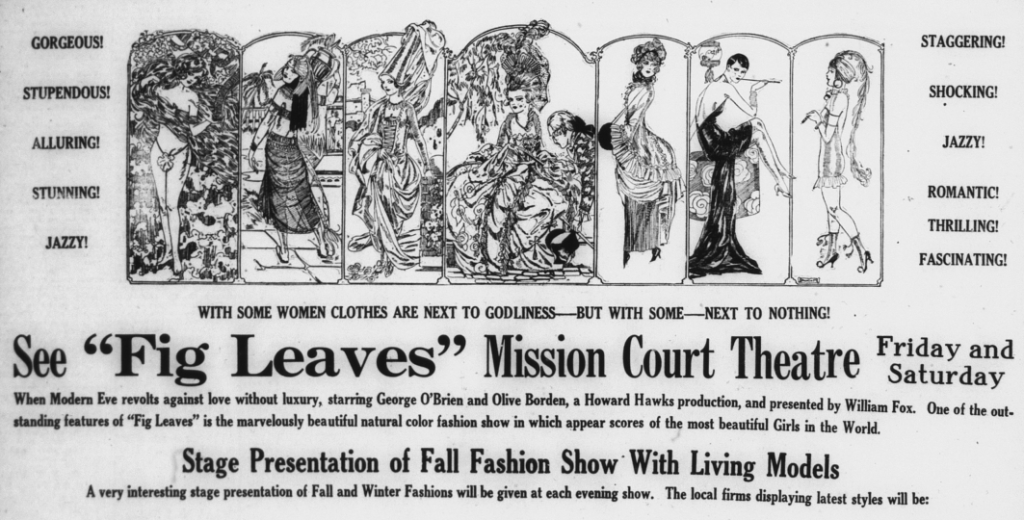
In the previous year, 1925, Chapman’s Alician Court Theater (later to be known as the Fox Theater) opened with great fanfare. In 1926, the theater’s name changed to the Mission Court Theater.

Transportation
Plans were in the works to convert the City’s sewer farm on the west side of town into a municipal airport.

Education
In education news, a few articles appeared extolling the virtues of the Fullerton Union High School “Americanization” program, in which Mexican American children and adults who lived in segregated work camps were taught English and various aspects of American citizenship.

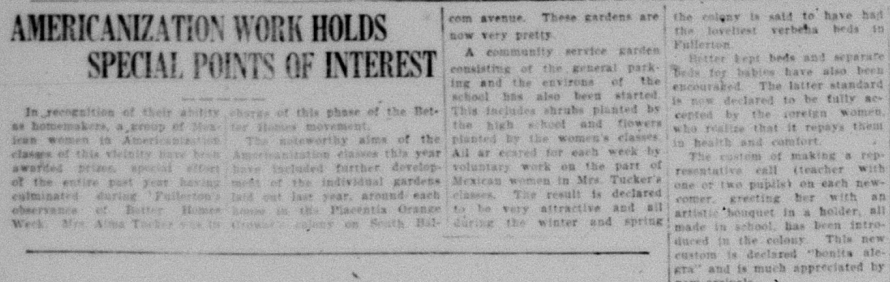

Occasionally students of the Americanization program showcased their progress to the community at large.
At one of these ceremonies, master of ceremonies, Crescencio Duran “distinguished himself by announcing every number in clear, well chosen English,” the Tribune reported. “Members of beginning English classes dramatized the various processes of buying and selling, while pupils in advanced English classes read original essays on Lincoln, Washington, Benjamin Franklin, and Roosevelt. They had also two excellent papers on thrift, accompanied by a dramatization of how to open a savings account in English.”
To read more about the social and educational segregation of Mexican Americans at this time, check out my article “The Roots of Inequality: The Citrus Industry Prospered on the Back of a Segregated Immigrant Workforce.”
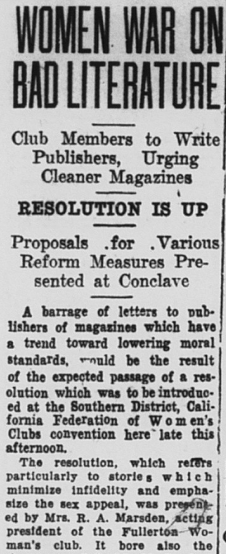
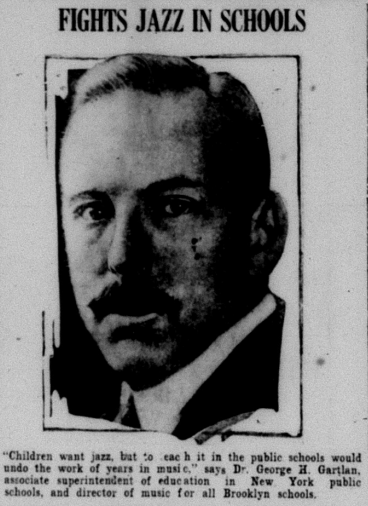
The 1920s were a time of rapid social and cultural change, and some feared the influence of “evil” things like jazz and certain types of literature and sought to ban them.
Agriculture
Along with oil, citrus was the other big industry in Fullerton and surrounding environs.

Sports
In sports news, there was a popular “indoor” baseball league that played its games on the field next to Ford Grammar School, now Ford Park.

The mascot of Fullerton High School was, and is, the Indian. In more recent years, this has proved controversial, as native American groups over the years have tried to get the district to change the mascot, arguing that it is offensive. Despite the fact that activists have been unsuccessful in changing the name, I too find it offensive, especially considering the fact that in 1926, the Fullerton Indians were regularly called the “redskins.”

Racism
In other racism news, despite facing national controversy in their peak year of 1925, the Ku Klux Klan was still a formidable force in American society. The Ku Klux Klan may be seen as the progenitors of today’s movement of Christian nationalism.

Healthcare
In the category of “the more things change, the more they stay the same,” the subject of mandatory vaccination proved controversial.


History
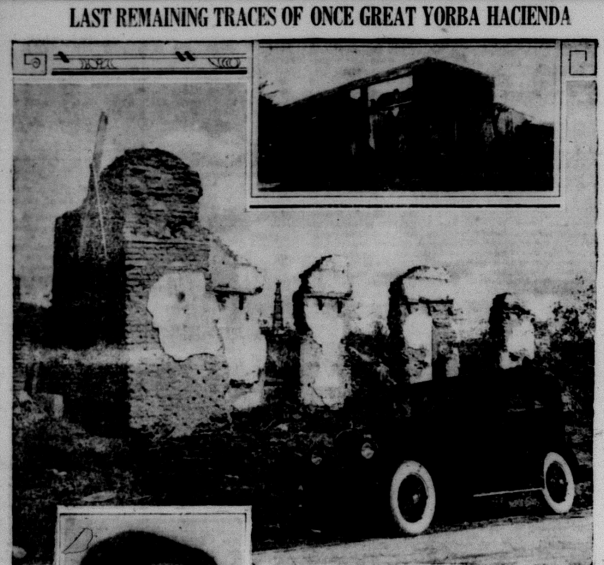
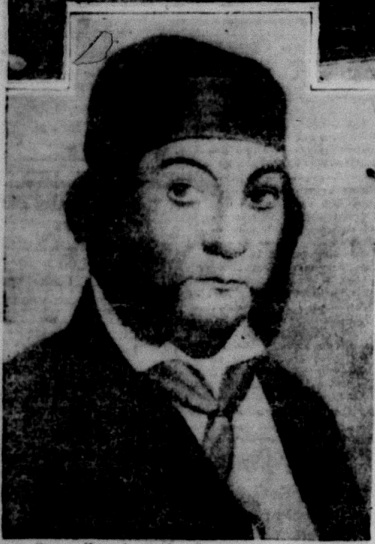
In local history news, the old Yorba adobe in the Santa Ana canyon was destroyed to make room for a barley field. This was done at the direction of property owner Samuel Kraemer, who was married to Angelina Yorba, a descendant of the Yorba family, one of the oldest families in California, who owned a huge Spanish/Mexican land grant prior to the American conquest of California.

“One by one the visible links with the early days of California are being broken and the chain of picturesque adobe homes with their quaint architecture and delightful atmosphere of the days when the land was in its primitive charm, is fast disintegrating into the dust from which it was made,” the Tribune stated.
Miscellaneous
Here are a few miscellaneous articles from 1926:

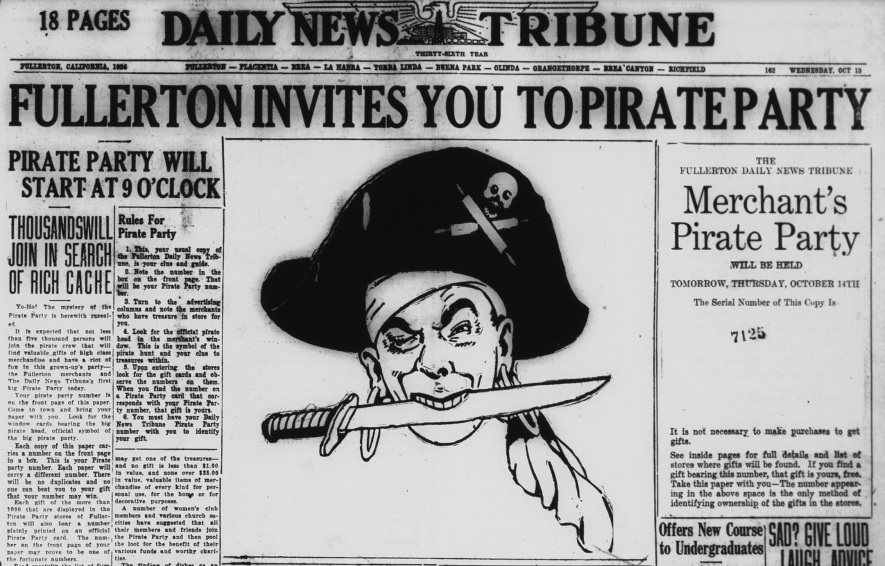


Death
In death news, Jennie Des Granges, wife of pioneer Otto Des Granges, passed away.

A native of Tennessee, Jennie came to Fullerton area in 1869. She was the oldest daughter of James Gardiner, another Fullerton pioneer. Their children were Paul Des Granges and Marie Brewer. Her brothers were John R. Gardiner, Lilburn Gardiner, Frank Gardiner, and W.A. Gardiner.
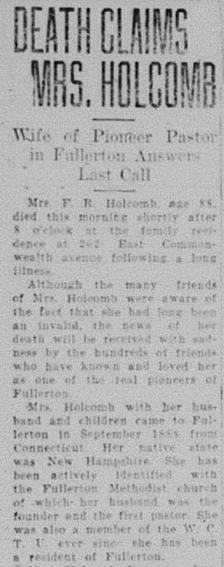
The wife of pioneer Fullerton pastor F.R. Holcomb passed away.
Orange County Superior Judge Judge Z.B. West passed away.

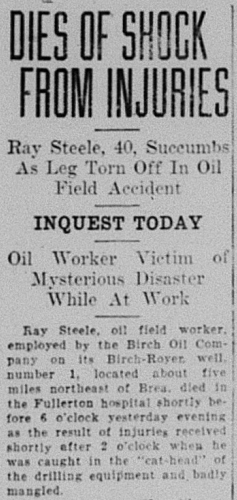
Ray Steele, a local oil workers, died of shock after his leg was torn off in an accident.
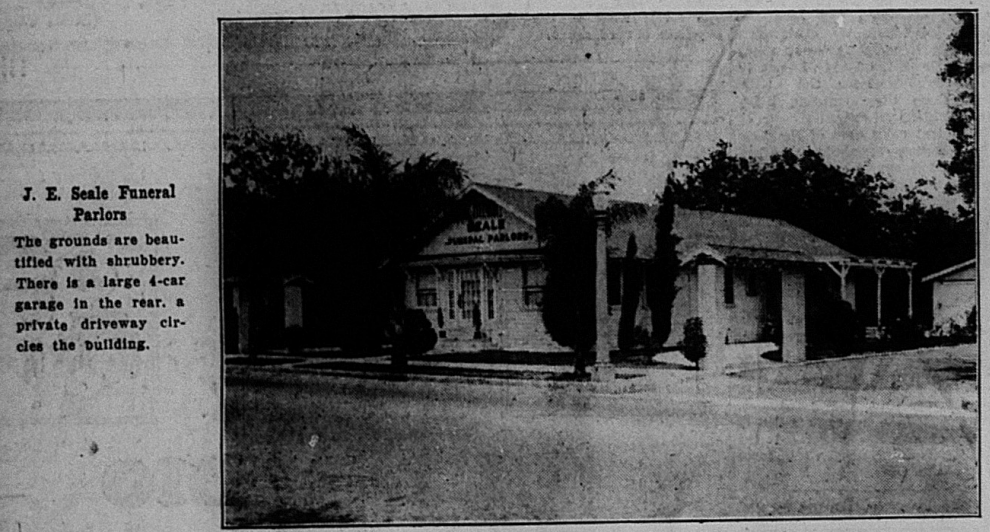
Here is a photo of the Fullerton funeral parlor of J.E. Seale at 137 E. Chapman Ave.
Stay tuned for news articles from 1927!
 Fullerton History