The following is from a work-in-progress about the history of Fullerton. You can support my ongoing research and writing on Patreon.
The Local History Room of the Fullerton Public Library has microfilm from the Fullerton Tribune newspaper stretching back to 1893. I am in the process of reading over the microfilm, year by year, to get a sense of what was happening in the town over the years, and creating a mini archive. Below are some news stories from 1924.
Calvin Coolidge was president of the United States. Revelations and indictments surrounding the Teapot Dome oil scandal were making headlines. Native Americans were finally given citizen status. Congress passed the Immigration Act of 1924 (the Johnson-Reed Act), a profoundly racist law (one of its authors, Albert Johnson, was a eugenics proponent) that barred immigrants from Asia and created quotas that severely limited immigration from countries that weren’t northern European (i.e. white). This law was widely supported by many Americans at the time.
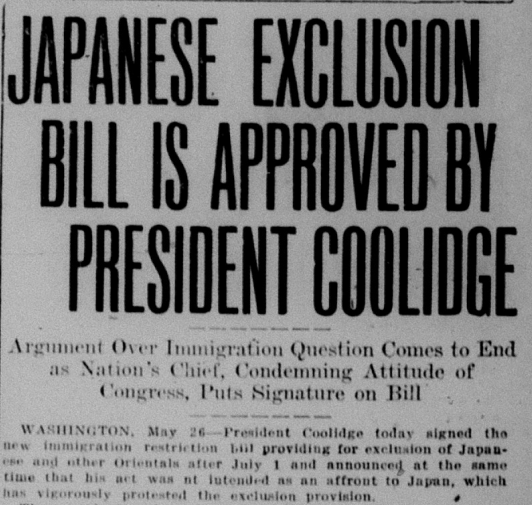
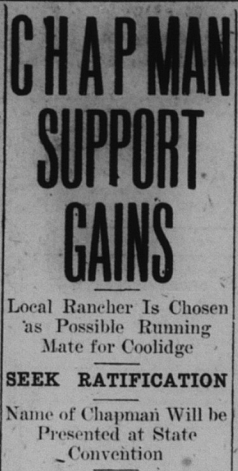
1924 was an election year, and Coolidge was running for re-election. There was a proposal for Fullerton rancher Charles C. Chapman to be Coolidge’s vice presidential running mate; however, he ultimately chose Charles G. Dawes.
Local Politics
In the 1924 Fullerton City Council election, Harry Crooke, O.M. Thompson, and W.J. Carmichael were elected.

Meanwhile, in Anaheim, the Ku Klux Klan claimed a city council victory, electing E.H. Metcalf, Emory F. Knipe, A.A. Slabach and Dean W. Hasson. In 1924, the Ku Klux Klan had around 5 million members and was a major force in politics.
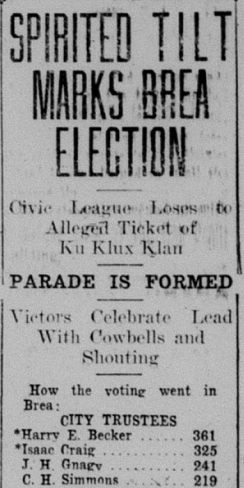
In Brea, Harry E. Becker and Isaac Carig were elected as city trustees. “Local gossip has it that the Ku Klux Klan played a prominent role in the election backing the successful candidates and defeating the nominees of the Brea Civic League.,” the Tribune reported.
Ku Klux Klan
As shown above, the Ku Klux Klan was very active in local politics. A cross was burned on a hill in north Fullerton on election day.
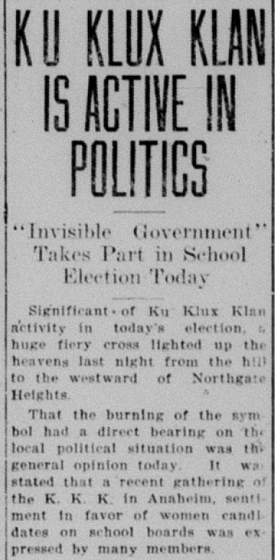
“Significant of Ku Klux Klan activity in today’s election, a huge fiery cross lighted up the heavens last night from the hill to the westward of Northgate Heights,” the Tribune reported. “That the burning of the symbol had a direct bearing on the local political situation was the general opinion today.”
According to the Tribune, “The claim was made today by a person in close touch with local Klan affairs that there is a membership of from 2500 to 3000 in this territory.”
Ku Klux Klan rallies drawing thousands took place throughout Orange County in 1924, including at least two large meetings at what is now Amerige Park, across the street from City Hall.

The Klan was so popular, in part, because it was presented as a patriotic organization. At the above advertised meeting, the speaker stressed the fact “That it is a white man’s organization, a gentile organization, a protestant organization and an American organization in which membership is restricted to native-born American citizens. That the KKK stands for white supremacy; for the enforcement of the law by the regularly constituted authorities; development of the highest standard of citizenship; rightful use of the ballot, and the worship of God.”
At another Klan meeting that drew around 5,000 attendees, the violence that lay beneath the rhetoric almost broke out.
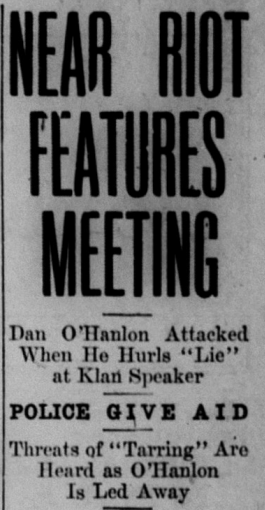
Local businessman Dan O’Hanlon, who was Irish Catholic, was unhappy with the Klan speaker’s denunciations of catholicism, so he shouted “Liar!” during the speech.
This led to cries of “get that guy,” “where is a tar bucket?” from different parts of the crowd. O’Hanlon was taken by police officers, for his own safety, and booked him briefly at the city jail. He was released later that night, and according to an oral history interview with O’Hanlon’s wife Margaret, a cross was burned on their lawn that night.
The Klan also made an appearance at a downtown city carnival.
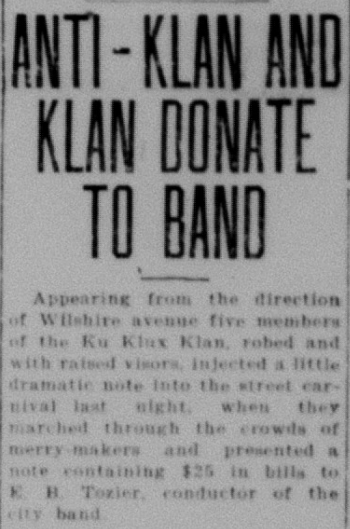
“Appearing from the direction of Wilshire avenue five members of the Ku Klux Klan, robed and with raised visors, injected a little dramatic note into the street carnival last night, when they marched through the crowds of merry-makers and presented a note containing $25 in bills to E.H. Tozier, conductor of the city band,” the Tribune reported.
Meanwhile, the Fullerton Rotary Club passed a resolution condemning the Ku Klux Klan.

“The action of the Rotary club today marks the first tangible, public recognition of the fact that the Ku Klux Klan has become an issue here in Fullerton as it has in Anaheim and in other parts of the county, state and country,” the Tribune reported. “Sentiment has been greatly inflamed here of late by the secret circulation of a list of names purporting to be that of local members of the order.”
The resolution read as follows:
Whereas, a situation has developed in our fair city by virtue of the teachings and activities of the Ku Kux Klan which has set neighbor against neighbor, causing suspicion, distrust and fear to fill the hearts of many; and
Whereas such teachings and activities impede the normal development of our beautiful city, interference with the happiness and contentment of our citizens, hold us up to ridicule before the outside world, and stamp us as being a narrow, factional, intolerant, un-American people; and
Whereas the objects of Rotary International are to promote fellowship and harmony among men of all nations, to make them better business men, better professional, better fathers and in fact better citizens of the country in which they live, having as its motto, “Service above self at all times,”
Be it resolved, that the Rotary club of Fullerton, unanimously deplores the existence of such conditions and is anxious to do all in its power to restore conditions to normal so that the right to the free exercise of our constitutional rights, together with tranquility and those blessings of liberty for which our constitution was ordained and established, be guaranteed to everyone, be it further
Resolved that we hereby publicly condemn the organization known as the Ku Klux Klan, which, by its teachings and actions, tends to develop racial hatred, religious intolerance or in any way denies full constitutional rights to any of our citizens no matter what his race, religion or political affiliations may be.
Local attorney Tom McFadden spoke at the above-mentioned Rotary Club meeting, suggesting that administrators of Fullerton High School were members of the Klan.
“We must keep out all forms of intolerance in our schools,” he declared. “We must keep it out of our high school here. No one has a right to hold a position of responsibility in that institution who holds and subscribes to intolerant beliefs. There are all shades of opinion and religion in our schools and Fullerton has attained a high standing by reason of its progressiveness and efficiency. It will sink from this position if intolerant views are allowed to interfere with its operation and administration.
“A community cannot grow and prosper when its citizenry is divided by mutual distrust and suspicion,” McFadden continued. “We must restore harmony and try to re-establish friendly relations. The Rotary Clubs of Anaheim and Fullerton can do much to foster the right spirit between the two cities and in their respective communities.
“A house divided against itself can accomplish nothing,” he said in closing.
The Tribune stated, “Although no direct mention of the KKK was made by name in McFadden;s talk, and no particular individuals were designated, he clearly indicated by innuendo that he was concentrating his attack on members of the local high school administration whose names are declared to be on the lists which are being circulated in this city.”
Although he didn’t name him by name, McFadden was likely referring to high school superintendent Louis E. Plummer. A 1979 UCLA doctoral dissertation entitled The Invisible Government and the Viable Community: The Ku Klux Klan in Orange County, California During the 1920s by Christopher Cocoltchos states, “Councilman W.A. Moore, Judge French, and Superintendent of Schools Plummer joined the Klan in the latter part of 1923…Civic leaders were especially eager to join. Seven of the eighteen councilmen who served on the council between 1918 and 1930 were Klansmen.”
The Rotary Club was not the only local group opposed to the Ku Klux Klan.

“Anti-Klan forces in Anaheim are going to make a determined effort to change the entire city administration. Recall petitions are to be circulated at once, it was announced at a mass meeting held under the auspices of the USA Club…last night,” the Tribune reported.
To read more about the Ku Klux Klan in Orange County, check out my brief history HERE.
Prohibition
Prohibition was in full effect in 1924 and local officials struggled to prevent bootlegging.
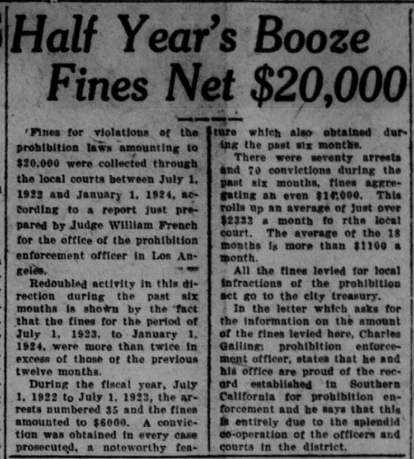
One way the Ku Klux Klan gained popularity was by adopting popular positions on hot-button issues. In addition to being opposed to racial minorities, Catholics, and Jews, they were also in favor of restricted immigration and prohibition.
According to a 2012 OC Weekly article on the 1920s Klan by Gustavo Arellano, in 1924 the Klan and their supporters worked with local and federal law enforcement to conduct a massive arrest of bootleggers.
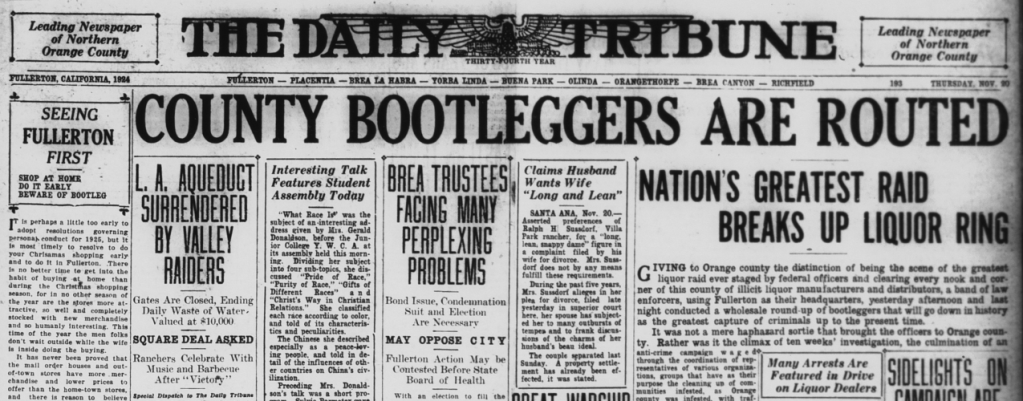
The headquarters of the massive raid was the ranch of Fullerton pharmacist William Starbuck.
In what proved to be a dumb move, these anti-bootleggers then presented a bill to Fullerton city council for $2,800 to cover the costs of the raids (they hadn’t bothered to inform city council of the raid in advance). City Council refused to pay, as did other local city councils who received similar bills.
Growth
Prior to the 1920s, Fullerton’s two main industries were oranges and oil. Starting in the 20s, the city created a 400-acre industrial zone where factories could locate.

These early factories included: Western Glass Company, Balboa Motor Corporation, Newton Process Company, Los Angeles Paving Company, Citrus Fruit Juice Company, and Orange County Brick and Tile Company.

In 1924, Fullerton had over 17 miles of paved roads. New housing subdivisions were being built with racially restrictive housing covenants that prevented non-whites from purchasing homes there.

Education
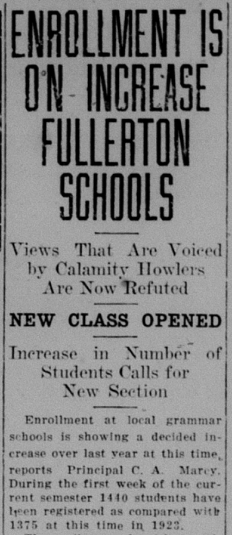
In 1924, to satisfy increasing enrollment, Maple School opened on the southside of Fullerton.

Lottie Morse was elected to the School Board, one of the first women to hold elected office in Fullerton.

Here’s a panoramic photo of Fullerton Union High School in 1924:
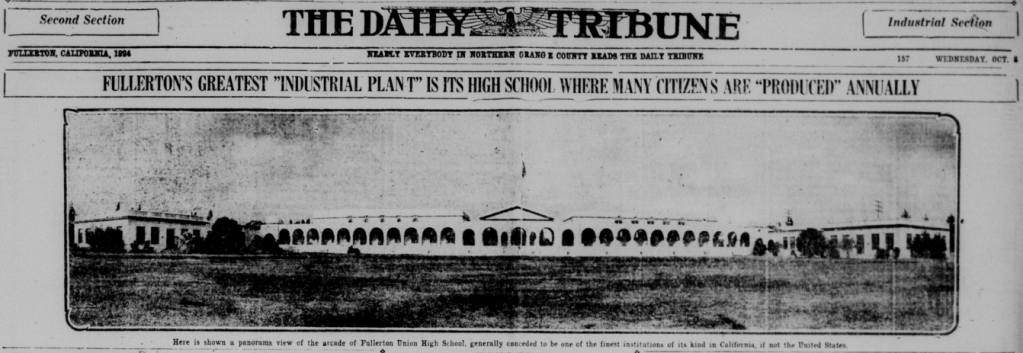
In high school news, a policy was adopted in which girls (but not boys) had to wear uniforms. This was likely a reaction to popular new clothing styles.

There was serious consideration of establishing a new University of California campus in Fullerton on land that was mostly owned by the Bastanchury family. Ultimately, these plans did not pan out.


The Foot and Mouth Disease Epidemic
In agriculture news, an outbreak of foot and mouth disease in California led to restrictions on some California crops and even restrictions on human gatherings and travel.

“Motor touring outside the county is to be further restricted, according to announcement made at the Rotary Club luncheon here this afternoon by A.A. Brock, county horticuturalist,” the Tribune reported. “Coupled with an urgent plea to the public to stay home and in this way help the authorities to cope with the menace of hoof and mouth disease. Mr. Brock made the statement that a general tightening up of the present quarantine regulations is to be put in effect at once.”
Culture and Entertainment
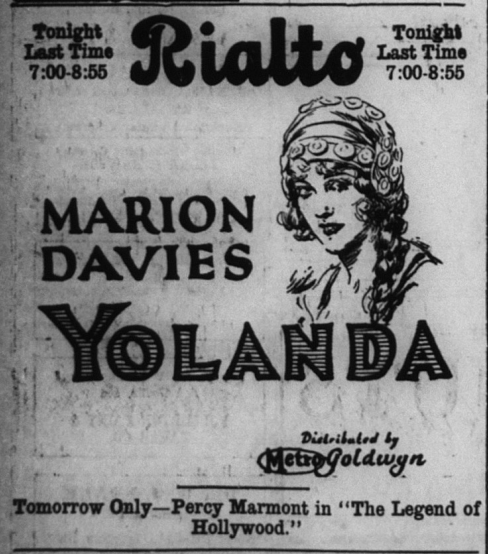
For culture and entertainment, Fullertonians went to see movies at the Rialto Theater downtown.
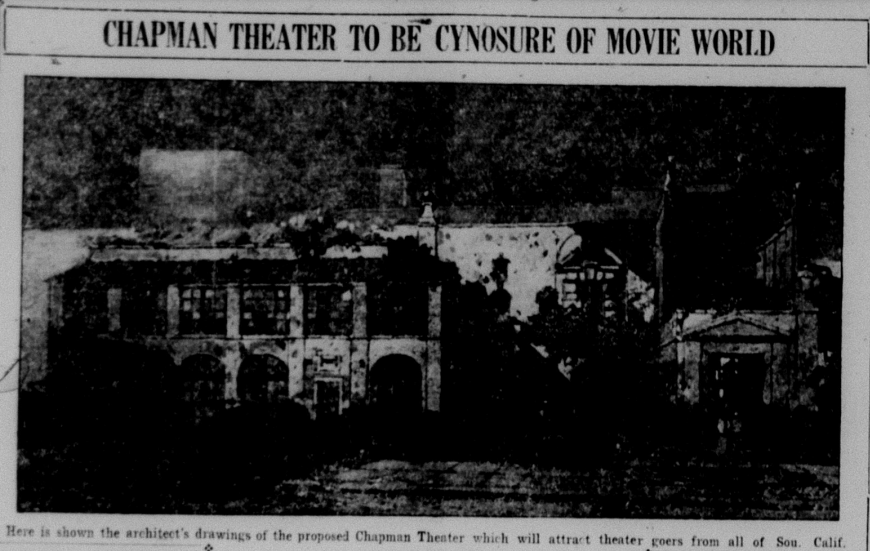
The Chapman Theater (later called the Fox Theater) was under construction, and would open in 1925.
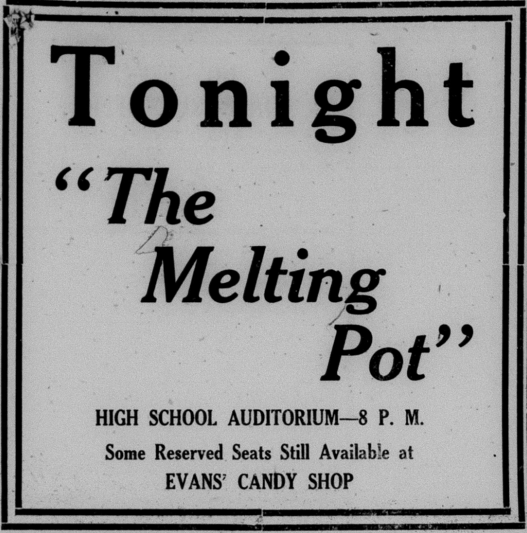
Local theatrical and musical productions also drew crowds to the High School Auditorium.
Fashion
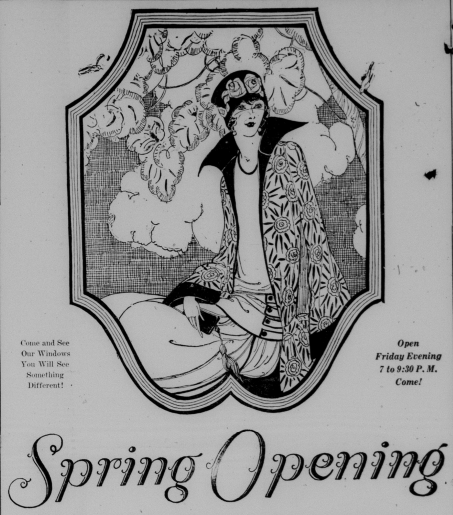
The 1920s were an interesting time for fashion. Here are a few clippings that show popular styles of 1924, which Fullertonians could get by shopping at stores in the growing downtown:


Sports
By far, the biggest local sporting event was a fundraising game featuring baseball legends Walter Johnson (who went to Fullerton High School), Babe Ruth, and other big-league players which drew around 15,000 spectators.

Local athlete Glenn Hartnraft placed second in the shot put at the 1924 Summer Olympics in Paris.

Miscellaneous
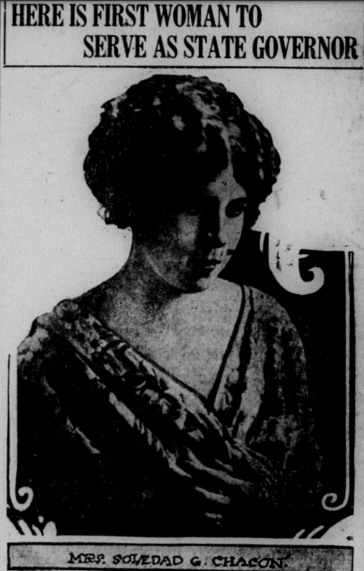
And here are some miscellaneous news items from 1924:




Deaths
Prominent local businessman E.K. Benchley passed away. Click HERE to read more about the Benchley family.

Local pioneer Stella Yaeger, mother of Fullerton auto dealer Lillian Yaeger, passed away. Yaeger was born in Anaheim in 1861. Her parents were German immigrants who joined the Anaheim colony. Her father, a Mr. Kuelp, started the first school in Anaheim and was the first justice of the peace there. Stella married to Jacob Yaeger of Anaheim in 1883. Later they moved to Fullerton and lived in a house on the present site of the California Hotel (now the Villa Del Sol).

Stay tuned for news stories from 1925!
 Fullerton History