The following is from a work-in-progress about the history of Fullerton. You can support my ongoing research and writing on Patreon.
The Local History Room of the Fullerton Public Library has microfilm from the Fullerton Tribune newspaper (which became the Orange County Tribune in 1908) stretching back to 1893. I am in the process of reading over the microfilm, year by year, to get a sense of what was happening in the town over the years, and creating a mini archive. Below are some news stories from 1919.
Housing
Fullerton’s population was growing, and there was a housing shortage, so there was much new construction. The 1920s would bring a big housing boom to Fullerton. The Board of Trade established a “housing fund” to finance construction of new housing.
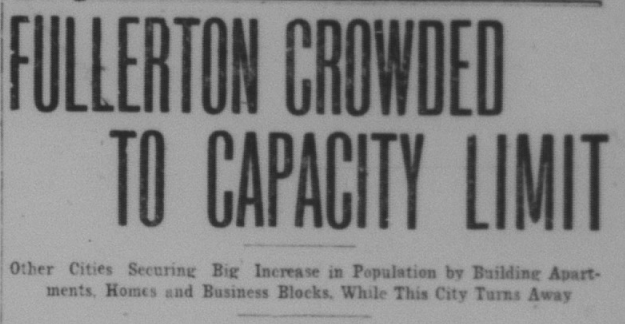

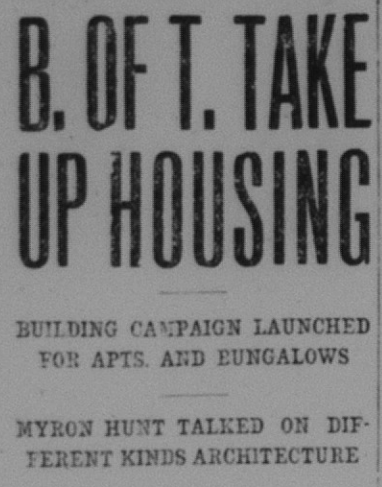
“The Housing proposition is the most important problem which confronts the city today. We not only need good houses but we need business blocks, as people who desire to engage in business here are turned away every day,” the Tribune reported.

Realtors R.S. Gregory and George A. Ruddock announced the opening of a new subdivision on six acres of walnuts and Valencias on the 200 block of West Whiting, next to downtown. Many of these houses still exit.
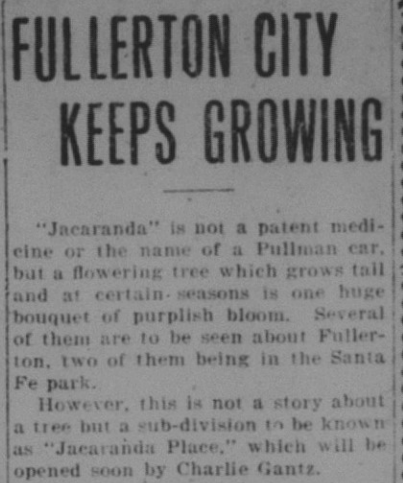
Another new subdivision was Jacaranda Pl., developed by Charlie Gantz. Many of these homes still stand today as well.
New Construction
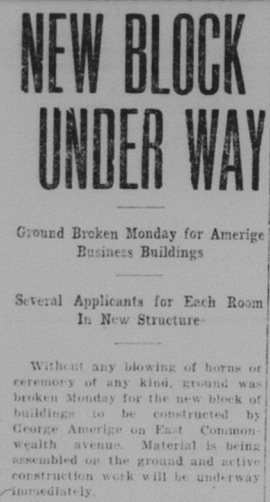
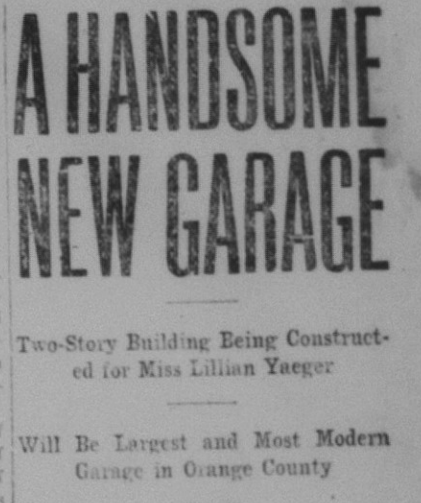
New construction downtown featured apartments and a bungalow court, plans for a new Masonic Temple, a new business block, and a new garage for Fullerton’s pioneering auto dealer Lillian Yeager.


Racism
While Fullerton was building new housing and businesses for its white residents, there was vocal opposition for the construction of housing for Mexican Americans.

“The first thunderbolt was in the form of a petition from 117 prominent citizens headed by former trustee August Hiltscher and backed up by William French, former city marshal and now justice of the peace and newly appointed city recorder. This petition was a protest to the building of a concrete structure by the Santa Fe at Highland and Santa Fe avenues for the housing of its Mexican employees,” the Tribune reports. “The petitioners asked if it would not be possible to prevent the erection at that point or at least the housing of the Mexican element in that locality. The matter was discussed from every angle but there seemed to be no relief from a legal standpoint, and finally a resolution was adopted by the board asking the company to abandon that site and erect its building near its section houses, and City Attorney Allen was delegated to present the resolution in person to Superintendent Hitchcock at San Bernardino. Mr. Allen left for San Bernardino this morning to carry out the mission.”
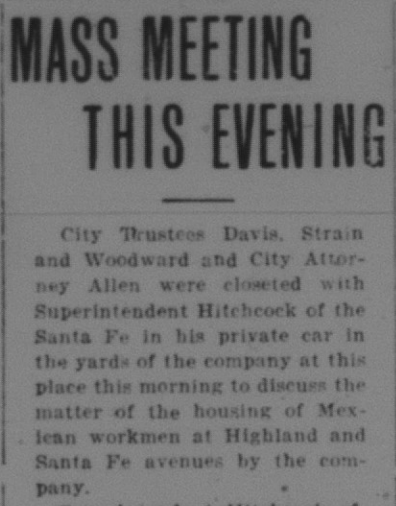
“City Trustees Davis, Strain, and Woodward and City Attorney Allen were closeted with Superintendent Hitchcock of Hitchcock of the Santa Fe in his private car in the yards of the company at this place this morning to discuss the matter of the housing of Mexican workers at Highland and Santa Fe avenues by the company,” the Tribune reported. “A mass meeting has been called for this evening at the city hall for taking action.”

Utlimately, the Santa Fe Railroad won, and got the housing built, much to the consternation of Fullerton residents, many of whom showed up at a “mass meeting” to protest the construction.
“The Santa Fe Railroad Company will continue its work and complete its building at the corner of Highland and Santa Fe avenues for the housing of its Mexican employees and will house them right there,” the Tribune reported. “This bald assertion is made because the mass meeting at the city hall Thursday evening to take steps to avert the menace simply went up in smoke, and went sky high. The council chambers was filled to the doors with property owners, principally from the “infected” district, and they talked and talked and talked, but never got anywhere.”
One of the protestants was heard to say, “Well, we don’t like it, but we’ve got to take it.”
Anti-Asian Sentiment
In other racism news, there was a statewide movement to prevent Japanese immigrants from living among whites and owning property.
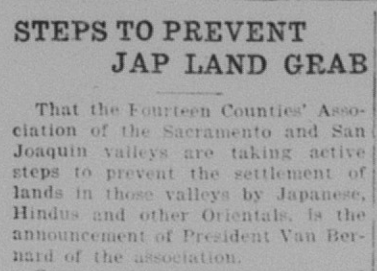
“That the Fourteen Counties’ Association of the Sacramento and San Joaquin Valleys are taking active steps to prevent the settlement of lands in those valleys by Japanese, Hindus, and other Orientals, is the announcement of President Van Bernard of the association,” the Tribune reported.
“Orange County should take similar steps to protect the lands of this county,” is the declaration of Garden Grove ranchers.
President Van Bernard issued the following statement at Sacramento:
“With the crystallized sentiment throughout California that the citizens of this state should encourage only such newcomers in their midst as they would permit to associate with their wives, daughters, and sons, we are prepared to make a fight to the finish against the present system of leasing lands to Orientals.
“There are Japanese babies in this state owning farms paid for with money earned by their mothers and fathers working 18 hours a day, and living according to a standard which means extinction for the white race. The blight is menacing, indeed. I will say that if in the struggle for existence the fittest to survive are those who can live in the most primitive surroundings, then the Japanese are the fittest to survive.
“We must have means to abrogate this state of affairs. If Orientals are within the law in acquiring land in this manner, we must change the law. Else the future of this state will resemble the Hawaiian Islands in their change from a fairly American community to one in which the Japanese have an immensely dominant interest, and where Buddhist temples out-number Christian churches.
“In making these remarks I am not, instigated by prejudice against Orientals. My contention is that the Oriental and the Caucasian are so absolutely opposed in every viewpoint and outlook of life that they cannot live harmoniously in close association or even on contiguous land.”

“Dangers which confront the residents of Orange County, such as forest fires and the Japanese question, were the principal features which were brought up and discussed by the Association of Commerce of Orange County at its regular monthly meeting, which was held at the…Round Table Women’s club house at Placentia Wednesday night,” the Tribune reported.
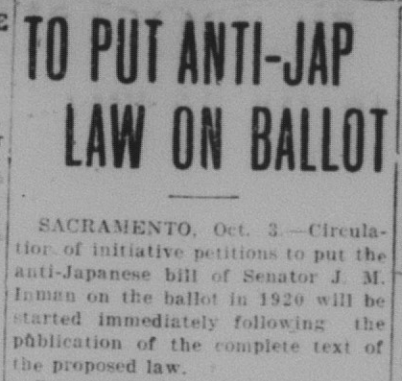
“Circulation of initiative petitions to put the anti-Japanese bill of Senator J.M. Inman on the ballot in 1920 will be started immediately following the publication of the complete text of the proposed law,” the Tribune reported. “Senator Inman who is president of the State Anti-Japanese association which will circulate the petitions, stated that the nine sections of the law will positively prohibit Japanese or other aliens ineligible to citizenship from owning or leasing agricultural land in California.”
These movements led to the passage of California’s Alien Land laws, which prevented many Asian immigrants from owning land in California.
The pages of the Tribune are filled with anti-Asian sentiment and racial slurs:


Race Riots
Anti-immigrant sentiment and racism was a growing problem throughout the United States, culminating in a series of actual race riots in cities across America. This became known as the “Red Summer.”
According to Wikipedia, “Red Summer was a period in mid-1919 during which white supremacist terrorism and racial riots occurred in more than three dozen cities across the United States, and in one rural county in Arkansas. The term “Red Summer” was coined by civil rights activist and author James Weldon Johnson, who had been employed as a field secretary by the National Association for the Advancement of Colored People (NAACP) since 1916. In 1919, he organized peaceful protests against the racial violence.”
The Tribune reported on these race riots.


Labor Strikes
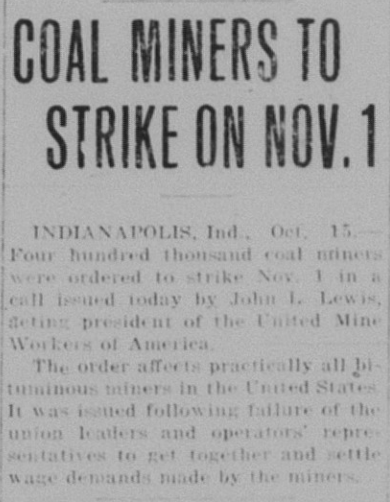
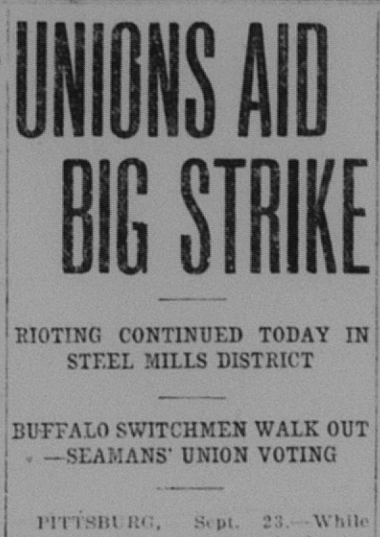
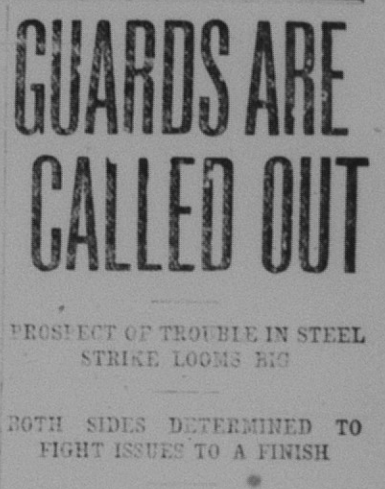
Adding to the racial unrest across the United States, there were many labor strikes, many of which turned violent.


Americanization

A popular movement seeking to prevent both racial and labor strife was called “Americanization” in which employers provided education to “Americanize” its foreign-born immigrant workforce. In contrast to today’s appreciation for diversity and cultural and linguistic difference, the Americanization movement sought to mold different ethnic identities into English-speaking Americans.

The Fourth District Congress of Mothers and parent-Teachers’ Associations met in all day conference in Santa Ana and a prominent theme was the “Americanization” of the foreign-born.
“Where no English is spoken disease breeds, because the immigrant cannot read the suggestions of the Board of Health. The I.W.W. [Industrial Workers of the World] breeds where no English is spoken,” the Tribune reported. “The country is awake to the danger of the alien population, and “Americanizing” must become the great national movement.”
Locally, citrus growers, in collaboration with educational leaders, established special schools in “Americanization” for their predominantly Mexican workforce.
Read more about Fullerton’s Americanization program HERE.
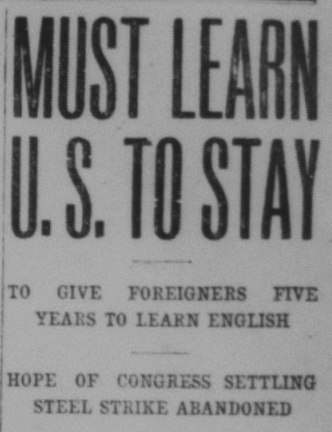
At the national level there was discussion of actually deporting immigrants who did not speak English.
“Deportation of immigrants after five years residence in the United States unless they learn to speak and read English will be considered by the Senate labor committee, following its investigation of the steel strike, Chairman Kenyon announced on his return from Pittsburg,” the Tribune reported. “Senators on the investigating committee declared Americanization of foreign-born persons must be undertaken at once if grave industrial trouble is to be averted.”
Infrastructure
As the population increased, there were movements locally and across the state to expand and improve infrastructure.
A massive bond was passed by voters to create Newport Harbor.

The national “Good Roads” movement led to the expenditure of much public funds for more and better roads, including a state highway from San Diego to San Francisco.


Transportation
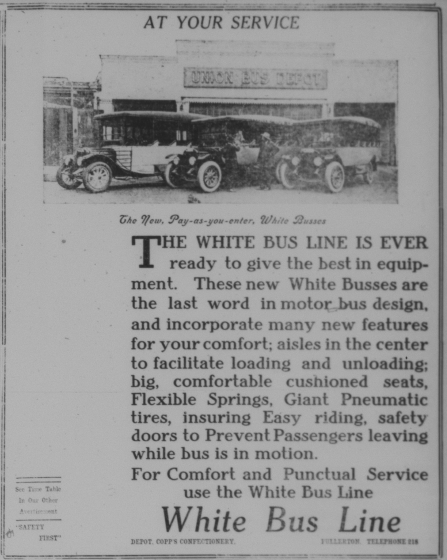
In transportation news, a new Bus Service was established that provided transportation to Fullertonians.
Oil!
In 1919, Fullerton’s two biggest industries were oranges and oil. Nearly every issue of the Tribune included articles about new wells and big gushers coming in the local fields.
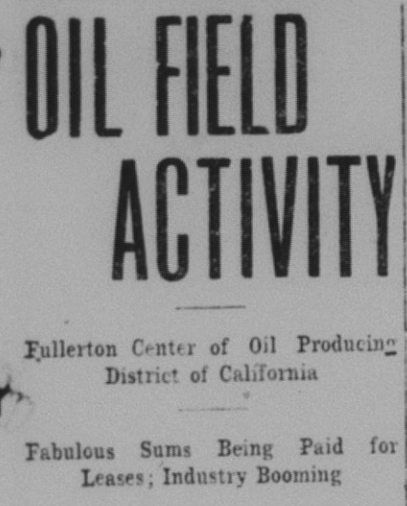
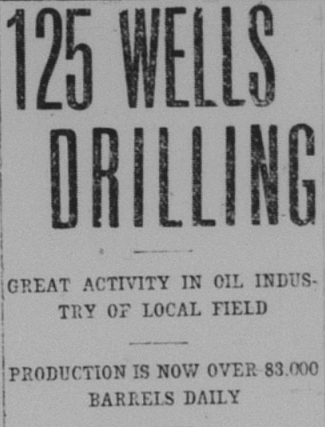
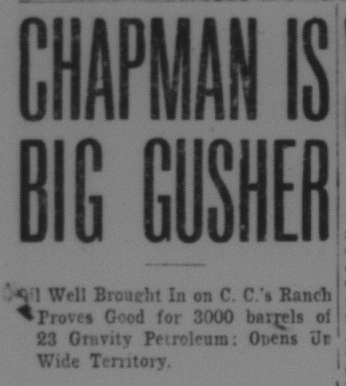
The oil industry provided an excellent source of taxes for schools and other public amenities in town. However, Standard Oil protested their tax burden for local schools.

Perhaps a part of the widespread labor unrest, some oil wells were bombed in the Fullerton fields.

“Believing that they have in custody one of the perpetrators of the recent bomb outrages in the Fullerton oil fields the police today detained a man describing himself as Antone-Kratchel, aged 35, an Austrian, who was arrested at First and Gless streets by Patrolmen H.R. Boehm and J.Y. Walton,” the Tribune reported.
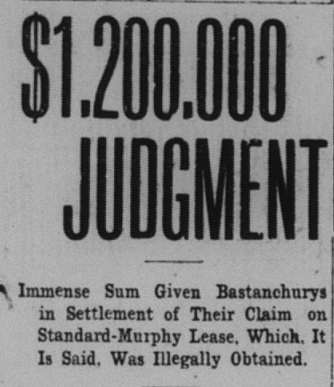
The Bastanchury family won a large $1,200,000 judgment against the Murphy Oil company, which had defrauded them out oil profits.
Culture and Society
Local culture and society took a few forms in 1919. For entertainment, folks would go see movies or vaudeville shows at the Rialto Theater.
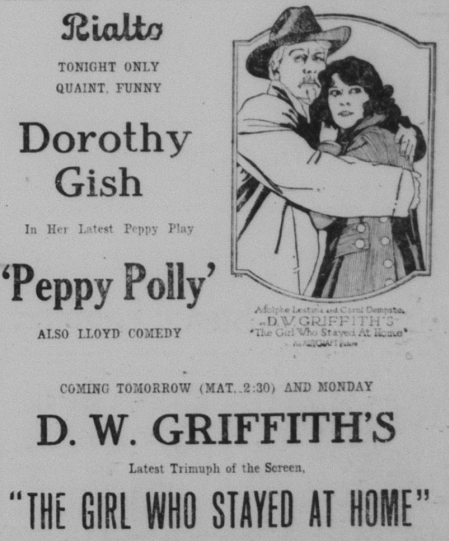
Another form of culture was the traveling Chautaqua show, which was kind of like a high-brow circus.


Crime
Here are some local crime stories:
The Des Granges daughters (Helen and Getrude) accuse dad (John) of defrauding them of land left to them by their late mother (Harriet).


Prohibition
Prohibition was a popular issue, both locally and nationally, in 1919. The US Senate had passed the 18th Amendment in 1917, but it would not be ratified by a majority of the states until 1919, and national prohibition did not take effect until 1920, with the passage of the Volstead Act. Prior to that the Wartime Prohibition Act took effect in 1919, which banned the sale of beverages having an alcohol content of greater than 1.28%.

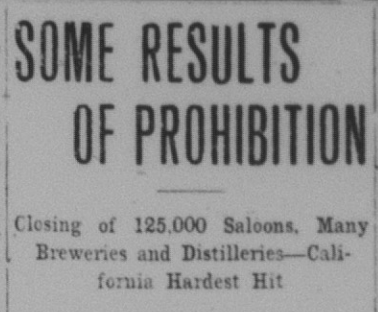
Both locally and nationally, the Women’s Christian Temperance Union had been an active proponent of Prohibition for many years.

International News
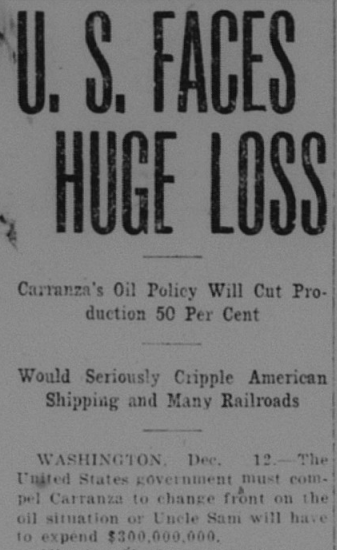
In international news, World War I was over, but the United States was seriously considering war with Mexico due to the destabilizing effects of the Mexican Revolution, president Carranza’s movement to confiscate oil lands owned by U.S. companies in Mexico, and the kidnapping of American industrialist William O. Jenkins by Mexican Revolutionary forces.

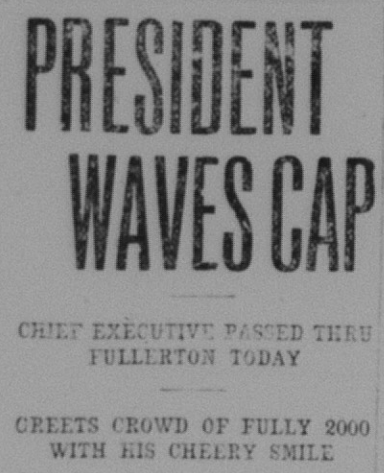
President Passes Through Town
Many Fullertonians gathered to watch president Woodrow Wilson’s train pass through town.
Stay tuned for news stories from 1920!
 Fullerton History