The following is from a work-in-progress about the history of Fullerton. You can support my ongoing research and writing on Patreon.
The Local History Room of the Fullerton Public Library has microfilm from the Fullerton Tribune newspaper (which became the Orange County Tribune in 1908) stretching back to 1893. I am in the process of reading over the microfilm, year by year, to get a sense of what was happening in the town over the years, and creating a mini archive. Below are some news stories from 1918.
Goodbye, Old St. George Hotel

The Shay Hotel, originally called the St. George Hotel, was one of the first buildings in town at the corner of Spadra (Harbor) and Commonwealth. Sadly, in 1918, it was torn down.
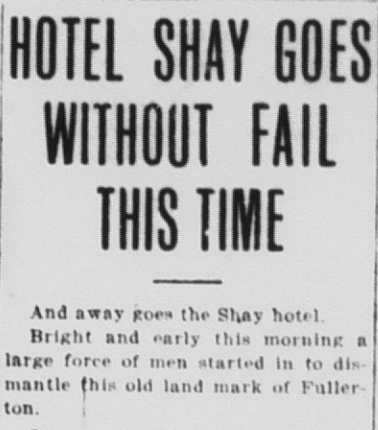
“Bright and early this morning a large force of men started in to dismantle this old land mark of Fullerton,” the above article states. “George Amerige, the proprietor, has sold the building to the Whiting Wrecking Company of Los Angeles for wrecking purposes and the work of razing the old structure has started. Big signs with white background and black lettering have been plastered all over the exterior of the building which read “Watch It Go.”
The Bastanchury Lawsuit
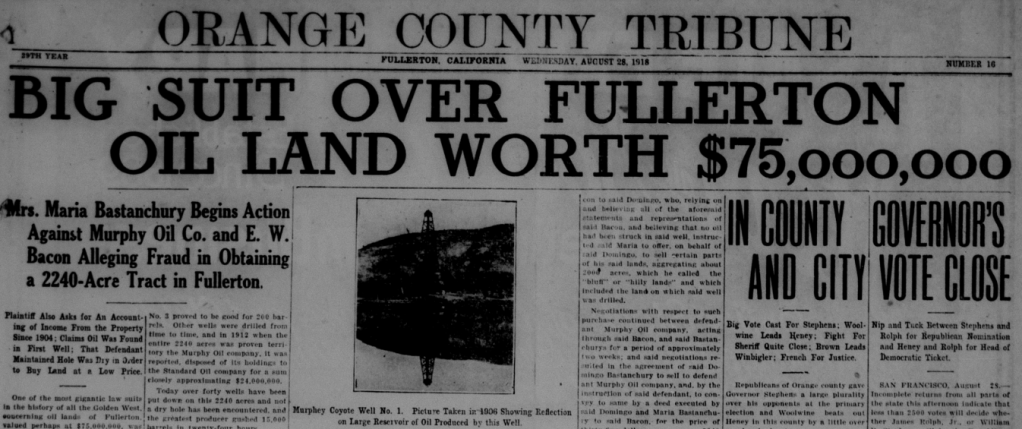
The pioneering Bastanchury family sued the Murphy Oil company for defrauding them of millions of oil dollars.
Back in 1903, Simon J. Murphy secured a lease of a couple thousand acres to search for oil. He told Domingo Bastanchury that he found no oil, and yet still convinced the old man to sell him the land for $35 an acre. He paid Bastanchury $79,000 for the land.
About a month after purchasing the land, the newly-formed Murphy Oil Company sunk a well that was a 3,000-barrel a day gusher. Many other oil-producing wells were subsequently sunk on the land.
In 1912, the Murphy Oil Company sold its oil holdings to the Standard Oil Company for around $24,000,000.
Meanwhile, Domingo Bastanchury died, and his lands fell to his widow and sons.
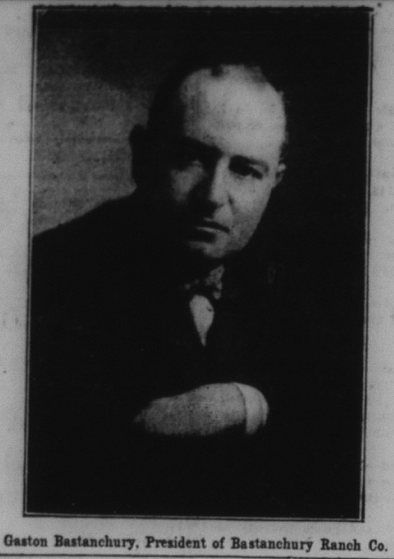
In 1917, former workers of Murphy Oil told Domingo’s son Gaston that they had actually discovered oil prior to the purchase of the land, and Murphy lied to Domingo about this fact.
The Bastanchury heirs sued Murphy for recovery of funds from the millions of barrels of oil that had been extracted over the past fourteen years, alleging that the property was obtained by fraud.
The “Spanish” Flu Epidemic
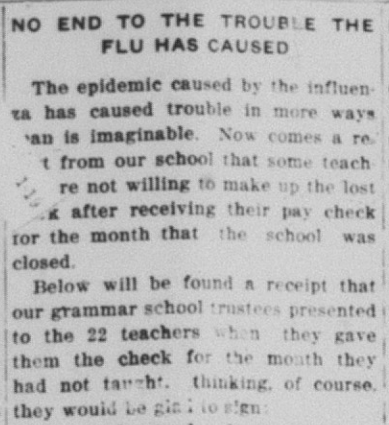
In 1918, a deadly flu epidemic spread across the world, including the United States. Though it likely did not actually originate in Spain, it became known as the Spanish Flu. Hospitals were filled to capacity, and lots of people died, including here in Fullerton.




Just as during the COVID-19 pandemic, mask-wearing was encouraged.
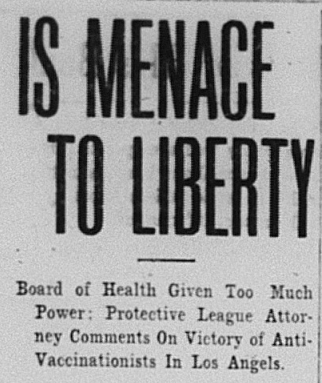
Also, just like during the COVID-19 pandemic, people feared that enforced vaccinations were “a menace to liberty.”
The above article, which is actually about smallpox vaccination, but presumably also included influenza vaccination, states, “Marshall Stimson, attorney for the Public School Protective League, in a statement commenting on the victory of opponents to enforced vaccination in Judge Wellborn’s court in Los Angeles, asserted that the proceedings showed that the tendency of boards of health to arrogate more and more power was constituting a serious menace to individual liberty.”
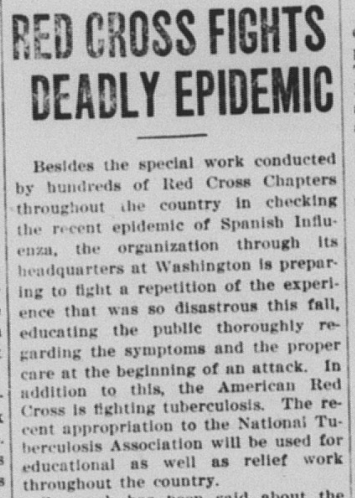
World War I
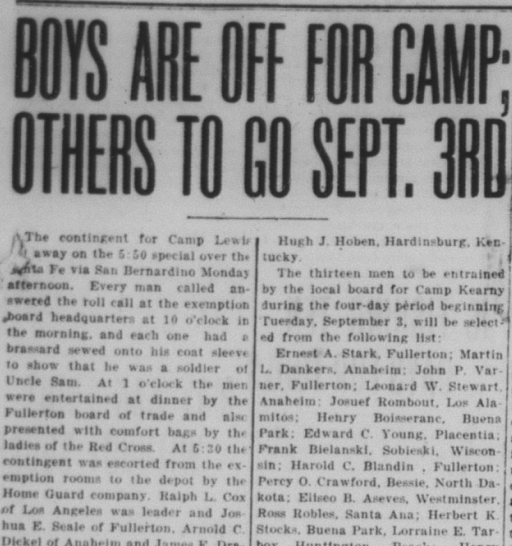
Meanwhile, World War I raged in Europe. Many local boys had been drafted, sent off to training camp, and then to war.
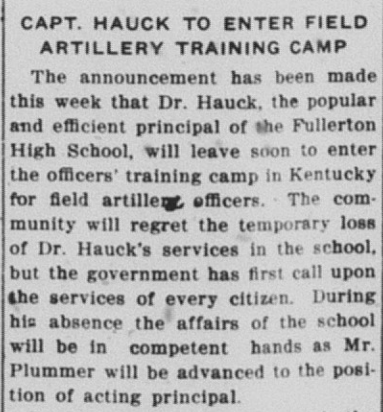
High School principal E.W. Hauck enlisted, or was drafted.

Hunting Draft Dodgers
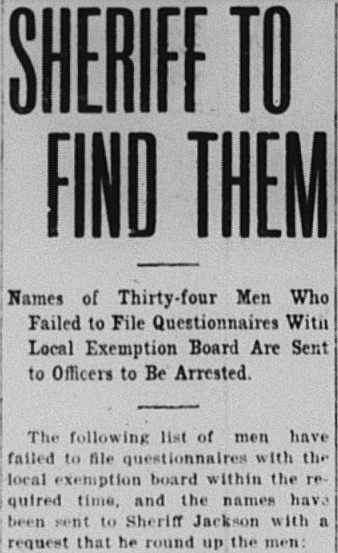
Draft dodgers were shamed in the pages of the Tribune, and were hunted and arrested by law enforcement.

Germans in America Must Register
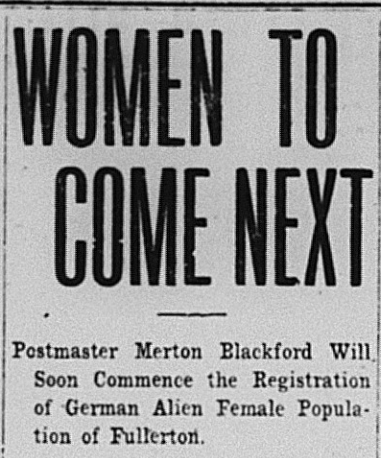
Unnaturalized Germans over the age of 14 living in the United States had to register with the postmaster.
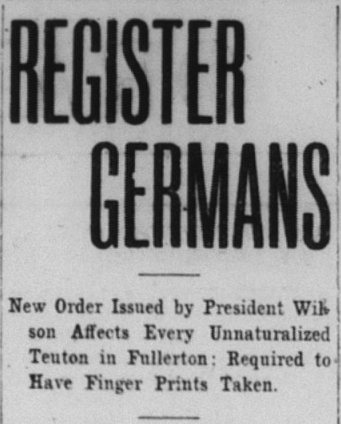
“The order coming from President Wilson, affects every unnaturalized German in the United States and a number in this city will be affected by the order,” the above article states. “The order requires every German citizen to make our four affidavits setting forth his age, residence business, friends, habits, and many other important subjects…After once being registered the German may not move from his place of residence without the approval of the postmaster, who will record the new residence. The finger prints of each man will be taken by the police and kept as a part of the identification. In cities more than 5,000 the chief of police will be required to register the Germans.”
Propaganda Posters/Ads
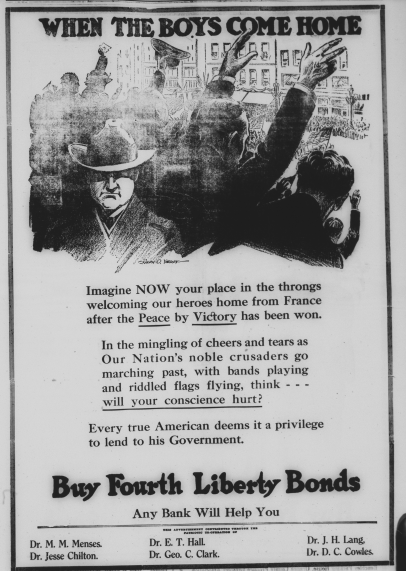
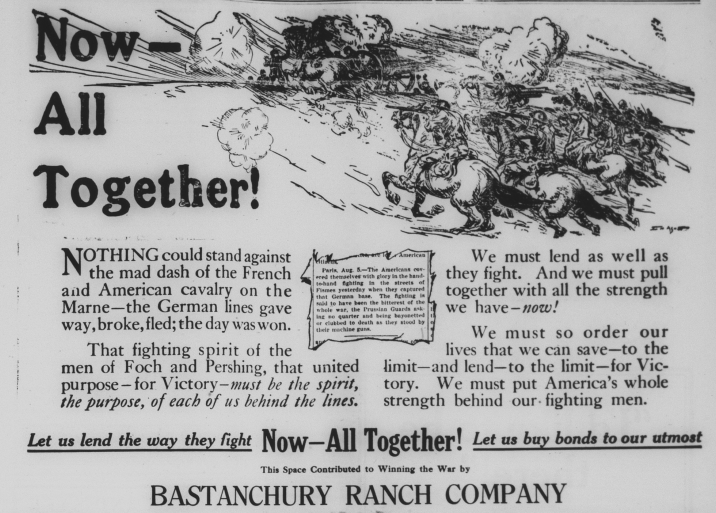
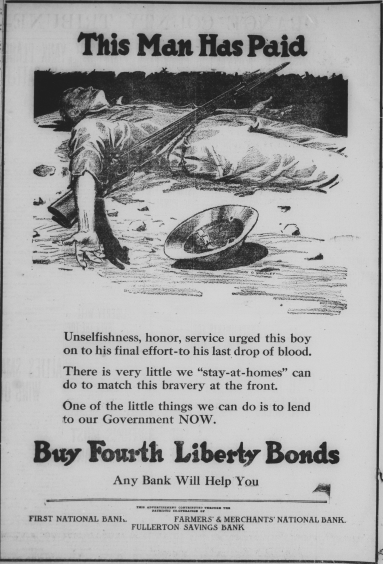
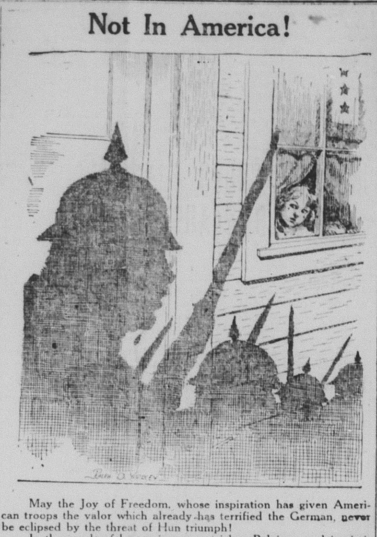
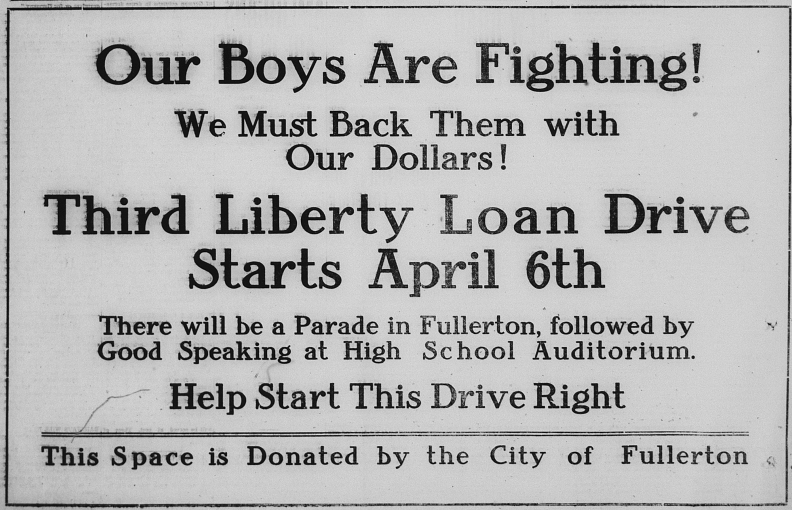
The pages of both Fullerton newspapers, the Tribune and the News included large propaganda advertisements for Liberty loans and bonds. Here are some of them:







Liberty Day
Fullerton celebrated Liberty Day.

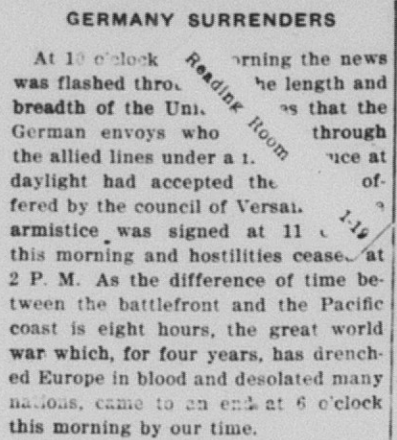
Germany Surrenders
Finally, Germany surrendered, essentially ending the war. This event, it seems, deserved a bigger headline.
Transportation
In transportation news, the Pacific Electric passenger rail service began in Fullerton.

In the first half of the 20th century, it was an open question whether southern California would be a rail-based or car-based culture. Ultimately, cars won. The Pacific Electric would be dismantled in the 1950s.

Politics
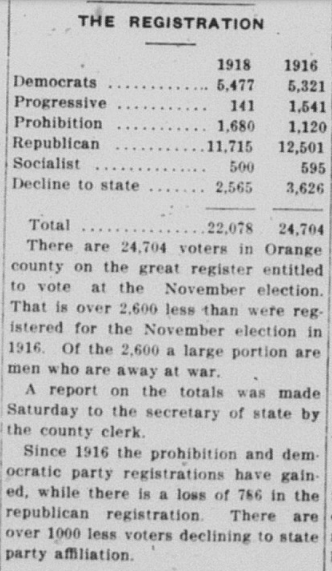
Voter registration numbers showed that Orange County in 1918 was a predominantly Republican region. It would remain so until around 2018.
In the 1918 city council election, R.R. Davis, Robert Strain, and Perry Woodward won.

Tribune editor Edgar Johnson criticized the low voter turnout.
“Out of a total of over 1,260 electors only 425 managed to saunter to the polls of the three city precincts and cast ballots for the men who will govern the city for the next two years,” Johnson wrote. “This indicates that there was precious little interest in the election by some 825 electors.”

Mayor Carhart was chosen to serve another term as mayor, although he didn’t really want to. The process of mayoral rotation continues to be a problematic one today.
“Mayor Carhart has been selected to again be president of the board of city trustees for a term of two years, notwithstanding the fact that he insisted that the honors should be passed around among the members,” the Tribune stated. “He claims it has been the custom in Fullerton to change every two years; but that had no weight with the new board and there being no other nominations, City Clerk Hezmelhach out the question, and Mayor Carhart was declared the unanimous choice for the highest office in the gift of the city.”

At the state level, voters defeated Proposition 19, which had something to do with property taxes. Don’t fuck with Californians’ property taxes.
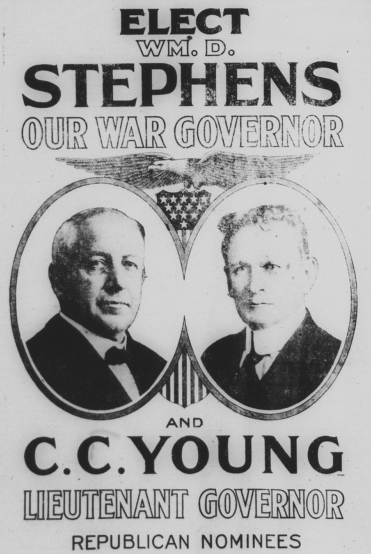
William D. Stephens was re-elected as Governor.
Citrus News
With some wartime labor shortages, there were special provisions to bring in Mexican farm labor, but not Chinese Labor, which Californians were not keen on.

“Last year Mexicans were brought here to help in the sugar beet harvest. This was done through a resolution of congress allowing the immigration department to make that kind of an importation, and in the regulations those bringing in the Mexicans were under bond to return them to the border,” the above article states. “This does not apply to Chinese labor. It is my firm opinion that efforts to get the bars lowered so that Chinese can come in will not be successful. Whatever the qualifications of the Chinese as a laborer may be, I don’t believe there is any possibility of getting congress to alow the Chinese to be brought in even temporarily.”
Local orange tycoon Charles C. Chapman urged his fellow citrus men to oppose “free trade” in favor of protectionist tariffs. Milton Friedman would be sad.

Entertainment
For entertainment, Fullertonians went to the Rialto Theater at 219 N. Spadra (now Harbor). This was Fullerton’s premier movie house before the Fox, which would come in 1925.

The Tribune ran ads for features shown at the Rialto. Here are some:

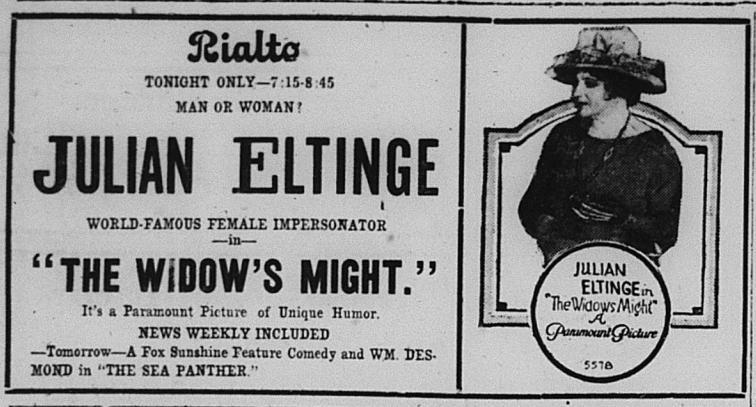
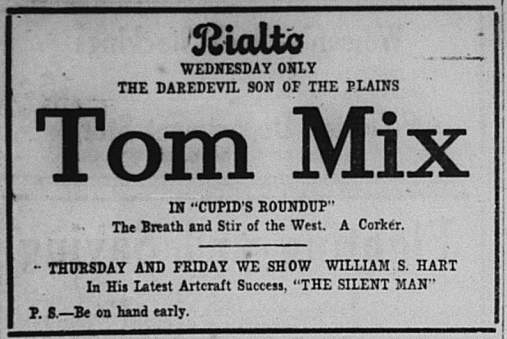

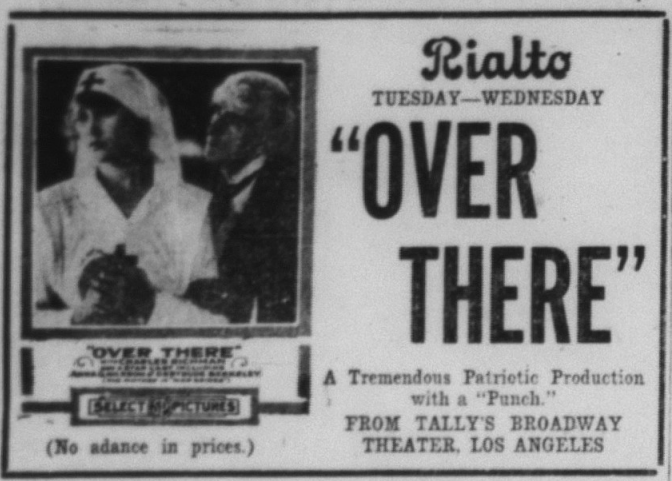
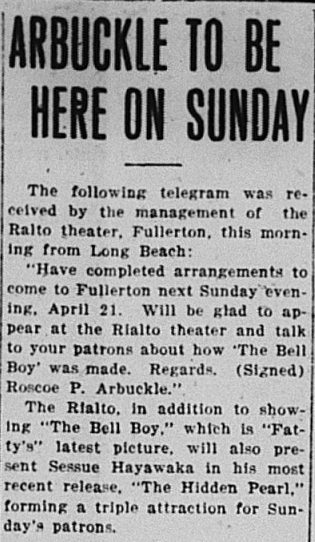
Popular entertainer Roscoe “Fatty” Arbuckle made a special appearence at The Rialto.
Another form of popular entertainment at this time was the traveling Chautauqua show, which came through town.

Law and Order
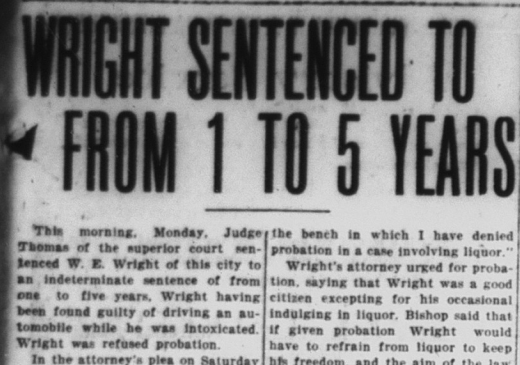
In crime news, a local man named W. E. Wright drunkenly drove his car through a patriotic event, injuring four people. He was found guilty and sentenced to from 1 to 5 years.

In hate crime news, someone threw a rock at the Japanese Consul.

Prohibition
The first salvo in what would become national prohibition was fired in 1919.

Death
A man named Charles E. Vogele committed suicide in the back of his home at 214 W. Wilshire Ave. Perhaps this residence could be a new addition to the Fullerton Haunted Walking Tours.

 Fullerton History
Leave a comment