The following is from a work-in-progress about the history of Fullerton. You can support my ongoing research and writing on Patreon.
Juanita Hawkins was interviewed in 1973 by Kamila Hardy for the CSUF Oral History Program. Here are some things I learned from her recollections about her family and Fullerton:
Hawkins (whose maiden name was Frazee) moved to Fullerton from Kansas with her family in 1920, for her father’s health. Her parents were Myrtle and George Frazee. Her sister was Mary Louise and her brother was Dick Frazee. They first lived on the corner of Pomona and East Truslow, and then to 141 West Wilshire, where the Wilshire Promenade apartments are today.
According to Hawkins, “things were booming” at the time. This was the second big boom in Southern California–the first being in the 1880s, the second in the 1920s, and the third after World War II.
Her father was a plumber and then he went into contracting and did lots of work because there were many homes being built at that time.
She remembers that some of her neighbors at the time were Black, including “a Negro lady named Lollie Smith,” and the Roscoe family, who owned a livery stable in town. This is fascinating because I was under the impression that Blacks and Mexicans were not allowed to purchase or rent homes “north of the tracks” until civil rights laws passed, decades later. It seems that there were exceptions to this pattern, as shown by Hawkins’ childhood neighbors around Wilshire and Malden in the 1920s.
Although they lived basically downtown, it was still “predominantly orange groves all around us and walnut trees.”
In 1924, the family moved to around what is now the 800 block of West Commonwealth.

Hawkins was eight when she came to California, in the fourth grade. She remembers the old red brick school house on the corner of East Wilshire and Lemon.
She married her husband Jim Hawkins in 1931. They moved around a lot in the early years of their marriage, mainly for financial reasons (it was the Great Depression).
They lived for a a while on a farm on Ball Road in Anaheim, where they raised the pigs, turkeys, and chickens. One notable thing about this property was that it contained the original boysenberry plants that Rudy Boysen and Walter Knott created for Knott’s Berry Farm.
During World War II, Jim worked in shipyards and the family moved into the family house on Commonwealth.
In 1954, the family moved to Buena Vista Drive, near the Muckenthaler mansion.
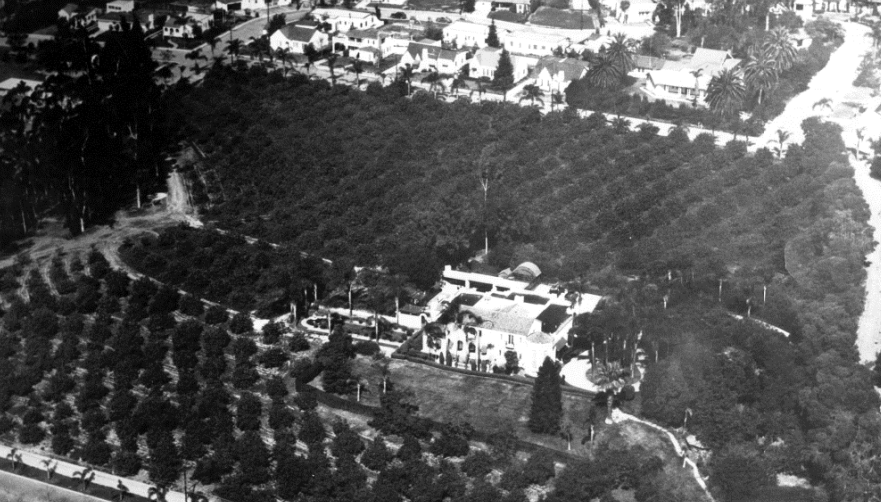
“The Muckenthalers got their money from oranges, because they owned that whole area up in there at one time,” Hawkins recalls. “They owned as far down as where the Lucky Market [now Stater Bros.] is on the corner of Euclid and Chapman Avenue.”
She remembers the 1933 earthquake.
“I heard this grumbling, it sounded like a whole fleet of trucks, heavy heavy trucks and the ground tremering just a little bit, and I could hear this dog howling and then just all of a sudden it was waves, besides the shakes, it was just actual like walking over waves,” she said.
She also remembers the 1938 flood. At the time, they were living on Ball Road in Anaheim.
“I looked out the window of the front door and the water had raised from the street level up to the second step of the porch and we had five steps up to our house,” she said. “It was just like a raging river. Our chickens and our turkeys, the ones that couldn’t fly up, and our poor old cow she came floating along and finally her rope hooked on to something and she was standing there with her head up trying to keep her head out of water…All of Anaheim was under water. People were on their roofs.”
After the war, Jim worked for Union Oil. Juanita worked for a glass company.
Juanita and Jim’s first four children died either in infancy or early childhood. They then adopted a boy named Norman who lived into adulthood. They had one daughter, Judy, who lived into adulthood.
 Fullerton History
Leave a comment