The following is from a work-in-progress about the history of Fullerton. You can support my ongoing research and writing on Patreon.
The Local History Room of the Fullerton Public Library has microfilm from the Fullerton Tribune newspaper stretching back to 1893. I am in the process of reading over the microfilm, year by year, to get a sense of what was happening in the town over the years, and creating a mini archive. Below are some news stories from 1914.
Fullerton’s population was growing fast, reaching 4,000 people.

Education
Enrollment at Fullerton Union High School was 243 pupils.

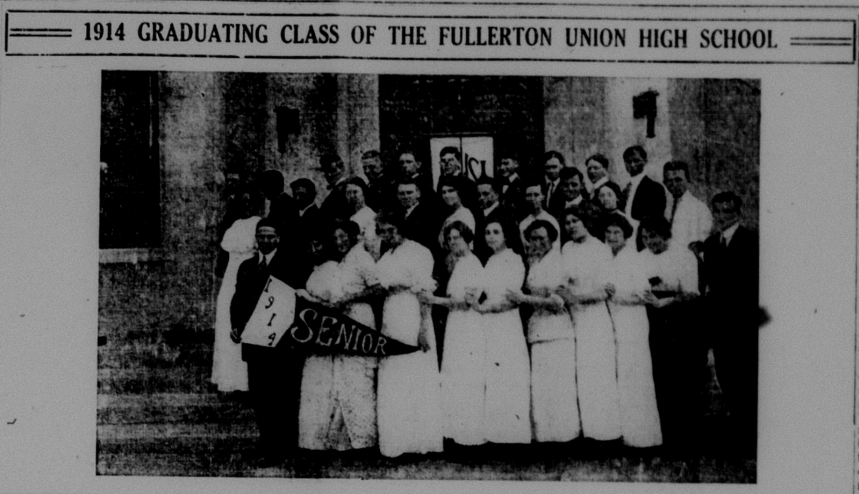
Here’s a photo of the 1914 high school graduating class:
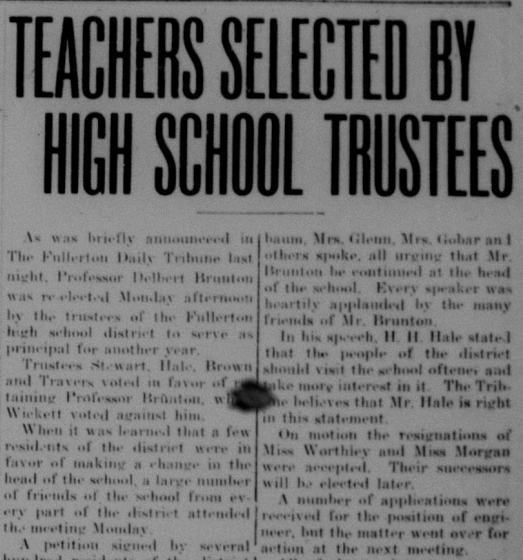
In 1914, the principal of FUHS was Delbert Brunton, and teachers were chosen by the Board of Trustees.
A new grammar school was built.

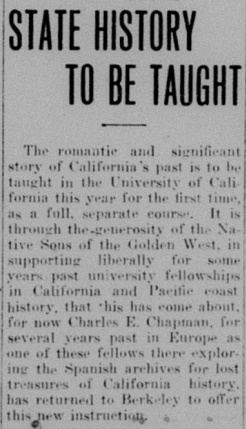
For the first time, in 1914, California history was taught at a university.
Government and Politics
George Anin, R.S. Gregory, August Hiltscher, and E. Livingstone were elected to the City Board of Trustees (now called City Council).
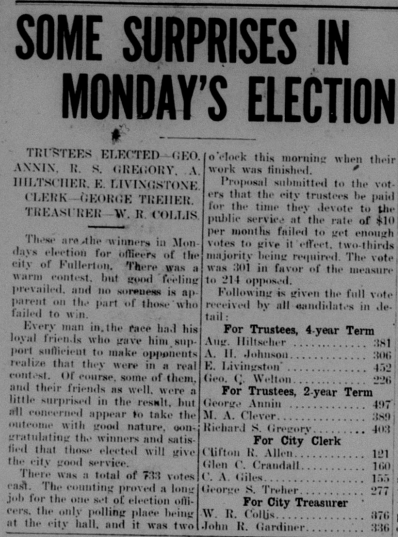
Gregory, a local real estate broker, was chosen as Chairman of the Board (Mayor).

Charles C. Chapman, orange rancher and Fullerton’s first mayor, considered running for governor. He did not ultimately run.

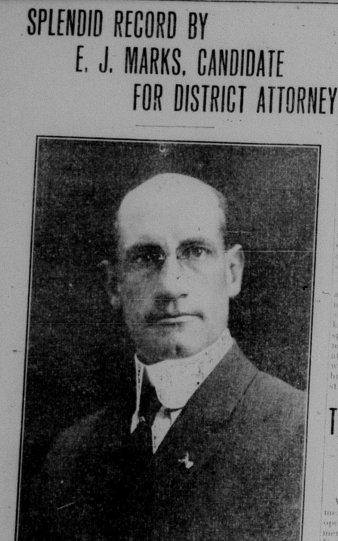
Fullerton City Attorney E.J. Marks ran for Orange County District Attorney.
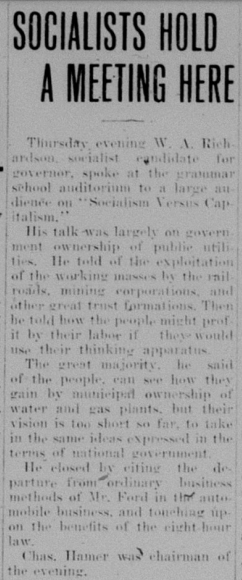
In the early 20th century, there was a small but active Socialist Party in California. They sometimes held meetings in Fullerton. They were in favor of government ownership of utilities, the 8-hour work day, and other reforms.
Progressive Governor Hiram Johnson made a stop in Fullerton, running for re-election. He was introduced by high school principal Delbert Brunton, and gave a speech about progressive reforms created under his administration.
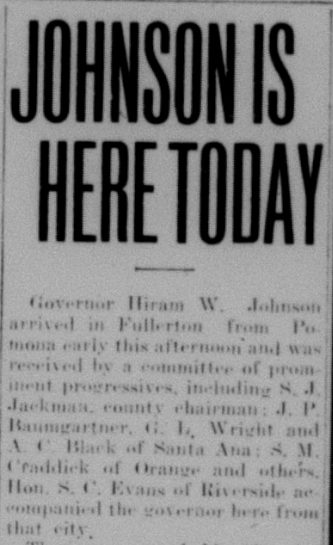
“When we assumed control in 1911,” Johnson said, “the S.P. [Southern Pacific railroad] company regulated the state; now, the state regulates the company…We have been endeavoring during these four years to provide the weapons with which the electorate may defend itself in case the corporations should ever again get control of state affairs. You have these weapons in the initiative and referendum…I say to you that government has a higher purpose than to make men richer. Its chief concern should be the social welfare–to place in the system of laws the hearts and conscience of the people…The reduction in rates for freight, electricity and phone service made by the railroad commission during this administration will mean a saving of over $7,000,000 per year to patrons of these public utilities. In view of these figures, I ask you, does it pay to own your own government?”
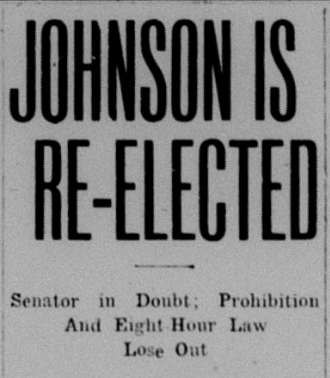
Johnson was re-elected governor.
Deaths
Jose Antonio Yorba, a descendant of the pioneering Yorba family of Orange County, passed away.

The local funeral home was McAulay and Copp, located at 103 South Spadra (Harbor Blvd.)

Loma Vista Memorial Park, Fullerton’s first cemetery was established. It remains Fullerton’s only cemetery, and many early pioneers are buried there.

B.G. Balcom, pioneering Fullerton banker, died. Balcom Avenue is named after him.

Arts & Entertainment
Before the Fox was built in 1925, Fullerton’s first movie theater was called the Fullerton Theater, and later the Rialto Theater. It was located at 219 N. Spadra (Harbor Blvd). The proprietor was R.A. Speicher. Here are some ads for shows at the theater:
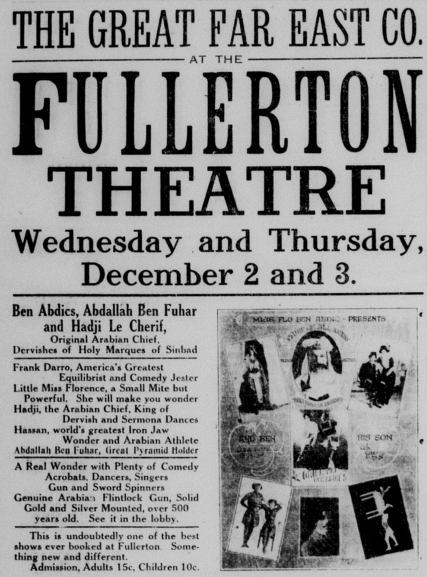
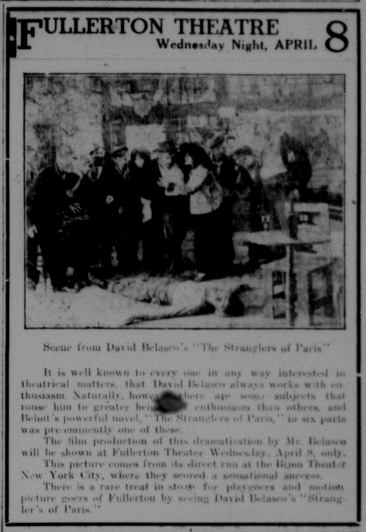
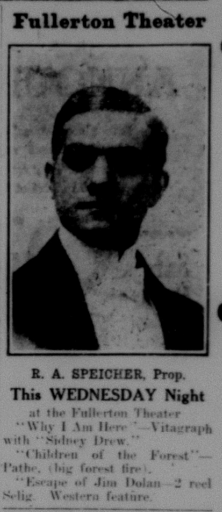

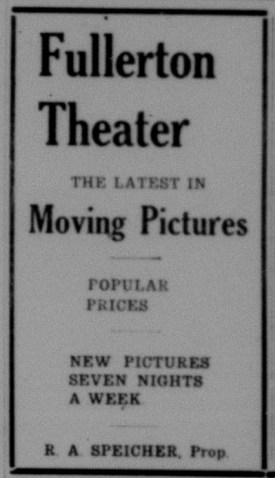
Another big attraction was Helen Keller, who “spoke” at the High School Auditorium through her helper Mrs. Macy.


Labor
There was a proposition on the 1914 ballot (evidently put there by socialists) to establish an 8-hour work day. It’s something we take for granted today, but it was a radical idea back then. It was opposed by powerful business interests, and ultimately failed to pass.
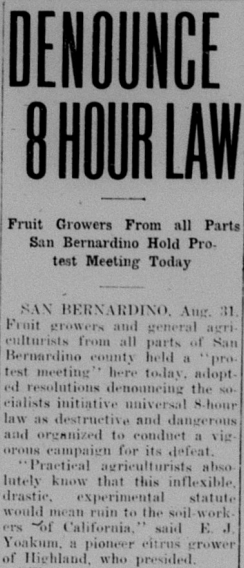
Here is a difficult to read political cartoon denouncing the 8-hour law as “the Socialist plan for California agriculture.”

Oil!
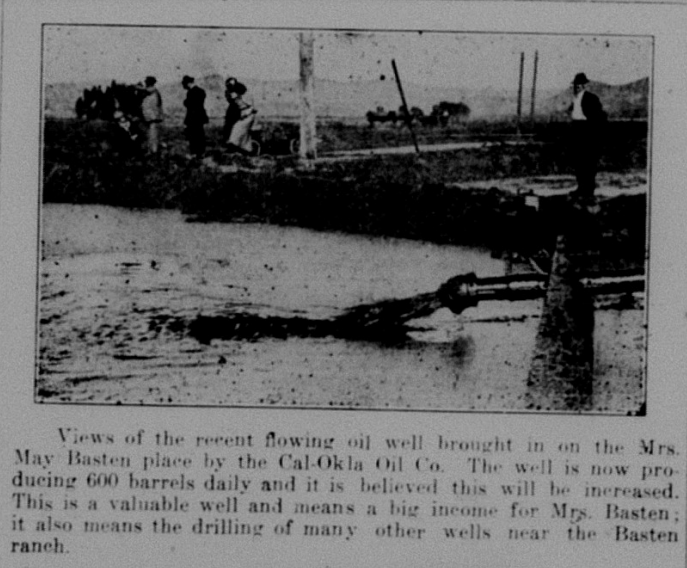
Fullerton continued to be a major oil-producing area.
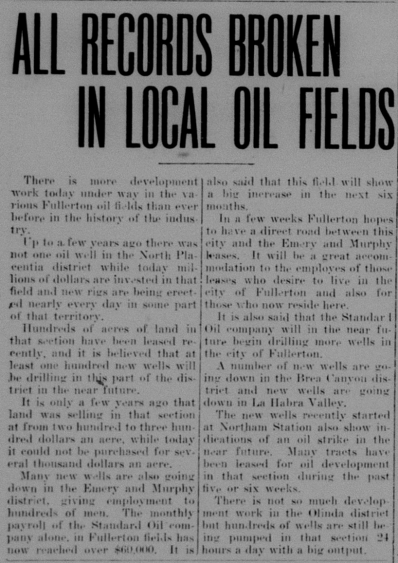
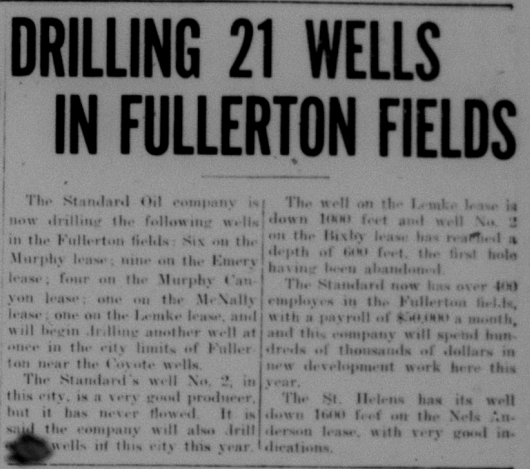
A number of lawsuits were filed against A. Otis Birch, owner of the Birch Oil Company by landowners who felt they were cheated out of oil profits on their land.

Meanwhile, two large oil conglomerates were dominating the industry–Standard Oil and Royal Dutch Shell.

Women’s Issues
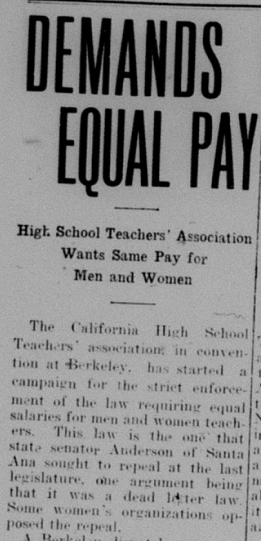
Members of the California High School Teachers Association were agitating for equal pay for women and men.
Local Women’s Clubs held a convention in Los Angeles, at which they passed resolutions denouncing militarism, and in support of conservation and environmental protection.


Newspaper
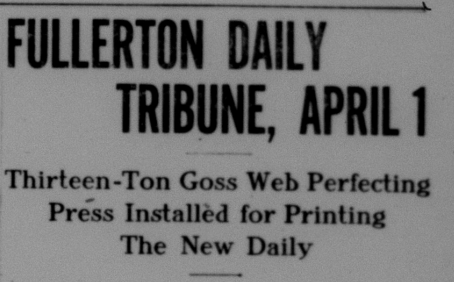
In 1914, the weekly Orange County Tribune started printing the Fullerton Daily Tribune and got a new printing press to accomodate the increased circulation.

Transportation & Infrastructure
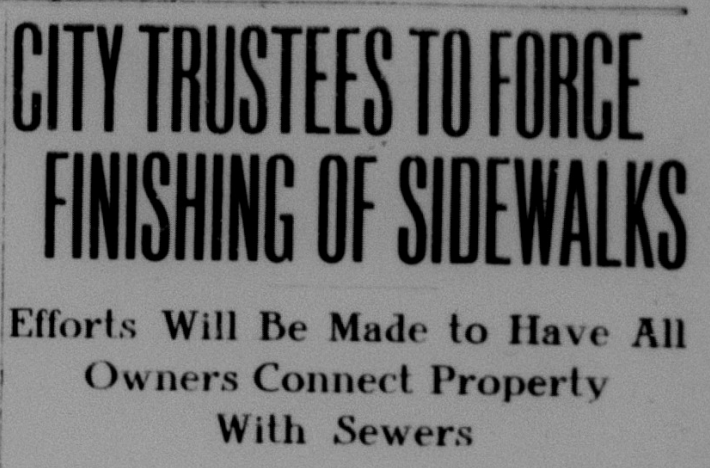
While the city or county paid for road improvements, business owners were responsible for paving the sidewalks outside their stores downtown.
Fullerton voters approved bonds for the fire department but voted down bonds for road improvement. What else is new?

Fire Department
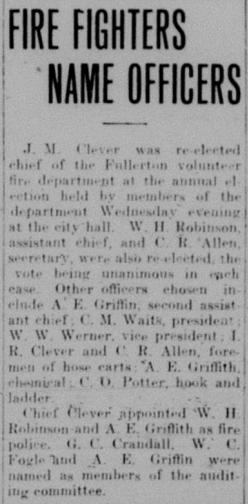
In 1908 following a big fire downtown, Fullerton created its first volunteer fire department. In 1914, they approved bonds for a fire truck and named officers. J.M. Clever was chosen as chief.
Miscellaneous
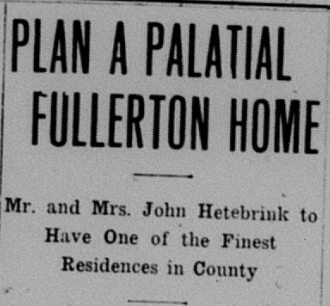
Pioneer ranchers the Hetebrinks planned a large home which still stands today at the corner of Chapman and Berkeley.
Eugenics
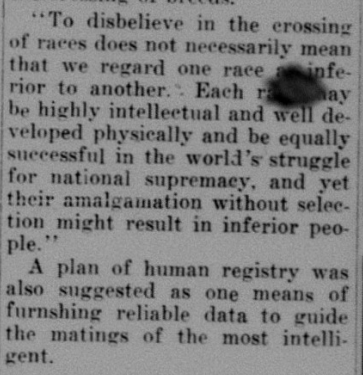
In the early 20th century, there was an emerging pseudo-science called eugenics which was the basis for racist beliefs and practices, such as laws which prevented interracial marriage.

A Dr. Webber gave a talk in Riverside. Here are some excerpts:


Anti-Japanese Sentiment
Speaking of racism, in 1914, California had laws on the books which outlawed interracial marriage. The Tribune printed an article which pointed out that some Japanese people in California had married white Americans. Given the widespread anti-Japanese sentiment at the time, this article was likely meant to provoke outrage, rather than sympathy. Interracial marriage, which was outlawed since California became a state in 1850, would remain illegal in California until the 1948 court case Perez v. Sharp.

In 1913, California passed the racist Alien Land Law, which prevented certain Asians from owning or leasing property long-term. Some citizens protested.

Mexican Revolution
South of the border, the Mexican Revolution raged.

The Revolution turned out to be bad news for lots of American businessmen who had oil, mining, and other interests in Mexico, and who enjoyed a cozy/corrupt relationship with the Diaz administration.
An article entitled “Has Mexico Right to Hate Some Americans” paints a pretty negative picture of how Americans treated their Mexican workers.

Here are some excerpts from this disturbing article:
Do Mexicans hate Americans? They do; millions of them do. And during the past two months in Mexico I have learned why so many Mexican Indians wish to kill or abuse American mine managers and planters. I have heard, first hand, from Americans, more than one terrible story of how they abused their Mexican employees. Those stories have been told to me in a boasting spirit. In the days when Diaz ruled with his iron hand, Americans, as a rule, treated their Mexican workmen as the most cruel slave owners of the Old South treated their black slaves.
“I’ve ridden into a bunch of them and mowed them down with a machete as if they were dogs,” one American told me. “It was the only way to treat them. Now and then some of them would get drunk on my ranch in Tampico. I found the best way to do was to ride in amongst them with a big knife and slash right and left as they scattered. If any showed fight, I’d shoot them. Revolver in one hand, machete in the other. That was the way I used to fix them. We’d have the funeral the next day and peace for a long time after that. I’d have the governor of the state and the mayor of the town on my payroll, and I’d report the slaughter to the and they’d always answer that I had done just right. Those were good old days, the Diaz days. The foreigners had plenty of rights then.
Another American boasted to me: “I had a strike in my mines one time, in the Diaz days, and I asked the governor of the state, who was on my payroll, to send me some soldiers. Instead of that he sent me a lot of uniforms and rifles and ammunition and a commission as major in the Mexican army. He told me to organize an army of my own, and give it all the orders I wanted. I told some of the strikers they’d have to join the army. I put them in uniform, gave them rifles and bullets and took them in the mine. I ordered them to shoot against the strikers and they did. They killed 50 of their brothers and that ended the strike.”
In another article, an American oilman who had fled Mexico because of the Revolution spoke to the Tribune. He was in favor of the United States actually invading Mexico to protect American oil interests. America invade a country for oil? Never!

Here are some excerpts from the article:
That an invasion of the whole of Mexico by the American fighting forces is the only solution of the present international difficulties, is the opinion of R.W. Parkin, who arrived today in Fullerton where he will remain until matters in the southern republic are settled. Mr. Parkin has extensive interests in the oil industry there and left reluctantly. He is connected with the Panice Drilling and Construction company. Panice is situated about 60 miles north of Tampico.
“The feeling of hatred against all Americans is strong as ever in Mexico,” said Parkin, “and before leaving I saw some of their anti-American demonstrations.
Speaking of the oil industry in Mexico, Mr. Parkin stated that the country, in his opinion, contains the greatest supply of oil of any country in the world, and that the ill feeling the natives harbor against Americans is because of the success the latter have met with in developing the industry.
“Practically all the oil wells have shut down since the present trouble has assumed such serious proportions, and the loss in money on this account will be enormous when you consider all the machinery that is lying there idle and will deteriorate rapidly when not cared for. Then, too, there is the fear among all the oil operators that the Mexicans may set fire to the wells or submerge the fields by flooding them with water. The situation is critical.”
World War I
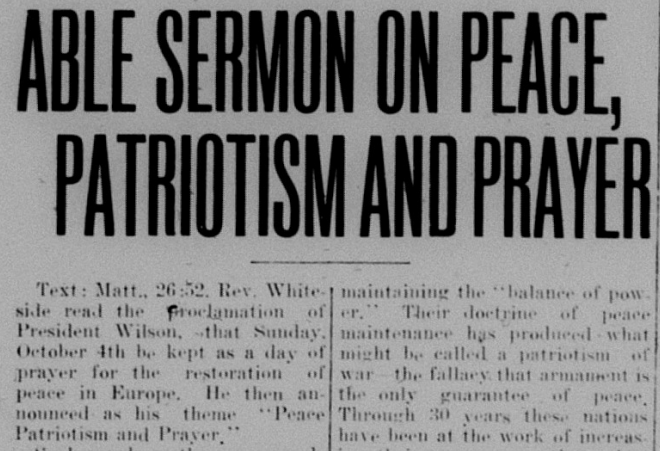
Meanwhile, World War I had begun in Europe. The United States would not officially enter the war until 1917. The Tribune printed numerous articles on this topic.

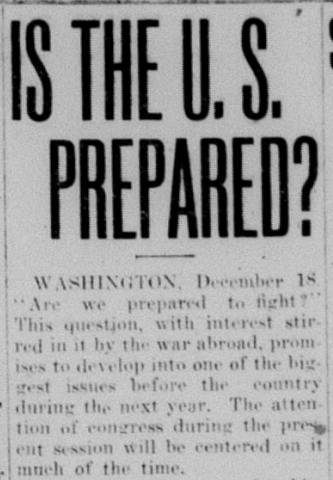
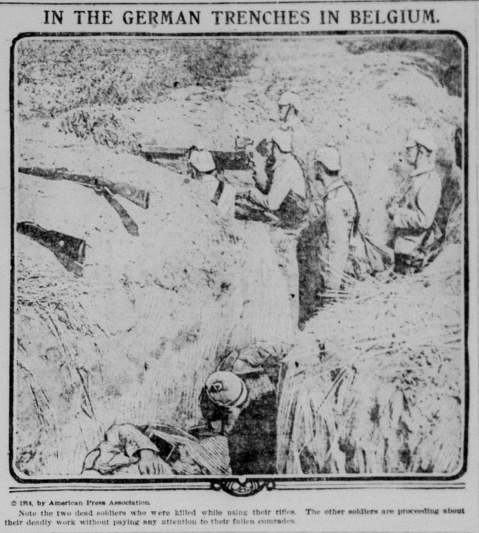


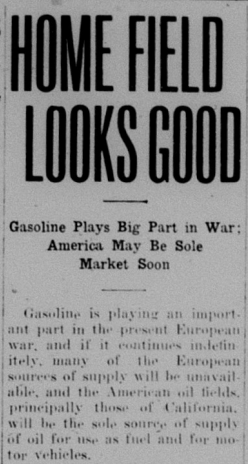
As is often the case, war was good for American business, in this case oil.

Stay tuned for news stories from 1915!
 Fullerton History
Leave a comment