The following is from a work-in-progress about the history of Fullerton. You can support my ongoing research and writing on Patreon.
“Someday, perhaps not long from now, the inhabitants of a hotter, more dangerous and biologically diminished planet than the one on which I lived may wonder what you and I were thinking, or whether we thought at all. This book is for them.”
–William T. Vollmann, No Immediate Danger: Volume 1 of Carbon Ideologies
As part of my research into the history of my hometown of Fullerton, California I’ve been reading over microfilm from the town’s oldest newspaper, the Fullerton Tribune. In the early days of the town, in the late 1800s, oil was discovered. For the first half of the 20th century, oil was a major export of the region. Oil derricks dotted the hills north of town, gushers came in and (for a while) produced thousands of barrels of oil a day. By 1912, Fullerton was producing hundreds of thousands of barrels per year. It was (for a while) one of the most oil-rich areas of California.

In the early 20th century, the Fullerton Tribune printed article after celebratory article about another gusher coming in, or about a big oil company buying up land, or how many barrels were being extracted from the local oil fields.
From a civic perspective, oil (for a while) meant prosperity. It meant jobs and wealth and tax revenue for things like roads and schools and irrigation projects, and a police department and a fire department and a city hall. Oil was (for a while) truly black gold.
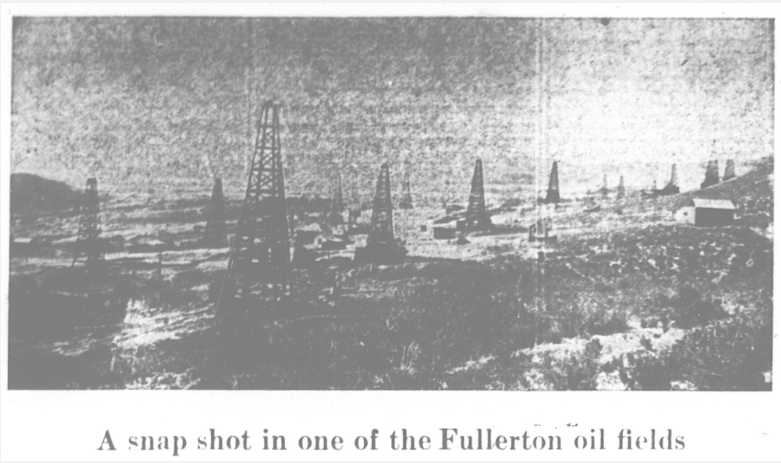
Oil was, along with oranges, the economic foundation upon which the town was built up and prospered for decades. From the perspective of someone who lived in the first half of the 20th century, oil was amazing. It was liquid wealth to be extracted from under the ground, piped and shipped all around the country to power American industry and development. It made cars and trucks and ships and factories and farming machines go. Oil was awesome–from the perspective of those who didn’t know about how the burning of it could affect the planet long-term.
Unfortunately, I do. We do, by which I mean those of us living today, in the year 2023. I know what Edgar Johnson, editor of the Fullerton Tribune, did not. I know that the burning of fossil fuels like oil and natural gas produces carbon emissions, especially carbon dioxide, and that this invisible harmless-seeming gas accumulates in the atmosphere and (after a while) creates the greenhouse effect, which today is causing the Earth to get hotter, and this global warming is going to make life on planet Earth a lot more precarious and difficult for everyone, especially our children and grandchildren. I also know that carbon dioxide stays in the atmosphere for between 300 and 1,000 years.
In the year 2023, this global warming (or, to use a less ominous term, climate change) has already begun–causing not just hotter temperatures, but is making life precarious in all kinds of insidious ways–extreme weather events–bigger hurricanes, vast apocalyptic wildfires, sea level rise, ocean warming and acidification, deaths of coral reefs, the melting of permafrost and polar ice caps which releases still more previously trapped gases like methane, which accumulates in the atmosphere and adds to the greenhouse effect–a sort of cascading effect.
The rising sea levels are making life increasingly unlivable in certain coastal and island communities. Unfortunately, it turns out that changes in climate affect whole ecosystems, causing weird migrations and diseases and just really horrible mass dying and even extinction.
Living (as I do) in a wealthy or (to use a somewhat ironic term) developed nation where we’ve gotten really good at hoarding and exploiting resources, it’s possible to feel less impacted by climate change. I don’t live on the island of Tuvalu, which is becoming swallowed by the rising ocean. It’s possible for folks like me to kind of just ignore climate change (for a while).
Climate change is big picture. It is systemic. And thus, because of its scale, it can become hard for us to see. It’s like the David Foster Wallace joke about the wise old fish who swims up to two younger fish, and says, “Morning boys. How’s the water?” To which one of the younger fishes replies, “What’s water?”
But the question I’ve been thinking about as I learn about the oil industry of early Fullerton is: How do I, as a local historian, address climate change? Some might say “You don’t need to.” Why mention a current or future problem when writing about the past? But, to me, sitting alone in the library, reading on microfilm a new article from 1911 in which Edgar Johnson is gushing with excitement and admiration about the hundreds of thousands of barrels of oil being extracted annually from the local oil fields, I feel the opposite of excitement. I feel something verging on sorrow or despair, knowing more than Johnson did about the long game of oil extraction.
I feel it must be somehow acknowledged that the very substance that helped build the town is the same substance that is contributing to our collective demise.
I suppose this same acknowledgement is necessary in coal towns, or towns with lead mines. Fullerton was built on oranges and oil. And oil, to me, is not something to be remembered with nostalgia, and definitely not celebration.
If we knew then, say in 1900, what we know now, namely that oil is a long-term planet killer, would we still extract it from the ground? The answer, I think (unfortunately), is yes. We still have big oil companies today that continue to extract oil in much vaster quantities than their 1900 counterparts, and I (unfortunately) continue to purchase products and services that are made from fossil fuels. Hell, I’m writing these words in a jet airplane which is emitting greenhouse gases so that I can get from one location to another more quickly.
So, when I write about the past, lamenting their ignorance or greed or short-sightedness, I cannot do so from a place of any moral superiority or arrogance. We are in some ways worse than our ancestors. They didn’t know about the greenhouse effect. We do, and continue our extraction and burning.
My only hope in researching and writing about the past is that it may create a space for reflection–on the past, present, and future–where we have gone wrong, and how we might do a little better, if for no other reason that our own survival and those of our descendants, who may not look kindly upon us when they write their own histories.
 Fullerton History
Leave a comment