The following is from a work-in-progress about the history of Fullerton. You can support my ongoing research and writing on Patreon.
Stanley Porter was interviewed by Dee Larson in 1986 for the CSUF Oral History Program.
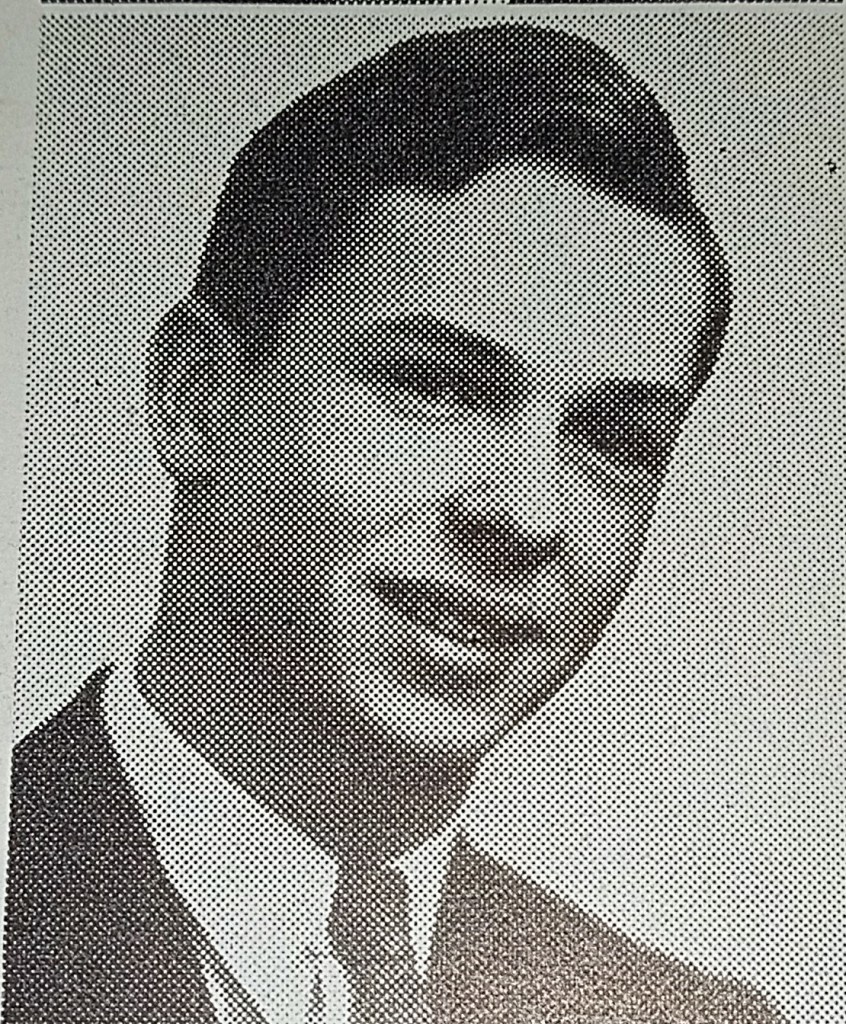
His grandfather Benjamin Franklin Porter was born in Tennessee, moved to Texas as a young man, and in 1870 came out west to California on one of the last wagon trains.
The family eventually settled in the Orangethorpe district just north of Anaheim, before the town of Fullerton was founded. A number of pioneer families settled in Orangethorpe, such as the Loverings, the Gardiners, the Royers, the Spencers, and the Skinners.
Some of these families’ houses still stand and are now officially designated Local Landmarks.
The Porter’s first house was located on a 40-acre farm on what is now the 600 block of W. Orangethorpe.
Benjamin Franklin Porter grew walnuts and later oranges. He and his wife Mary had 15 children and lived in the Orangethorpe District for the rest of their lives.
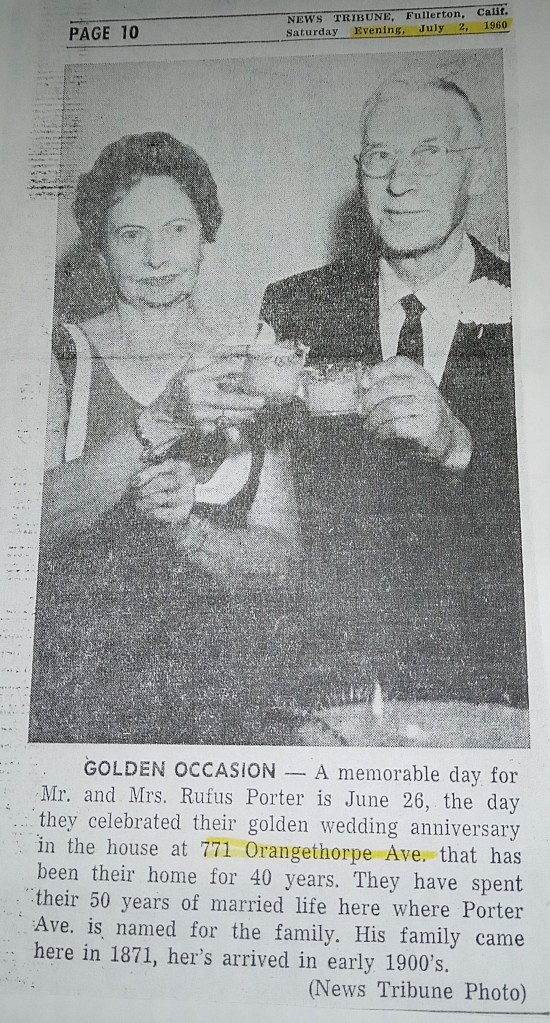
One of their children was named Rufus, who got married in 1910 and purchased property across the street from his parents where Woodcrest Park and school is today. Rufus built a nice home near what today is the corner of Richman and Orangethorpe.
Rufus’s son Stanley was born in 1917. When he was still a baby, the family moved into a house at 771 W Orangethorpe, with twenty acres of walnuts and oranges adjacent to Benjamin Franklin’s property on the north side of Orangethorpe. That house was built in 1882 and is still standing. It is the oldest extant house in Fullerton.
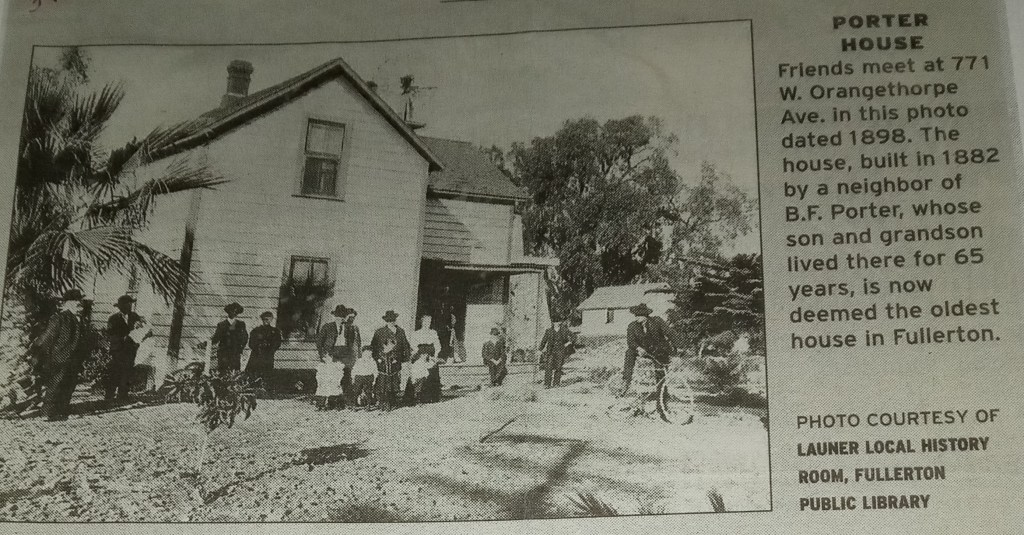
“The walnuts were harvested by Mexican families who came and camped there during the season,” Porter remembers. “I can still remember very plainly the horses drawing the wagon loads of nuts in big sacks, which weighed about a hundred pounds apiece.”
Eventually, the walnut crops were killed by a pest called the husk fly, and were replaced by oranges.
For water, the Porters had their own well. They also had a windmill. To irrigate their crops, they purchased water from the Anaheim Union Water Company.
Before they had electricity, the family would go to the ice house on Walnut to purchase 50-lb. blocks of ice for their ice box.
Electricity came to the Orangethorpe area in the 1920s.
The Orangethorpe community had its own school, which Stanley attended (like his father before him) for grades 1-8.

Porter remembers the first movie theater in town, the Rialto theater on Spadra [Harbor]. He also remembers the building of the Chapman Alician Court Theater, which later became the Fox, which featured both movies and live vaudeville shows.
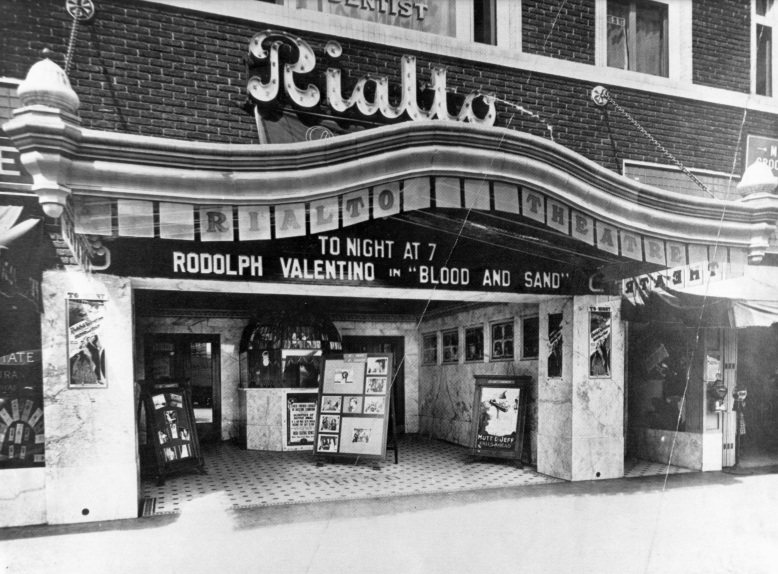
He recalls seeing silent movies as well as the first talkies, such as Al Jolson’s The Jazz Singer.
Speaking in 1986, Porter expressed regret that the theater had fallen into disrepair and the original murals had been painted over.
“They covered up those magnificent murals with paint,” Porter said. “I think Fullerton has a thing against murals, they’ve covered up the ones on the high school.”
He witnessed the painting of the “Pastoral California” mural on the side of the high school auditorium., which was also painted over in 1939.
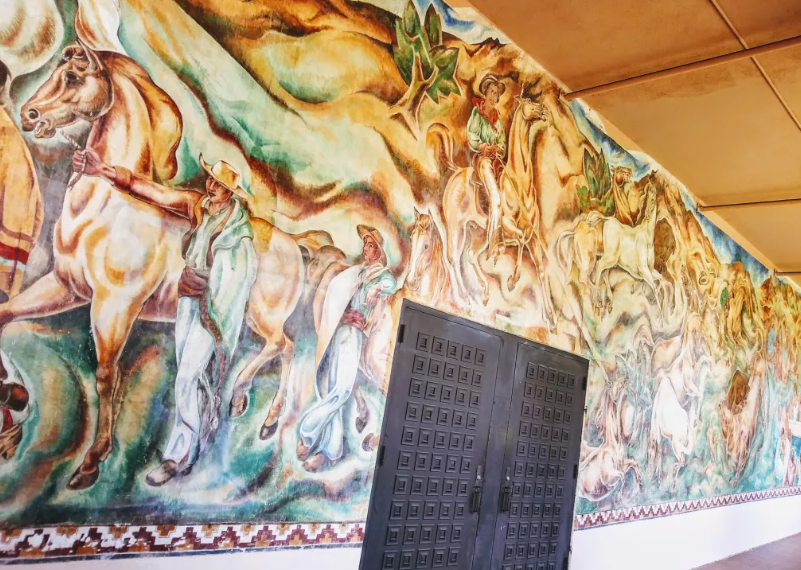
“I vividly recall the mural on the side of the high school auditorium, which is one of my pet peeves when they finally painted it over. I remember watching him [Charles Kassler, the artist] paint that,” Porter remembers. “it was a mural, or a fresco. And, was very representative of the life in early California, and it showed the Indian women washing in those stone troughs which are still around at some of the missions…And there were the horsemen. Beautiful horses. This man was very good at horses. As a matter of fact, he painted some of the museums at the LA County Library.
Porter graduated from Fullerton Union High School in 1935. Among his classmates was John Raitt, the famous singer.
He remembers the big Long Beach earthquake of 1933.
“My father was down in his walnut orchard. He said the trees actually just swayed like it was in the wind,” he said. “In Long Beach, of course, there were lots of brick buildings, and many of them were destroyed…The Orangethorpe School auditorium was damaged.”
He remembers the 1938 flood.
“My sister’s husband-to-be lived in Anaheim, on the north side of town where the water came through very strongly,” he said. “Anaheim was quite badly hurt by that. Over in this little section of town called La Jolla, over here east, it just practically demolished that. It was a Mexican community mostly, and small houses. And many of those they say they just never did find the people that lived in those places.”
He went to Fullerton College, where he studied ceramics under Glen Lukens, a very well known artist who eventually taught at USC.
As a young man, Porter worked at Hoppey Hardware, which was right next to the Stein-Strauss store on the southeast corner of Harbor and Commonwealth.
“At that time this was a very rural community, there was nothing out around the surrounding areas like there is now. You went into town if you wanted to go the drugstore or the grocery store, or anything else. Things were more centrally situated than they are today,” Porter said. “On Saturday nights, everybody went downtown shopping. It was like the malls now, you know. It was a sociable thing.”

He remembers the big parades that would occur in town, such as the Armistice Day (now called Veteran’s Day) parade.
“We had very good parades. Much better, I’m sorry to say, than we have now,” Porter said. “We used to have parades with the high school. We always had parades for the football season.”
He remembers other popular stores downtown, such as the Chapman-Wickett department store (in the Chapman building), and Dean’s Hardware.
Porter’s mother worked in the telephone exchange office downtown as one of the first switchboard operators.
Regarding African Americans in Fullerton, Porter said, “there were very few black families in Fullerton, even up until the wartime.” He remembers two families, the Berkeleys (who lived in the Orangethorpe district) and the Goodwins, who lived in the Truslow area.
Ruby Berkeley married a Goodwin and became a famous author and activist.
“Her name was Ruby Berkeley Goodwin,” Porter said. “She was one of the first activists for better relations between the races, or I would say better conditions for the black people…she was very well known…she spoke a lot at club meetings, the women’s clubs and things like that.”
After graduating from Fullerton College, Porter went to Chenard Art Institute and studied interior design and ceramics.
After working at a bank in Los Angeles, he opened a ceramic business, and also taught for seven years, adult education ceramics and other related craft, such jewelry enameling.
Porter lived in the house at 771 W. Commonwealth for 64 years before selling it. It is now an addiction recovery center.
He says that after World War II, in the 1950s, “things really started changing” as farmers began selling off their acreage for housing and business developments.
“My grandfather’s property was one of the first ones that was sold. Then we did later,” he said.
 Fullerton History
Leave a comment