The following is from a work-in-progress about the history of Fullerton. You can support my ongoing research and writing on Patreon.
“It was built on 350 acres in the gently sloping hills of the city’s northwest corner. With its broad lawns and stands of towering trees, the sprawling Hughes Aircraft aerospace complex looks more like a college campus than an industrial outpost of the Cold War.”
–Los Angeles Times, 1994
The post World War II boom in Fullerton saw acres of orange groves turn into housing subdivisions, shopping centers, and industrial businesses such as Hunt Foods, Kohlenberger Engineering, Rheem Automotive, Arcadia Metal Products, Sylvania Electric, Standard Products, F.E. Olds Co. and others.
The biggest of the post-war industrial employers in Fullerton was Hughes Aircraft Co. which established a large plant in Fullerton in 1957 on over 400 acres near Sunny Hills. For much of its history, the main output of the plant was components of ground radar systems for the the U.S. and foreign militaries.
In the decade that Hughes opened in Fullerton, the city’s population quadrupled, rising from 13,958 in 1950 to 56,180 in 1960.

By 1960, Hughes’ Ground Systems Group in Fullerton was working 26 military contracts worth more than $200,000,000 and had 6,000 employees. Hughes had become Fullerton’s largest employer, offering good paying jobs to scientists, engineers, and other employees.
While the company mainly focused on developing radar systems, it was also a pioneer in computer technology, developing the H-330 computer, which was in the early 1960s “the most powerful militarized general purpose computer ever developed.”
While the company’s major clients were the United States and allied nations’ militaries, they also developed technologies that allowed large oil companies like Shell drill in the ocean’s depths.
During the Cold War, Hughes’ offered powerful tools for countries to detect and prevent missile attacks.

Nicholas E. Begovich, a Hughes executive in the 1960s, said that the company’s systems “range in size from small, mobile air defense units to modular systems that cobweb across thousands of square miles to guide the air defense of a country–or a continent.”
In 1965, Hughes won a contract with NATO “to build a giant air defense network extending from Norway to Turkey.” The following year, the company won air defense contracts with Belgium, the Netherlands, West Germany, and Switzerland.

As the Vietnam War escalated, Hughes provided a number of products to assist the U.S. military, including portable “Manpack” combat radios.
By 1968, Hughes-Fullerton was selling over $1 billion in products annually.
While Hughes-Fullerton saw some cutbacks in the 1970s, the election of Ronald Reagan in 1980 proved a boom for the company, as he increased the United States defense budget.
By 1985, employment at the Fullerton plant reached a peak of 15,000 people. Hughes-Fullerton was providing air defense systems for 25 countries. That same year, Hughes was acquired by General Motors for over $5 billion.
In 1988, while on the campaign trail, George Bush visited the Hughes plant in Fullerton, where he criticized his presidential opponents Michael Dukakis and Jesse Jackson “for their lack of support for certain defense projects.”

Also in 1988, Hughes faced a bit of a public relations fiasco, when it was reported that the captain of the USS Vincennes was using Hughes radar equipment when he fired a missile that downed an Iranian jetliner, killing 290 civilians.
In 1989, the Berlin Wall fell and the Soviet Union began to break up, signaling the end of the Cold War and an uncertain future for defense contractors like Hughes, which had benefited from large defense budgets.
In 1992, Hughes-Fullerton welcomed a large contingent of military personnel from Saudi Arabia.
“Hughes Aircraft Co. is preparing for the arrival of up to 1,600 Saudi Arabian military personnel, the largest single delegation to seek training at the company’s Ground Systems Group,” the News-Tribune reported. “Training foreign military officers is nothing new for Hughes. The company has weapons systems in 22 nations. Visiting foreign-military personnel can be found at the company’s Fullerton site on any given day.”
By 1992, Hughes’ Fullerton workforce had shrunk to about 6,800, and the company unveiled a plan to transform 150 acres of its Fullerton property for a new housing development. The company was downsizing because of shrinking defense budgets.
Also in 1992, Hughes was ordered to pay a $3.9-million fine to settle allegations that it defrauded the government on several contracts to build shipboard defense systems.
And then in 1994 came the fateful news that the Fullerton Hughes plant would close.

When the announcement came, workers in the Fullerton Plant were working on a $1 billion contract from Saudi Arabia for an air defense system called the “Peace Shield.”
“It’s an early air warning and tracking system for countries that share borders with their enemies and is on schedule to be delivered to Saudi Arabia by early 1996,” the OC Register reported. “Closing Fullerton would almost certainly mean slowing the project. That, in turn, could wipe out an on-time delivery bonus worth about $50 million and sour Saudi Arabia’s neighbors from buying Peace Shields of their own.”
The closure of the Hughes plant had a significant impact on the City of Fullerton.
“At stake are 6,800 jobs in Fullerton–more than 10 percent of the city’s work force, the dreams of countless families, the future of local businesses and the very fabric of a town that has grown up with its largest employer since Hughes opened in 1957,” the OC Register reported. “Hughes is intertwined with Fullerton. The company contributes to Cal State Fullerton’s engineering department and to the city tax base. Employees patronize businesses, join civic groups and lead city government. Robert Singer, a Fullerton Joint Union High School District board member, works at Hughes. Mayor A.B. “Buck” Catlin used to.”

The plant closure would cost the city $735,000 a year in tax revenue, as well as lost business for smaller businesses that catered to Hughes employees.
“The formula is that for every manufacturing job, it creates three to four jobs to support that,” said Ed Paul, Fullerton’s revenue manager. “You see it in the restaurants, car-repair shops and dry cleaners.”
When the plant closed, many Hughes employees were laid off, and many were transferred to other facilities in Long Beach and El Segundo. About 700 workers stayed on in a much smaller facility.
“While sizable, the plant closure is only the most recent to hit Orange County since the end of the Cold War,” the LA Times reported. “It follows a nerve-racking series of layoffs that have slashed tens of thousands of jobs from payrolls in a county that once was awash in defense dollars and now finds itself hit hard by the nation’s effort to cut military spending.”
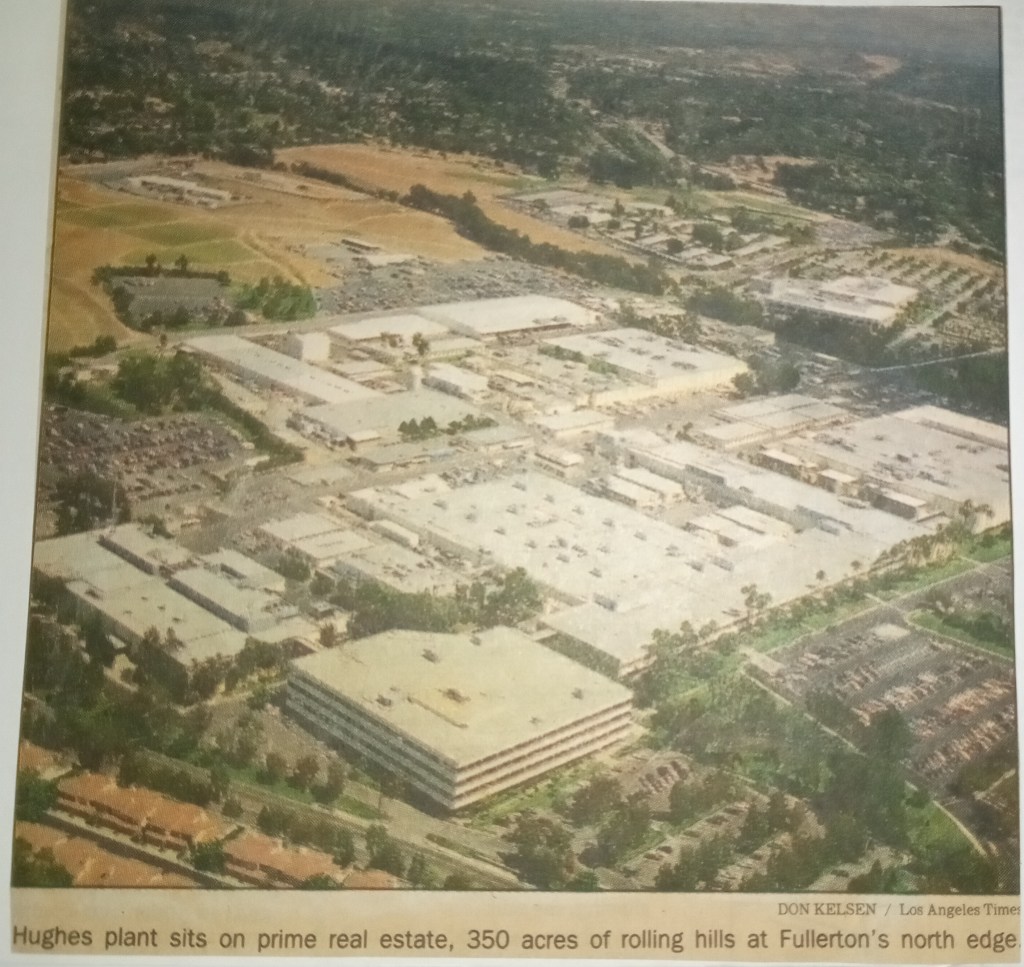
Hughes sold its sprawling land holdings to real estate developers, who eventually developed what is now Amerige Heights–a sprawling shopping center surrounded by housing.
“The role of Hughes Aircraft in Fullerton is part of the larger story of the aerospace industry in shaping Orange County in the post-World War II years, a time that saw the county evolve from an agricultural backwater to develop a factory-driven economy in which aerospace for years was the cornerstone,” the LA Times reported in 1994.
“We were the air defense system for the free world,” says Begovich.
A 1994 LA Times columnist wrote, “The Cold War was a perilous time for the nation, but ironically it fueled prosperity in the spread of defense-related industries and in the spawning of an optimistic way of American life–especially in the suburbs that surround Los Angeles.”
 Fullerton History
Leave a comment