The following is from a work-in-progress about the history of Fullerton. You can support my ongoing research and writing on Patreon.
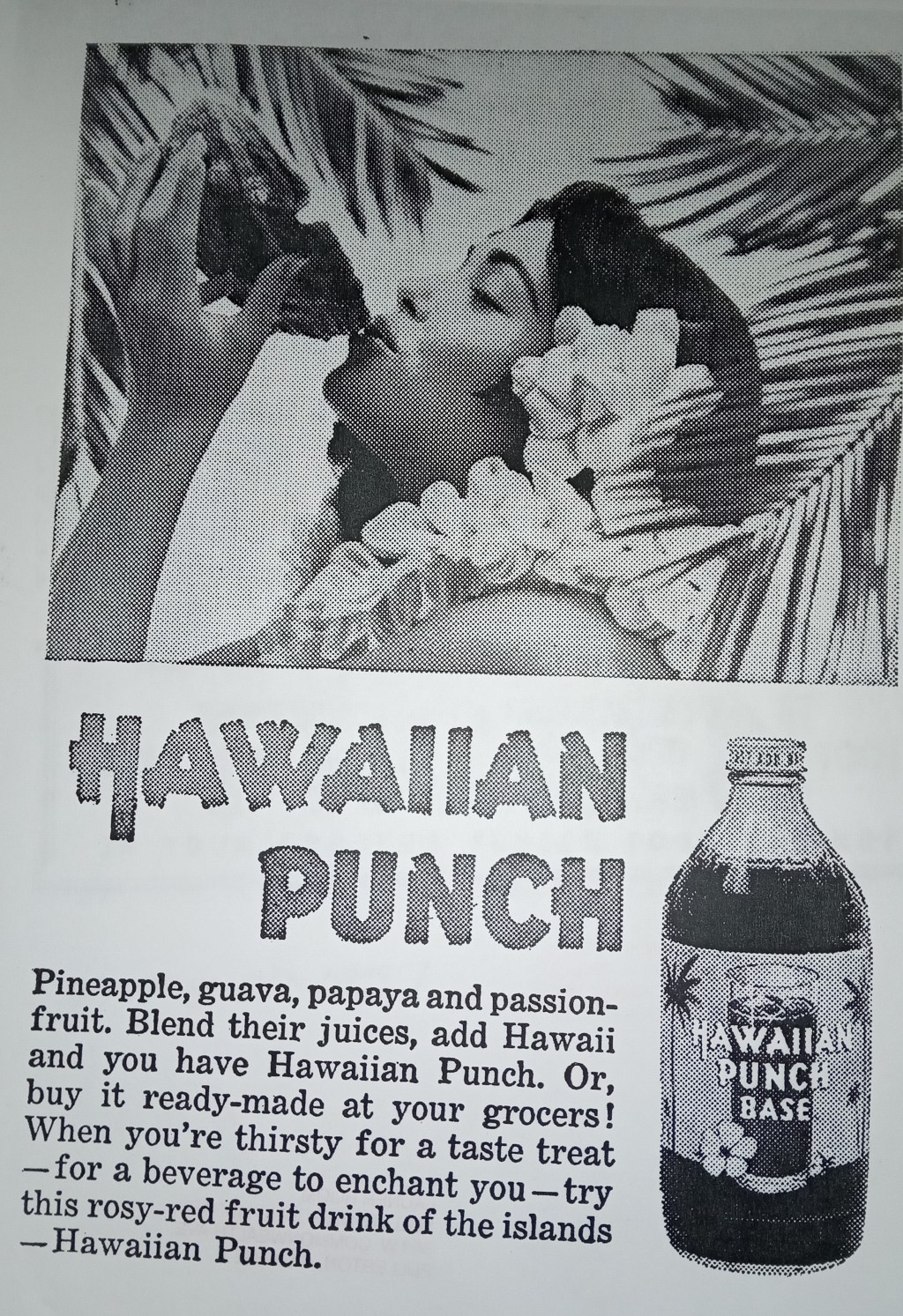
Like most medium-sized American cities, Fullerton has spawned a few companies over the years that have risen to national prominence and become household names. Fender Guitars is probably the most well-known. But a close second is Hawaiian Punch.
Hawaiian Punch was originally created as a drink base for juice stands and also as an ice cream flavoring in the early to mid 1930s by A.W. Leo in a converted garage in Fullerton at 120 W. Amerige. Leo’s company was called Pacific Citrus Products.
There has been some debate/confusion as to where Hawaiian Punch was actually created. A 2007 Orange County Register article tells of a Tom Jones of Fullerton, who placed a plaque on his garage at 1321 Frances Ave. stating that the formula for Hawaiian Punch was created in his garage in 1934.

However, according to records in the Fullerton History Room of the Fullerton Public Library, A.W. Leo did not live there in 1934. He moved there in 1936.
While Wikipedia states that “Leo’s Hawaiian Punch was created as an ice cream topping syrup in 1934 by A.W. Leo, Tom Yeats, and Ralph Harrison in a converted garage in Fullerton, California,” it appears that this “garage” was not a residential garage, but rather a converted auto garage.
In a 1968 interview for the CSUF Oral History Program, Rueben Paul Hughes, former president of Pacific Citrus Products, said, “The predecessor for Pacific Hawaiian Products was Pacific Citrus Products. The original plant was located at 120 W. Amerige in a former garage. The plant slowly expanded from there.”
In the 1920s, prior to Leo moving into his business at 120 W. Amerige, it was owned by Wickersheim Implement company, which sold cars and almost certainly had a garage.
It is thus much more likely that the “garage” where Hawaiian Punch was created was at the 120 W. Amerige site, which eventually was expanded into their first plant. Today, this is the parking lot of Ace Hardware.

In Leo’s laboratory, he concocted various “fruit juices and extracts to perfect formulae for sherbet bases, flavoring extracts and hot weather drinks.”
By 1940, the company had expanded to sell throughout the United States.
In addition to Hawaiian Punch, the company manufactured bar mixers, fruit concentrates, crushed fruits, citrus oils, sherbert bases, fountain syrups, extracts, emulsions, and specialty flavors.
Hughes worked his way up in the company from the warehouse to eventually becoming president and co-owner in 1946.
Hawaiian Punch originally was made from real fruit juices.
“We bought the pineapples from Hawaii and our basket fruit juice used to come from Oceanside,” Hughes said. “Any other fruits, we bought from various packers, the apricot and the peach puree, we bought from packing plants.”
At this time, Fullerton, and much of the surrounding area, was mostly agriculture.
While it was popular as a wholesale juice and ice cream concentrate, it eventually became more popular as a pre-mixed juice sold directly to customers.
“ln 1949, we decided to mix it for them, so to speak, into a ready to drink product in the big 46 ounce juice can,” Hughes said, “This was probably the smartest thing we ever did.”
Hawaiian Punch began to be shipped outside of California, first to midwest markets, and then all over the country.
And then in 1950, tragedy struck.

According to a 1950 Fullerton News Tribune article, “An early morning fire, believed to be the worst in the history of the city and probably the worst in Northern Orange County, totally destroyed an automobile agency and garage, a citrus products plant, a 58-room hotel, and damaged a hardware store…Destroyed were the McCoy and Mills Ford agency and garage at 125 W. Commonwealth, and the Pacific Products plant across the alley at 120 W. Amerige avenue.”
Unofficial estimates placed the damage at over half a million dollars.
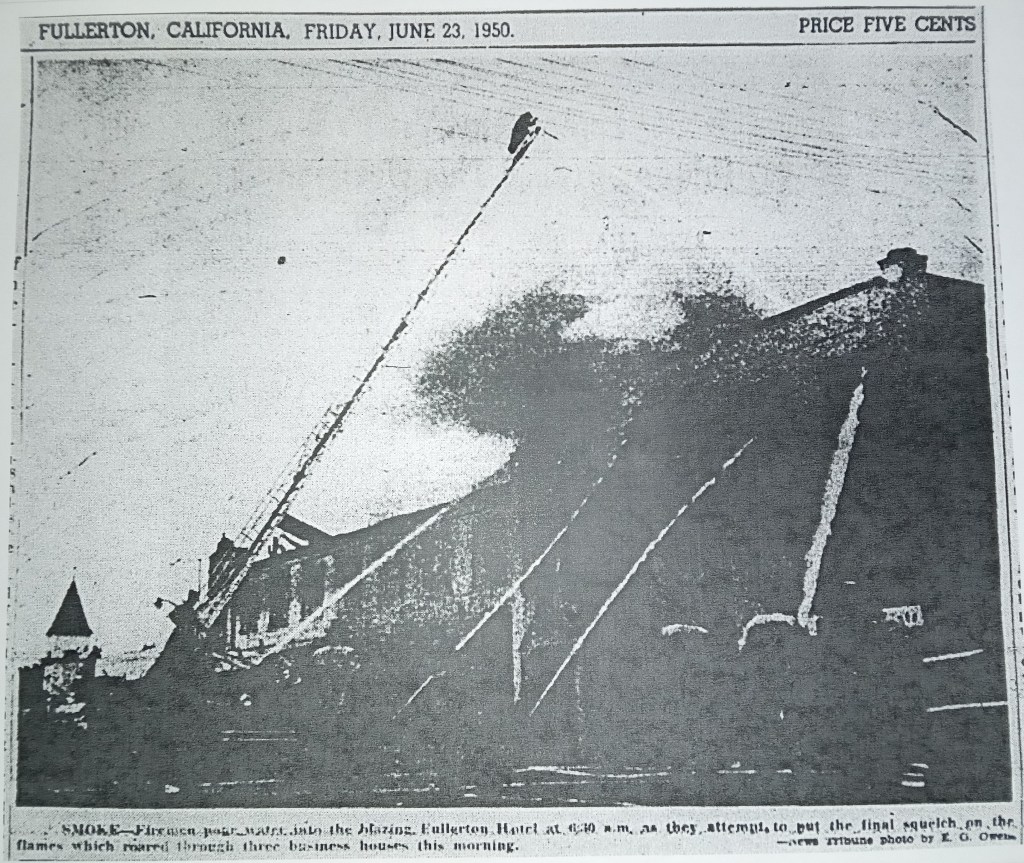
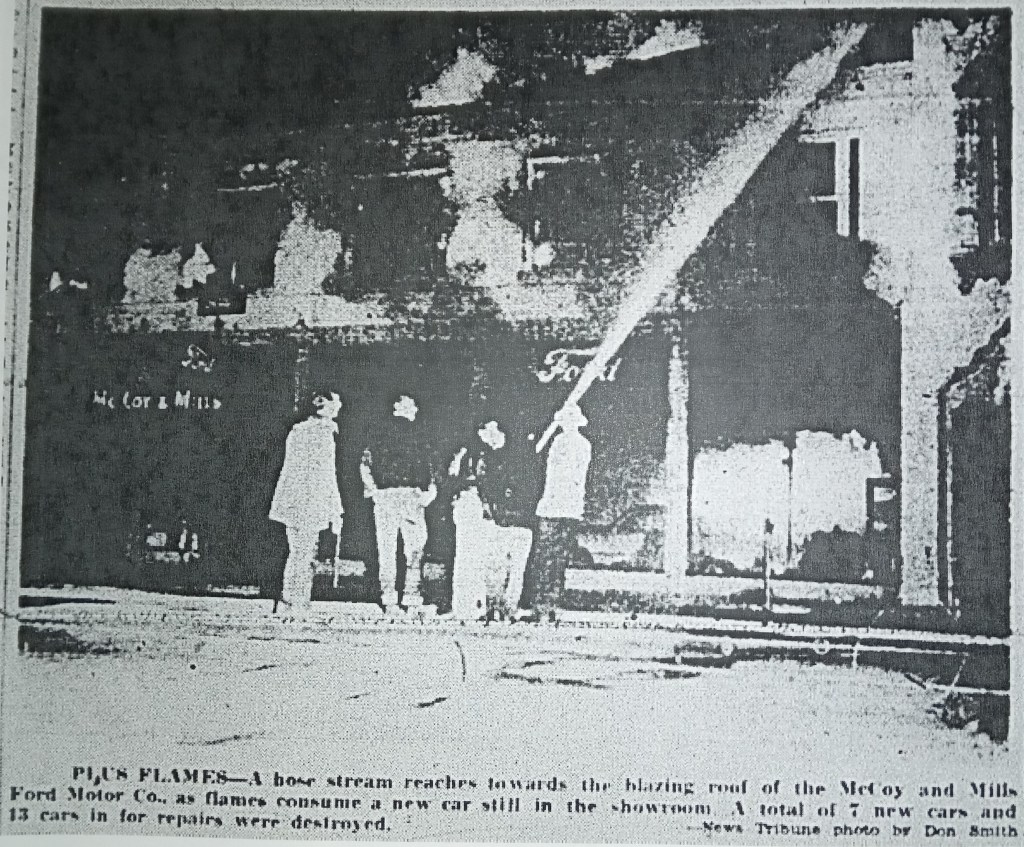

“The juice plant went up in a hurry as citrus oils and alcohol caught fire and an early morning breeze fanned the flames,” the Tribune stated. “As the citrus plant burned and bottles and cans exploded, syrup concentrate ran ankle deep in the gutters. The smell of scorched syrup filled the air.”
After this tragedy, the company temporarily moved into the Chapman packinghouse before building a much larger new plant at 336 E. Santa Fe Avenue, made out of concrete and steel, not wood. It was also located along the railroad tracks, which was better for shipping purposes.

This plant is now the Citrea Apartments. When they built this new apartment complex in 2019, a local artist painted a series of Hawaiian Punch murals facing the train tracks.

By the 1950s, Hawaiian Punch was a national brand advertised in newspapers, television, radio, and magazines. It had become a multi-million dollar company.
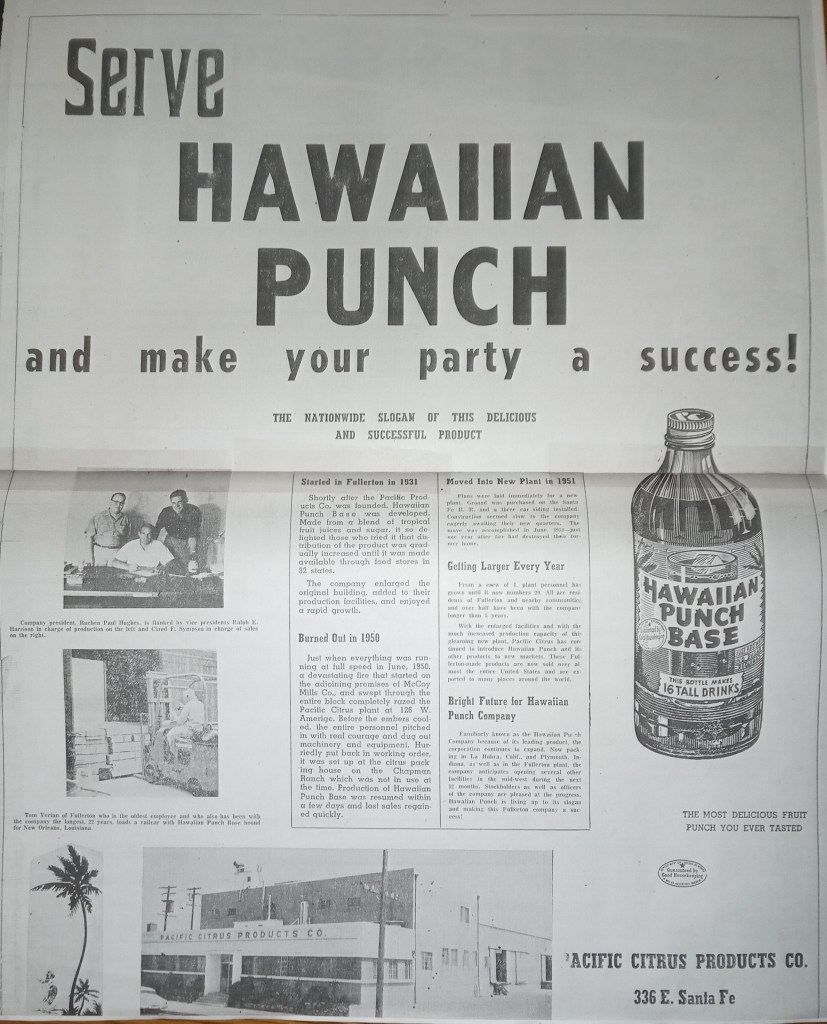
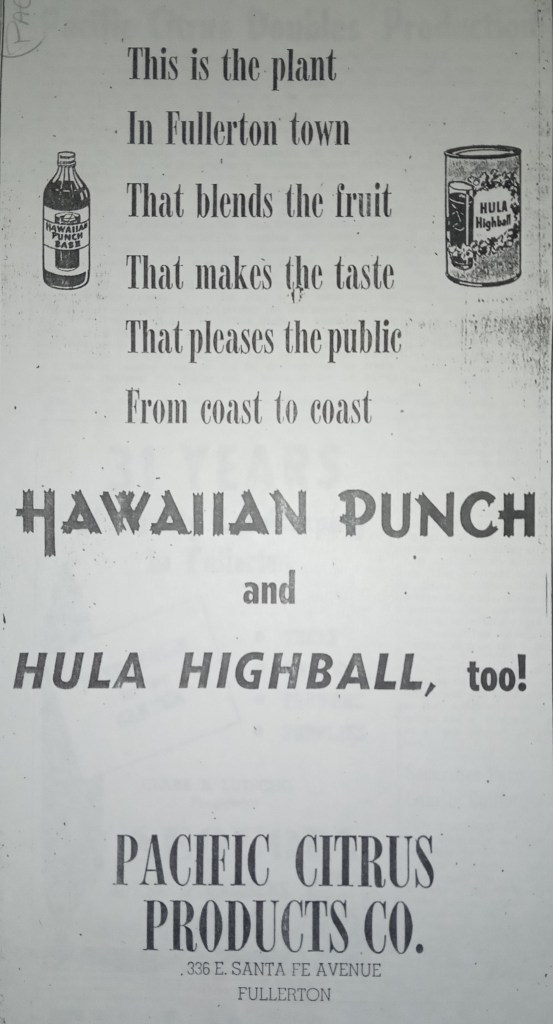
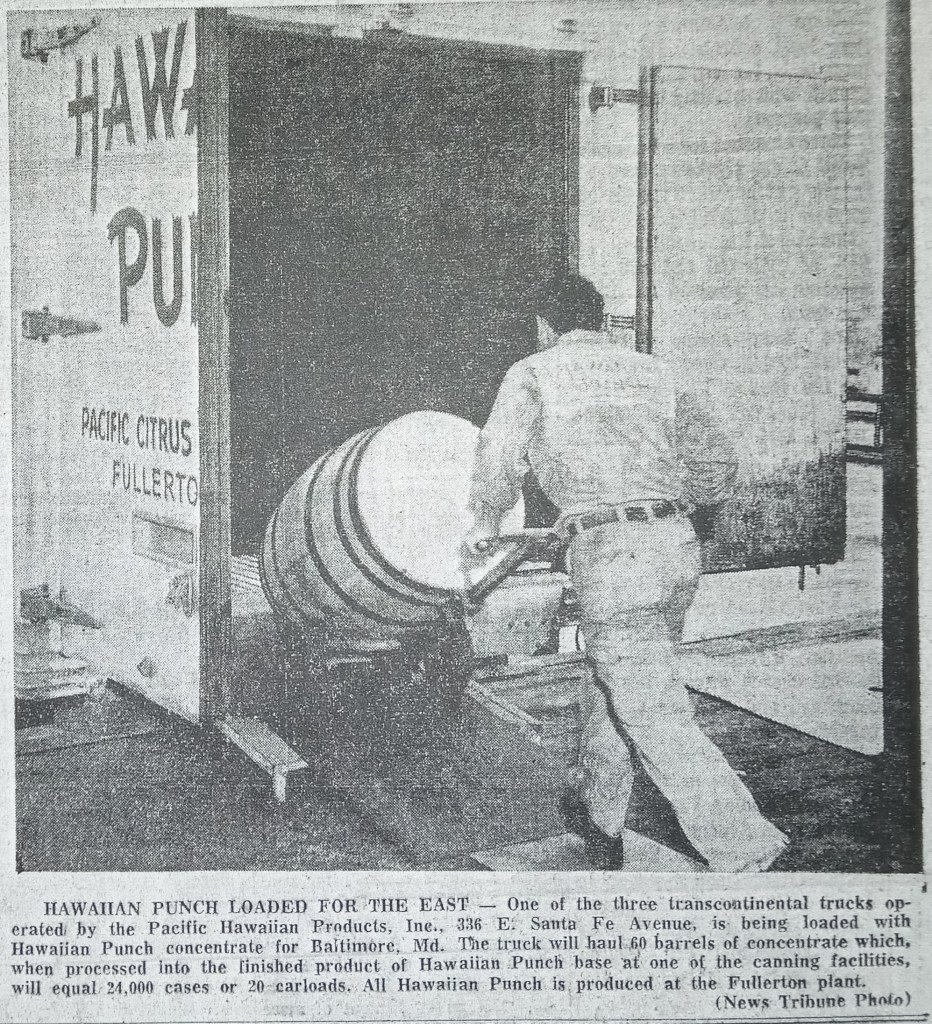
Because of the overwhelming success of Hawaiian Punch, the company was re-named Pacific Hawaiian Products.
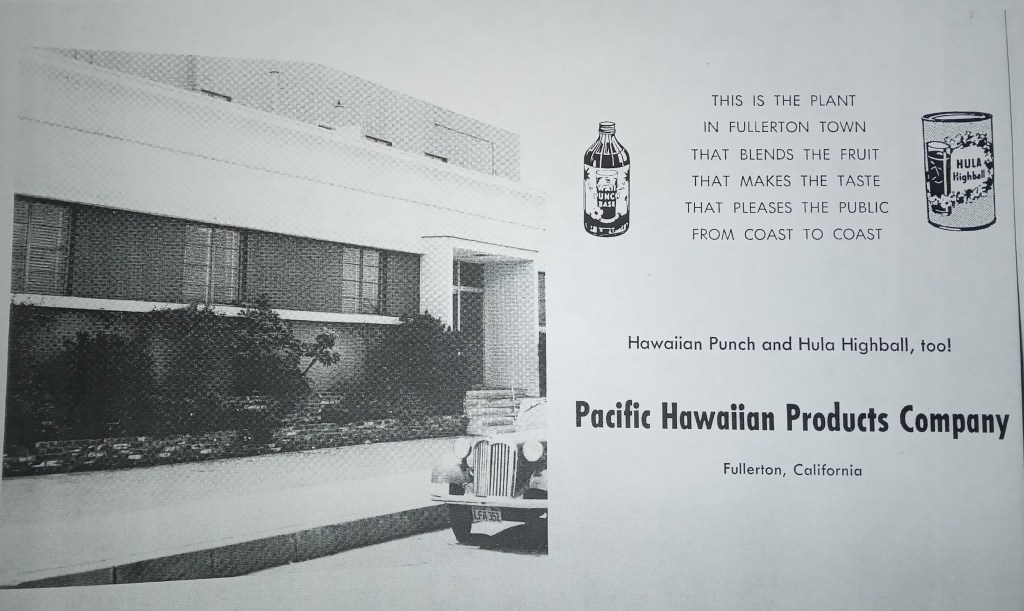

In 1960, Pacific Hawaiian Products moved into a new 5-acre, 63,000 square foot headquarters, production and warehousing building at Acacia and Ross Aves. It was now the largest producer of real fruit juice punch in the country.
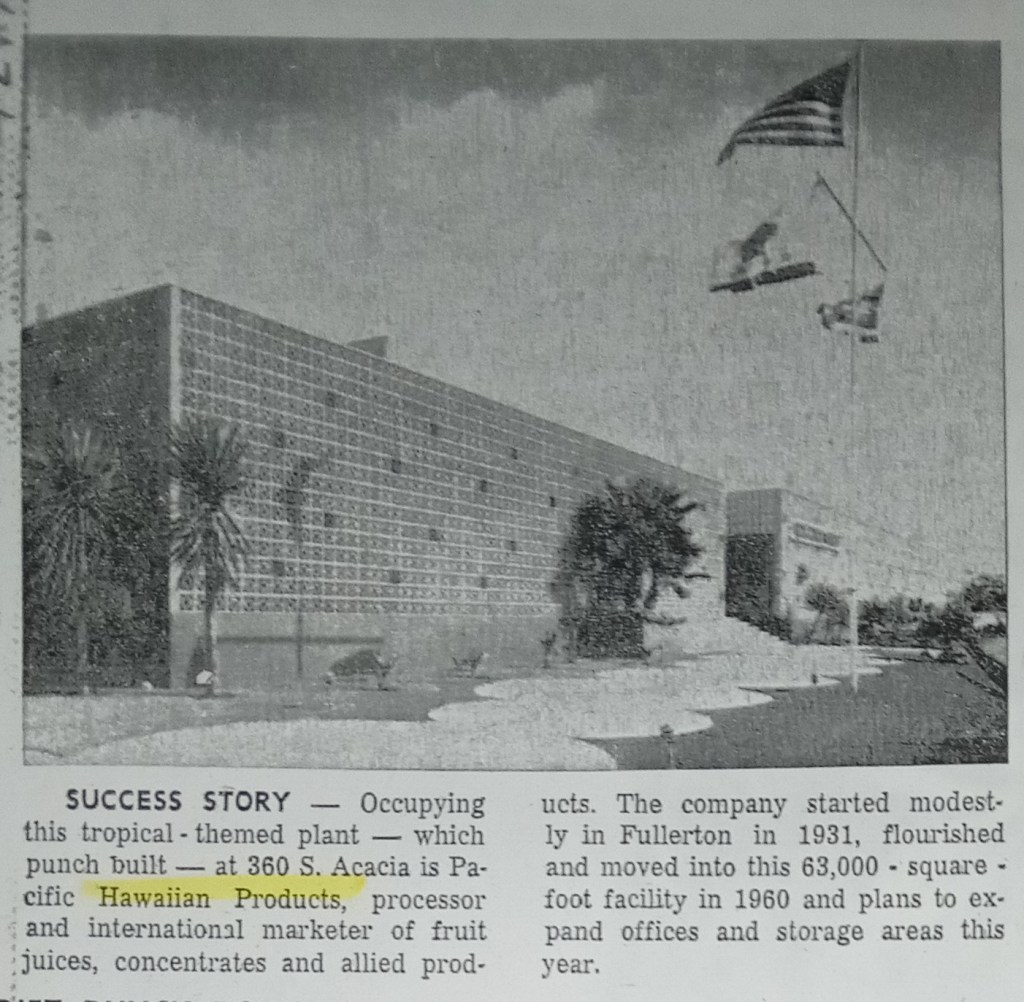

Hughes, the company’s president also became the president of the Fullerton Chamber of Commerce.
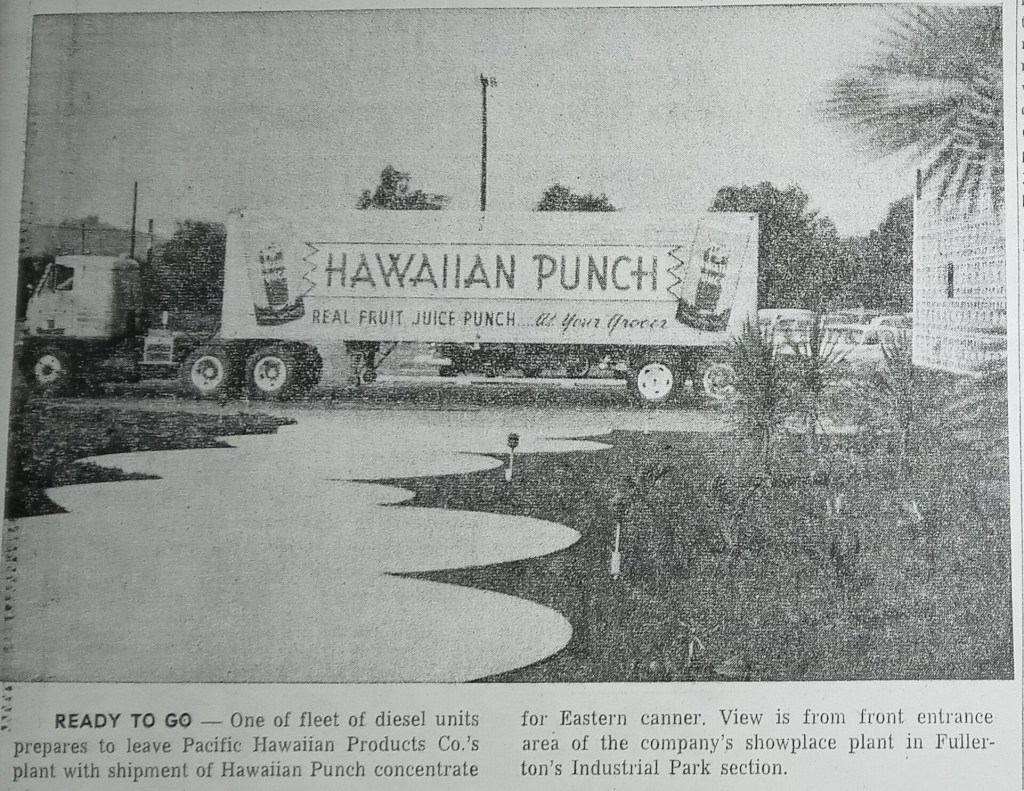
By the early 1960s, Hawaiian Punch was not only sold in grocery stores around the country, but was also available throughout the world, including on U.S. military bases.
In 1961, the Atherton-Privett ad agency created a 20-second commercial to advertise Hawaiian Punch drink, which introduced the world to Punchy, the popular mascot.
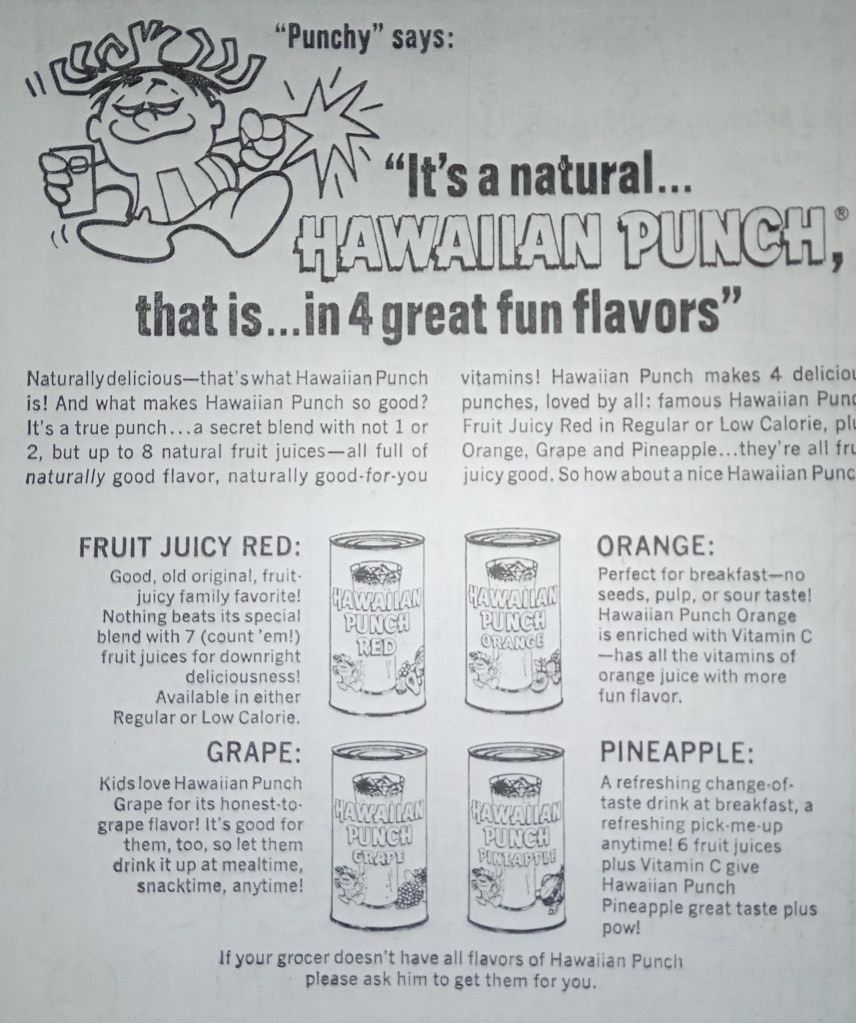
“Hey! How ’bout a nice Hawaiian Punch?” Punchy asked another man.
“Sure,” was the response.
Punchy proceeded to punch the man in the face. Artist Martin Mandelblatt is credited with the creation of Punchy.

In 1963, the company was acquired by R.J. Reynolds, the tobacco company, as part of their entrance into the food and beverage industry.


By 1967, Hawaiian Punch was sold in 230,000 grocery stores and was the best-selling fruit punch in the world.
In 1978, a disgruntled employee vandalized the company headquarters.
A 1978 Fullerton News-Tribune article entitled “Hawaiian Punch Plant Custodian Questioned About Monday Damages” reported:
An 18-year-old local man has been detained by police for questioning in connection with the extensive vandalism committed at the RJR Foods (Hawaiian Punch) plant at 360 S. Acacia Ave. Monday night.
Held since yesterday in the city jail pending further investigation and the filing of formal complaints is Jesse Le Tyree, Jr., a custodian at the plant. He was booked on charges of felony vandalism and suspicion of burglary.
Vandalism at the plant included destruction of vending machines, overturned office desks and file cabinets, plants uprooted and thrown into offices, files scattered all over the floor, and a forklift rammed into numerous 52-gallon barrels of syrup concentrate, allowing the syrup to spread across the warehouse floor.
The syrup loss alone was valued at in excess of $10,000.
Okay, here I must interject. It’s a little weird that this disgruntled employee had a name that was very similar to mine. However, I was born in 1979, so it was not me, I swear.
In 1978, RJR began to employ television personalities Donny and Marie Osmond as Hawaiian Punch advertising spokespeople.
In 1981, RJ Reynolds transferred Hawaiian Punch to another of its major food subsidiaries, Del Monte.
In 1990 Proctor and Gambled acquired Hawaiian Punch.
In 1992, a clever presidential promotion campaign targeted children ages 6 to 13 with Punchy as the favored candidate (“No one else has the punch”).
In 1999, Cadbury Schwepps, which became a subsidiary of Kraft Foods, acquired Hawaiian Punch.
Today, Hawaiian Punch is operated by the Dr. Pepper Snapple Group.
 Fullerton History
Leave a comment