The following is from a work-in-progress about the history of Fullerton. You can support my ongoing research and writing on Patreon.
The Local History Room of the Fullerton Public Library has microfilm from the Fullerton Tribune newspaper stretching back to 1893. I am in the process of reading over the microfilm, year by year, to get a sense of what was happening in the town over the years. Here are excerpts from some of the articles from 1904.
Click HERE to read highlights from previous years.
Incorporation
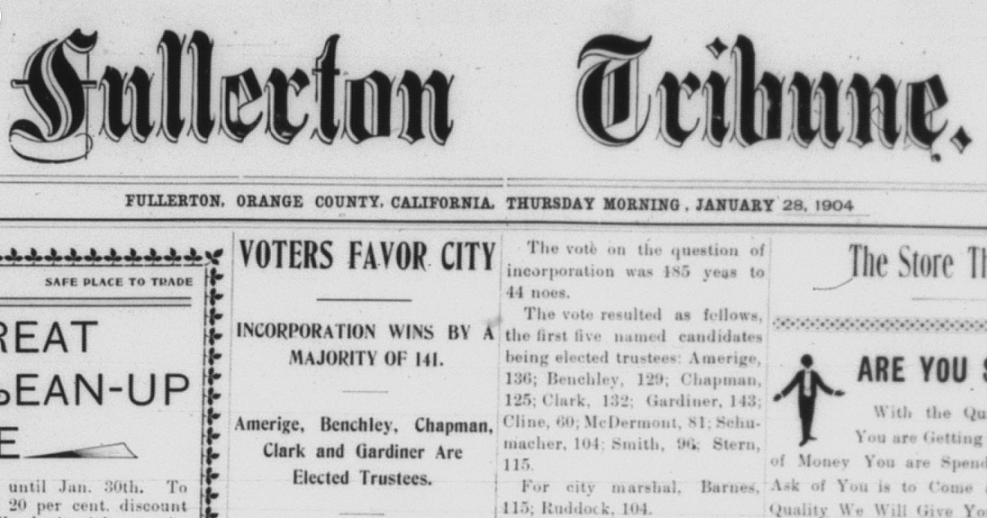
Perhaps the most significant event of 1904 was incorporation. Residents voted to establish Fullerton as a city, complete with a Board of Trustees and taxation powers. The first Board of Trustees (now called City Council) was Edward Amerige, E.K. Benchley, Charles Chapman, George Clark, and John Gardiner.
Additionally, W.A. Barnes was elected city marshal, George Ruddock was elected City Clerk, and J.E. Ford was elected city treasurer.
Prohibition
Easily the most divisive local issue in 1904 was prohibition–whether or not to allow saloons in town. Saloons had been essentially banned since 1894 (based on an ordinance passed by the County Board of Supervisors). But now that Fullerton had its own Board of Trustees, the liquor question was re-opened. The Board of Trustees decided to put the question to a town vote as part of a larger city election.
In the newspapers leading up to the election, the Tribune printed editorials for and against prohibition, as shown below.

Ultimately, a majority of residents voted to allow saloons downtown.

New City Laws/Civic Improvements
The newly-established Board of Trustees began to pass a series of ordinances. They established a fire protection district, a board of health, franchises with telephone, gas, and electric companies, built new sidewalks, and made street improvements.
They also passed ordinances prohibiting some things in town, most of which make sense–no fighting in the streets, etc. But some of the town prohibitions seem quite harsh, such as bans on vagrancy and cross-dressing.
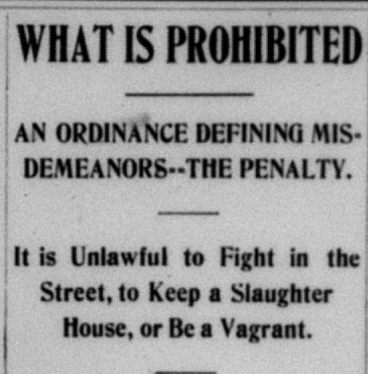
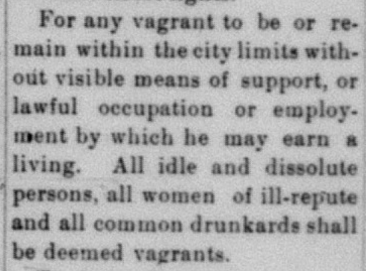

There was some conflict over the appointment of a postmaster for Fullerton. This was a position appointed by local congressman Daniels. Although a petition with 500 signatures advocated the appointment of Cora Vail, Congressman Daniels appointed Vivian Tresslar (a man), allegedly at the request of Mayor Chapman.
“Captain Daniels has announced that he will absolutely refuse to recommend the appointment of any woman for the position,” the Tribune stated.
Tresslar was also the hand-picked editor of the Tribune’s rival newspaper, the Fullerton News–which was bankrolled by Mayor Chapman.
Oranges!
A major industry of early Fullerton was oranges. One unique feature of the citrus industry was the fact that growers would pool their resources to market and ship their product. There was some debate at this time over the value of a “union” of this type.
Another article in the Tribune written by “one of the laborers” urged the workers to form a union of another kind–a worker’s union.

Here is the full text of the above (right) article:
The Tribune has received a communication signed “One of the Laborers,” which advocates increased pay for ranch laborers in this section and their organization into a union to attain that object.
The communication, addressed “To Whom it May Concern,” begins by stating that the American laborers in the Placentia district have a grievance in regard to their monthly pay. The writer says that the workers want a reasonable price for their day’s work, and cites the action of the Ventura laborers who organized a union, and decided not to work for less than $30 a month. The advantage of a union is then urged, and the local workers are called upon to organize for the purpose of getting their “price.” The communication declares that they now get 95 cents a day, which is denounced as a “regular outrage.” The warning is made that the workers will not stand for this “slavery any longer than the present time.”
After commenting that the hired man is “looked down on, snarled at,” the communication states that he is often forced to sleep in the barn, and concludes as follows:
“Boys, what do you think of that? We are not permitted to sleep in the house after a hard day’s work. We are brothers in Christ Jesus, born of one flesh and blood, and we ought to have a tender feeling for all. But after all of that the cold-hearted rancher sends his hired man to the barn to sleep with the living creatures that inhabit therein.”
On the same page as the above article was another entitled “The Chapmans Entertain Their Friends and Neighbors”:
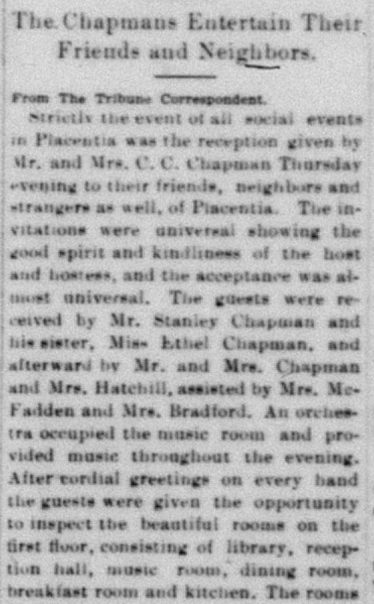
Here is the full text of that article:
Strictly the event of all social events in Placentia was the reception given by Mr. and Mrs. C.C. Chapman Thursday evening to their friends, neighbors, and strangers as well, of Placentia. The invitations were universal showing the good spirit and kindliness of the host and hostess, and the acceptance was almost universal. The guests were received by Mr. Stanley Chapman and his sister, Miss Ethel Chapman, and afterward by Mr. and Mrs. Chapman and Mrs. Hatchill, assisted by Mrs. McFadden and Mrs. Bradford. An orchestra occupied the music room and provided music throughout the evening. After cordial greetings on every hand the guests were given the opportunity to inspect the beautiful rooms on the first floor, consisting of library, reception hall, music room, dining room, breakfast room and kitchen. The rooms on the second floor were then shown. The guests were then invited to the third story which proved to be a hall strictly in keepinig with the rest of the house. Here the guests were seated and most thoroughly enjoyed an entertainment.
Dainty refreshments were served in the breakfast room and then after a littel longer social intercourse and a last lingering look the guests bade their host and hostess and family good night.
The above contrast between the situation of the workers and the lavish mansion of Chapman, the mayor and wealthiest orange grower, speaks to the social divisions of the day.
Oil!
The other major industry in Fullerton was oil. One ongoing issue was a conflict between the local Puente Oil Company and the mega-corporation Standard Oil. Apparently, Standard was using some shady tactics to undercut their local rival.
In 1911, the U.S. Supreme Court would order the breakup of Standard Oil because it was an “illegal monopoly.” Many of today’s major oil companies are descendants of Standard, including ExxonMobil, Chevron, and BP.

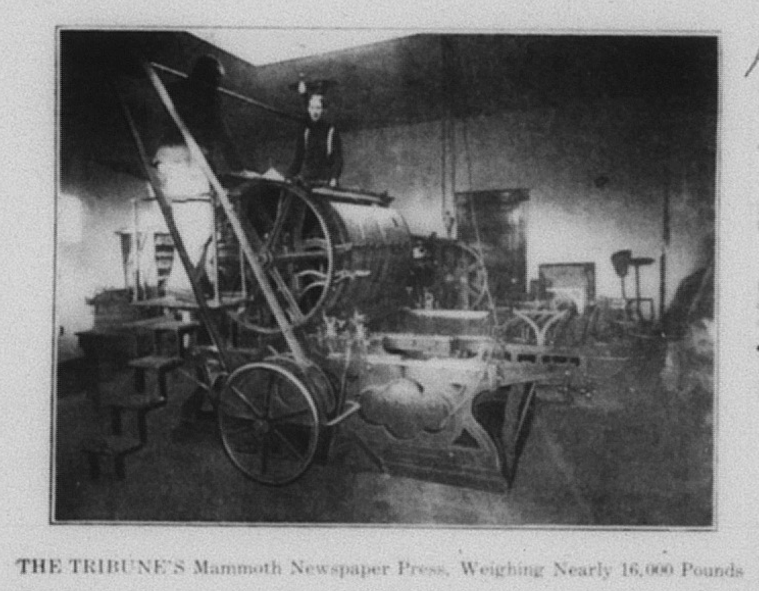
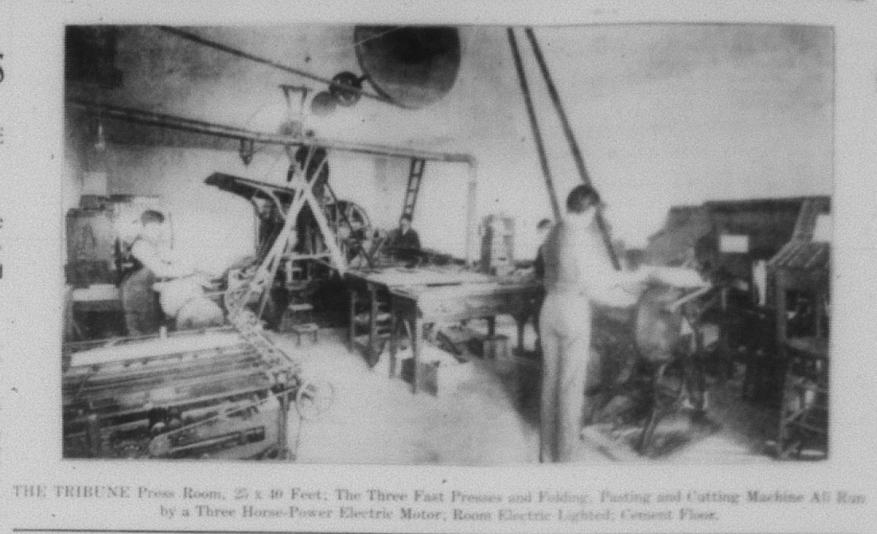
Inside the Tribune Building
To commemorate its 15th anniversary, the Fullerton Tribune published a brief history of the paper, and included some photos of the inside and outside of the newspaper’s building.

Water
Because Fullerton was a growing agricultural area, obtaining a regular water supply was extremely important. At this time, much of the water supply came from the Santa Ana river and underground wells. The vastness of the underground aquifer was not well understood. The company which controlled the water of the Santa Ana river in north Orange County was the Anaheim Union Water Company.

Miscellaneous
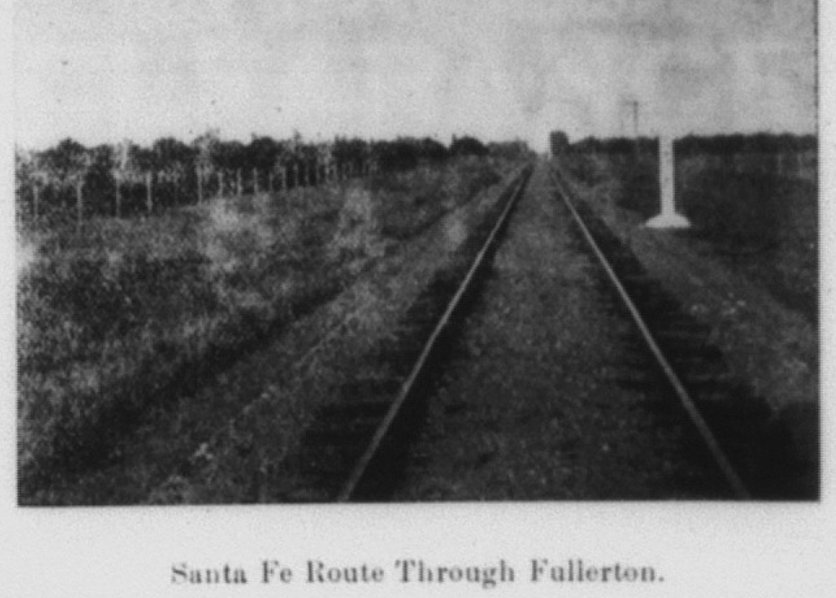
And here are a few random/miscellaneous clippings from the 1904 Tribune:



Stay tuned for headlines from 1905!
 Fullerton History
Leave a comment