The following is from a work-in-progress about the history of Fullerton. You can support my ongoing research and writing on Patreon.
Charlotte “Polly” Gobar Snyder was interviewed in 1981 for the Fullerton College Oral History Program. Here are some highlights from this interview.
She was born in Durand, Wisconsin around 1899. Her father was Dr. Frank Joseph Gobar. Her grandfather had been a doctor in the Civil War.
In 1901, the family moved to Trask, Oregon where they lived on a farm on a timber claim and had a small hotel.
In 1906, the family moved to Fullerton. They stayed with their friends the Blybacks while they got established.
She had seven siblings, all of whom graduated from Fullerton High School.
At first the family lived at 224 West Amerige in a small two bedroom house (it’s now the parking lot of the police department). Her father had his doctor’s office in the front bedroom. Eventually, they moved to 361 West Commonwealth, where the public library is today.
Fullerton was young, with about 1725 people.
Her father was a surgeon for the Santa Fe railroad company in the early years. He would travel to the oil fields in Olinda and Brea Canyon before there was a town of Brea. He was one of the first ones to have an automobile in town and, according to Snyder, the first one in Fullerton to have an electric washing machine.
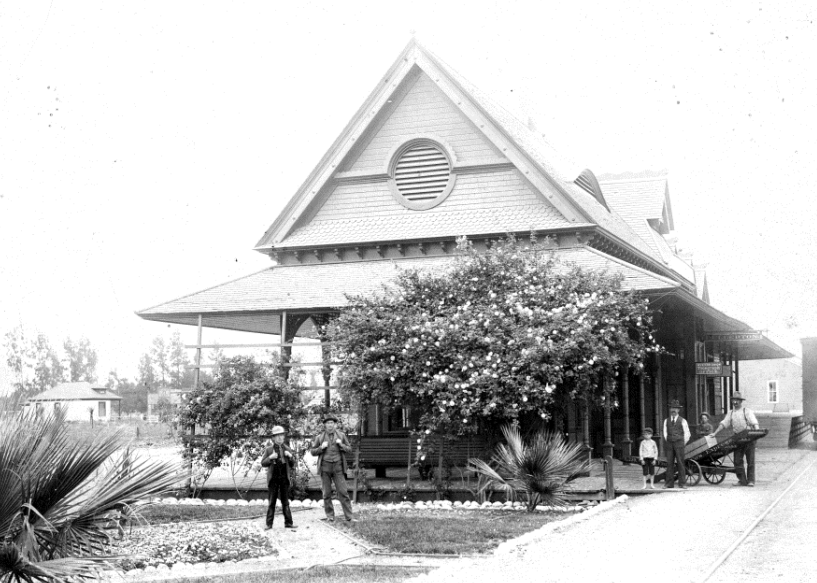
On her family’s property, there was “a big red barn at the Amerige end…with three large pepper trees close at hand. We had two cows for awhile and some chickens and pigeons. Part of the barn at the west end near Short Street [now Library Ln.] was converted into a garage for the new Kissel Kar. It was red, without a top, two seats in front and two in back. Formerly Papa had had a Rio and a Tourist automobile. The car was for Papa’s use to see his patients in Fullerton, Brea Canyon, Olinda, and La Habra.”
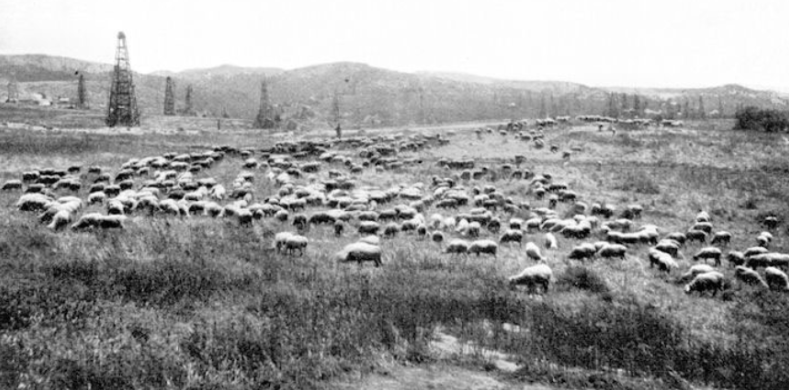
“The plateau north of downtown was owned by the Bastanchury family, Basques from Spain,” she remembers. “There were other Basque families here, and a great number of German families, as well as others. The Basques ran sheep on their thousand acres at one time…When my brother in 1927 built his home up on West Valley View on the six hundred block, across the road there were orchards that were part of the Bastanchury Ranch. We used to roam those hills and pick wild flowers and have picnics out there.”
She started second grade at the red brick grammar school—at the corner of Wilshire and Lemon, where the School of Continuing Education is today. Over on Lawrence and Wilshire (where a Fullerton College parking lot is today) was the high school, also a red brick building.

A new high school was built in 1908 on West Commonwealth (where Amerige Park is now), but it burned down in 1910. She remembers seeing the building burn: “I watched from our home across the way at 361 West Commonwealth. My three older brothers were in the fire brigade and were trying to save the building. They did save the Polytechnic Building, which was separate from the main building, and later it was moved to the present location over on East Chapman.”


After the high school burned down, the new high (and current) high school was built on Chapman Ave. Delbert Brunton was the first principal of the high school.
Before the high school was built, the land was orchards.
“There were orchards on the north side of Chapman. There were orchards east of Balcom on the east side of town. And orchards came up to Highland Avenue at Wilshire, and north of there,” she remembers. “To the south there were orchards right below Maple, which is Valencia drive now. We were surrounded by orchards, oranges, and walnuts.”
Living near downtown Fullerton, Snyder remembers the butcher, August Hiltscher, a grocery store owned by Lynn Cline, a bakery where the bus depot is now on East Commmonwealth owned by the Engmanns.
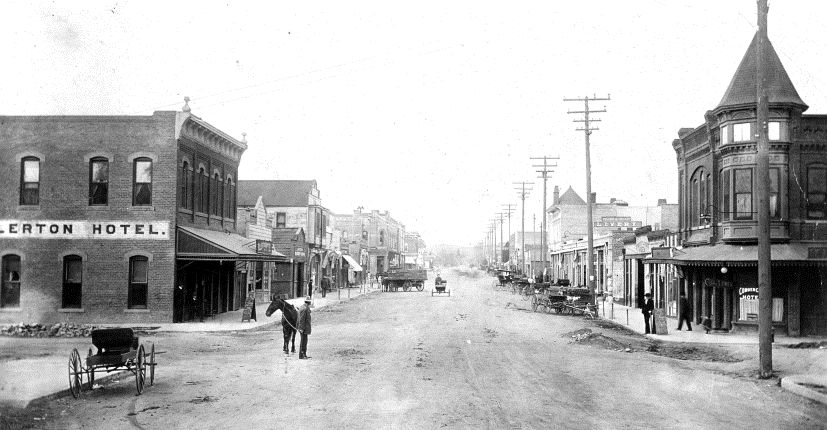
She remembers a fire in downtown Fullerton in 1908 that burned Cline’s grocery. Her brothers were in the volunteer fire department, and helped to put out the fire.
At that time, the town had a water tank west of where Villa del Sol is now, which provided water for downtown Fullerton.
For home entertainment, her brother Dave would play the piano.
Dorothy Lane, she remembers, was named for Dorothy Gage of the Gage family that lived out there when it was all orchards. Dorothy’s cousin, Ruth Dunham, married Roy Hale, “one of the Hale boys of the Placentia Hales, we called them. There were Fullerton Hales, Bill Hale’s family, and then there were Ray and Roy of the Placentia Hales.”
Other prominent families she remembers include the Knowltons (who lived at Wilshire and Acacia), the Hetebrinks, who lived in the house that still stands at the corner of Chapman and Berkeley (They had a large basement where they would host parties), the Sheppards (Carrie was the city librarian for many years), and the Dysingers.
She remembers Louis Plummer, who started as a commerce teacher and then became principal and superintendent. She babysat for Plummer’s children.
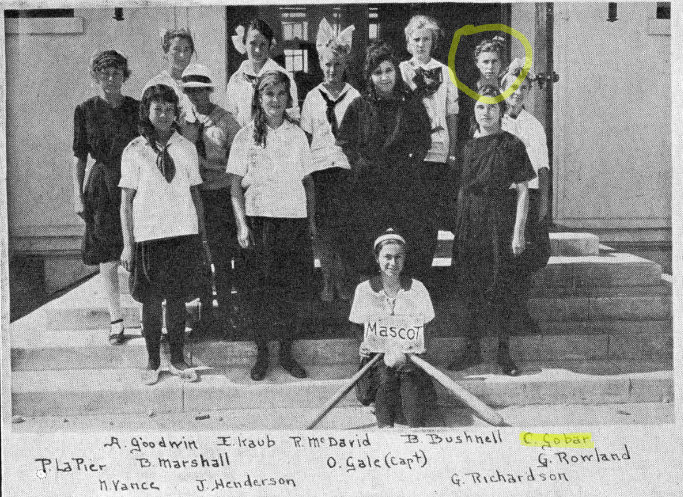
She graduated from Fullerton High School in 1918. She remembers Jessamyn West, who became a famous writer, who graduated in 1919.
She remembers the Pacific Electric “red cars” that once connected Fullerton to a vast passenger rail network.
After she graduated, she attended Fullerton Junior College, got married, and worked for the city from 1922 to 1929, for Mr. Hezmalhalch in the City Clerk’s office.
She married and had a family of three children. Her family moved for a while to Bakersfield, where her husband died in 1940. In 1942, she moved with her children back to Fullerton and worked for the water department in the newly built City Hall building, which is now the police station.

She attended the First Presbyterian Church in Fullerton. Dr. William Boyce and Dr. and Mrs. Lynn Sheller (of Fullerton College) belonged to her church.
Her children all graduated from Fullerton High School (Wilma in 1947, Fred in 1951, and Ned in 1954).
To read more summaries of oral histories click HERE.
 Fullerton History
Leave a comment