The following is from a work-in-progress about the history of Fullerton. You can support my ongoing research and writing on Patreon.
The Local History Room of the Fullerton Public Library has microfilm from the Fullerton Tribune newspaper stretching back to 1893. I am in the process of reading over the microfilm, year by year, to get a sense of what was happening in the town over the years. Here are excerpts from some of the articles from 1903.
Click HERE to read highlights from previous years.
Fullerton’s Progress
Toward the end of 1903, town co-founder Edward Amerige wrote an article describing the progress Fullerton had made up to this point. Here is the text of his article, along with some historic photos.
Fullerton, the youngest town in Orange County, has made most remarkable progress and growth during the year 1903, and is rapidly approaching the position as the second town in population in Orange County. Fullerton has already the proud distinction of being the largest shipping point in Orange County and the third or fourth position as regards shipments in Southern California. The Santa Fe railroad was compelled to put in an extra siding of 2000 feet in length the past year to accommodate the rapidly growing business of the town.
Fullerton ships annually large numbers of cars of oranges, estimated to be over 850 for the coming season; also hundreds of carloads of walnuts, grain, wool, hay, cabbage, potatoes, both white and sweet, hundreds of boxes of winter asparagus to the Chicago and eastern markets; besides large quantities of dried fruit, poultry and eggs. The country surrounding Fullerton is capable of producing the greatest diversity of products of any location in the state and is far famed for the extra quality of its oranges and fruits. C.C. Chapman, owner of the Santa Isabella ranchos and Orange groves, holds the highest record for prices obtained for oranges in the United States–$15.05 per box, besides being the largest individual grower and shipper of oranges in California. The soil and climatic conditions are such that this section is particularly adapted to the growing of the Valencia orange, the crop being harvested from May until as late as November, thereby being the latest and earliest oranges on the market, and securing the best possible prices.
Notwithstanding that over 75 new houses and buildings were erected in the town in 1903, there is not an empty store or cottage to be had here. At the present time a great number of houses are in process of construction and houses are taken as fast as they are completed.
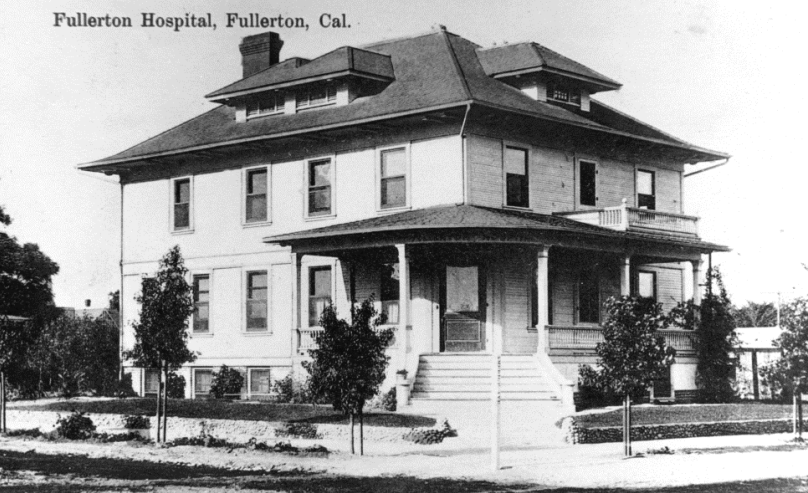
The new Fullerton Hospital, completed last August, is an up-to-date establishment and the best institution of its kind in Southern California. An efficient corps of nurses are in attendance at all times, so that patients of this hospital receive the best attention and care, which has already made the reputation of this hospital as one of the best.
Fullerton’s telephone exchange is one of the largest suburban exchanges in Southern California, outside the large cities, there being 200 subscribers, and the number is steadily increasing.
Fullerton’s mail service is as satisfactory as can be found in much larger places, there being several mails daily each way, besides the starting point of numerous rural delivery routes in northern Orange County. The salary of the postmaster has been increased twice during.
The products of the country are packed and handled in the nine large packing and warehouses adjoining the Santa Fe Railroad, which are all located in the central part of the town. Several new warehouses will have to be built to accommodate the increasing shipping business.
School facilities are of the very best, consisting of a six-room grammar school (graded) and as fine a high school as can be found anywhere. Both buildings are of brick and are large and commodious.

That Fullerton is a moral and progressive town is evidenced by the three fine church edifices here, namely, the Methodist, Baptist, and the Presbyterian, which are all liberally and largely supported.
The latest and most important move made during the year is the proposed incorporation of the town. If Fullerton succeeds in establishing a city government within the bounds already petitioned for, and on which an election will be held some time in February next, she will have placed herself on the map of Orange County as the second city in size and population and territory, and from that date whe will commence a growth that will eclipse all her former efforts. The year 1904 will see the dawn of a new era for Fullerton, eclipsing all her previous great records. Altogether the future is resplendent with roseate hues for the new city of the foothills, “Fullerton.”
Incorporation
A major local issue in 1903 was the question of incorporating the town, which would allow it to have its own government and taxation powers. Tribune editor Edgar Johnson wrote some editorials in favor of incorporation.
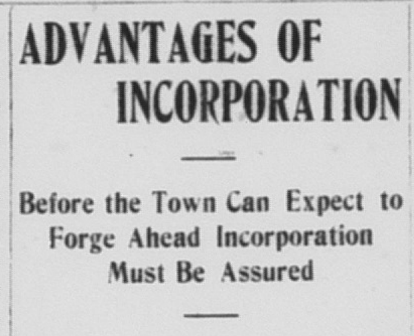
In the article above, Johnson writes: “A half-dozen men cannot lead a blind cow when all are pulling in different directions, and a town cannot advance when the people are divided into factions over minor questions, and are eternally at cross-purposes…The only question that seriously menaces the success of the question seems to be that of prohibition. Those estimable citizens who favor the suppression and annihilation of the saloon are fearful that the success of incorporation would abrogate the county prohibition law, and place the beast of intemperance in their very midst.”
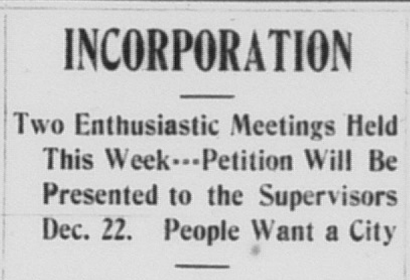
Toward the end of 1903, town leaders began to hold meetings in favor of incorporation. Those in favor included E.K. Benchley (“he believed such a move would be a success; it would give us good roads, increased values, clean streets and sidewalks”), Charles C. Chapman, and Edward Amerige. There was opposition from Orangethorpe residents like B.F. Skinner, who were opposed to increased taxation).
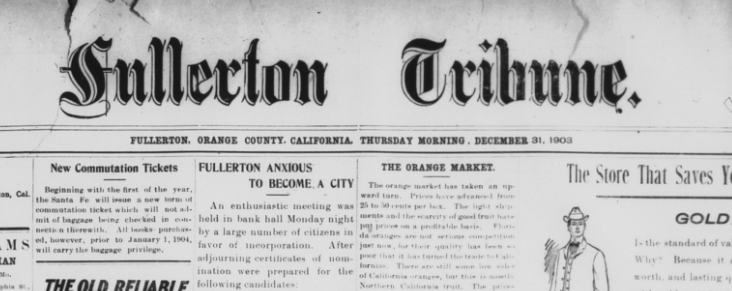
On December 31, a meeting was held to officially propose an election for incorporation. The following nominations were made:
For trustees, P.A. Scumacher, C.C. Chapman, John Gardiner, E.R. Amerige, G.C. Clark, E.K. Benchley, A. McDermont, T.W. Cline, A.V. Smith, Jacob Stern. The five receiving the highest vote will be elected trustees.
For city marshal, C.E. Ruddock, W.A. Barnes; for city clerk, G.A. Ruddock; for treasurer, J.E. Ford.
No nominations were made for assessor or tax collector as they county officials will act in that capacity.

Fullerton would vote to officially incorporate in 1904. Stay tuned for my highlights from 1904 Tribune headlines.
Temperance
An equally pressing issue in 1903 was the question of whether Fullerton would allow saloons in town. Saloons had been banned in Fullerton by county ordinance. One result of incorporation was that the newly elected city trustees could either allow or ban saloons. Those opposed to saloons included members of the Women’s Christian Temperance Union (WCTU), some local pastors, and the Anti-Saloon League.
Famous prohibitionist Carrie Nation passed through Fullerton and was interviewed by Tribune editor Edgar Johnson.
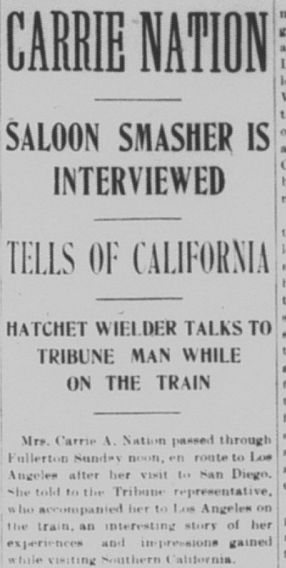
There was a highly publicized trial against a J.A. Kellerman who was accused of serving liquor in Fullerton as part of a Nationalist Club meeting. He was ultimately not convicted, as there was a hung jury.

Some local citizens petitioned the county supervisors to pass an ordinance outlawing drunkenness in town.

Oranges
Fullerton’s orange industry continued to grow.
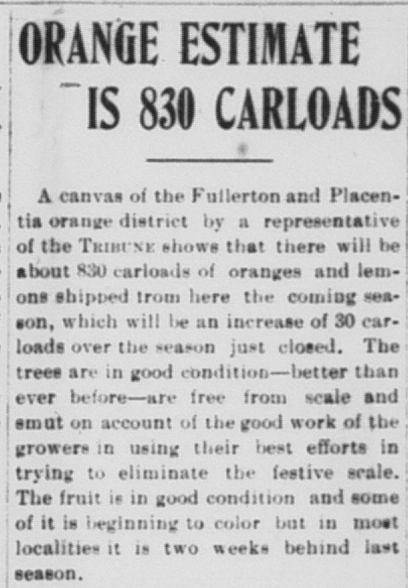
By the early 20th century, the orange industry was not functioning by the ordinary rules of capitalism and competition. Instead, the growers, shippers, and marketers were pooling their resources through Fruit Exchanges to eliminate the lower prices caused by competition.
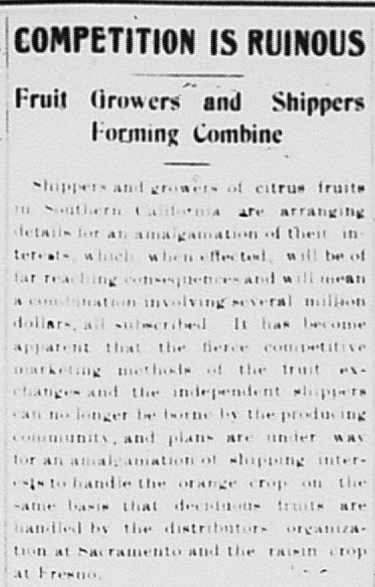
Here is the full text of the above article:
Shippers and growers of citrus fruits in Southern California are arranging details for an amalgamation of their interests which when effected, will be of far-reaching consequences and will mean a combination involving several million dollars, all subscribed. It has become apparent that the fierce competitive marketing methods of the fruit exchanges and the independent shippers can no longer be borne by the producing community, and plans are under way for an amalgamation of shipping interests to handle the orange crop on the same basis that the deciduous fruits are handled by the distributor organization at Sacramento and the raisin crop at Fresno.
In this amalgamation the fruit exchanges and the independent shippers are to participate, irrespective of past differences, and the fierce competitive battle for supremacy in selling markets is likely to be replaced by a well-organized central sales agency, through which all independent and all exchange fruit will be marketed by a single board of control. Details of this organization are nearly completed. The general groundwork of the amalgamation has been the subject of a score of special conferences held in Los Angeles during the last three weeks.
President A.H. Naftzger of the Southern California Fruit Exchange, acting by authority of these organized interests, has been in consultation several weeks with prominent independent shippers, and a working basis upon which all of these competitive factions will be amalgamated is the probably outcome.
Scope of work to be undertaken by the new organization, if it reaches final accomplishment, assumes to control marketing from the packing house to the jobber, eliminates various organization expenses, and stops the ruinous cutting of prices by competitive selling…Names of all the leading fruit shipping houses as well as the fruit exchanges collectively and separately have been definitely connected with the deal and its consummation may be looked for in the next few days.
Since the above was put in type the agreement between all parties has been made and provides that the Southern California Fruit Exchange shall permanently control 50 percent of the stock of the California Fruit Agency, that local exchanges shall be represented on the Board of Directors, in like matter as they are now represented on the directorate of the Southern California Fruit Exchange, and that the independent shippers shall be represented according their interests. These shippers include the Earl Fruit Company, the Fay Fruit Company, Ruddock, French & Co., Gregory Co., Spruance Fruit Co., Moulton & Greene, West American, Patte & Lett and three smaller concerns, and the fruit exchanges.
Oil!
Fullerton’s other big and growing business in 1903 was oil. An article below by Johnson gives a history of oil production in the Fullerton district:

Some seventeen years ago the first oil well ever drilled in Southern California was put down in Fullerton by the Puente Oil company on its own lease–today one of the best producers of high gravity oil in the state. For many years work on this lease went on quietly until 1893 a contract was made with the China Beet Sugar company for 80,000 barrels of oil the first year.
Since then output from this field has greatly increased. A 4-inch pipe line was at once laid from the wells to Chino, a distance of 15 miles. Oil was then worth from 75 cents to $1 a barrel but the same gravity oil from the Puente company’s lease now is worth $1.75 a barrel, as it runs up to as high as 37 degrees, gravity and most all of it is now sold for refining purposes.
The cost of drilling and equipping a well here or anywhere in California, while greater that in the eastern fields, is about uniform in all the California territory. It is estimated at from $2500 up for an average well of from 800 to 1200 feet. The wages here vary slightly, but as a tule they are about 20 percent higher than in the east.
The next oil field, which proved to be a heavy producer, was opened in the Fullerton field in the Santa Fe railroad company on its own territory, an extensive tract northeast of town, and about five miles east of the Puente company’s wells.
The Santa Fe had a large production within a year or tow after it became development work here, and for many years consumed all the oil from its Fullerton fields, and more, too, but the past two years it has been selling a good portion of its immense output for refining purposes at $1.75 a barrel, and purchasing a lot of cheap oil in Bakersfield for its engines, as low gravity oil from that field, mixed with some of the Fullerton oil, gives just as good satisfaction as oil of a much higher gravity. The Santa Fe has new over 30 wells, all good producers, on the pump here.
Soon after the Santa Fe had its work well under way, the Graham & Loftus company entered the field on an adjoining lease, and that company has since cleaned up something like $300,000 in profits during the past few years. This company opened up some of the best spouters in the Fullerton field, some of them going as high as 3,000 barrels a day. This company is now pumping a large number of wells, getting high gravity oil from all of them.
Then followed the Columbia oil company, the Fullerton Consolidated company, the Fullerton Oil Company, the Olinda Oil company all of which are in successful operation–and a number of smaller companies near the Santa Fe wells.
The next territory opened in the Fullerton field was in the Brea canyon hills, directly north of Fullerton, and about half way between the Puente Oil company and Santa Fe company leases, by the Brea Oil company and the Union Oil company. The Brea Canyon oil company opened up the biggest gusher ever tapped in any Fullerton territory, one of its gushers for a short time spouting at the rate of 24,000 barrels a day. One of the gushers on this company’s lease has paid net $142,000 during the past ten months, and it is believed this is the most wonderful well ever opened in any California field.

The Union Oil company has also been very successful with its wells in this canyon, and, like the Brea canyon company, has a large number of wells on the pump. The Union company has just installed a rotary drill which has a capacity of 3000 feet in depth, and the company is now going after very high gravity oil with the new rotary drill which is operated by two experts from the Pennsylvania fields.
A goodly part of the Fullerton oil is conveyed to San Pedro by the Union Oil company’s 4-inch pipe line, a distance of 30 miles, and from that point the Union company ships to San Francisco for refining an other purposes. The Union is the heaviest purchaser of oil in the Fullerton field, though the Santa Fe is still buying large quantities of oil here, in addition to its own output, on account of its ten-year contract with one of two companies not having expired, and which will yet run about three years. The Santa Fe moves its oil out, also the product of other companies, by a branch railroad built direct to the wells from its main line.
On account of so much of the Fullerton oil being refined and of the increasing output on the railroads and for oiling public highways there is a very strong demand here for every barrel of oil that can be produced, and the market price is now higher than ever before in the history of the Fullerton field.
There is much development work going on in the entire Fullerton field 24 hours every day, and there are…
The Fullerton field is now producing monthly nearly 125,000 barrels of oil, almost all of which is high gravity and it is believed the output will run up to between 175,000 and 200,000 barrels monthly within the next year.
At this time, as noted above, a number of oil companies, large and small, were drilling in the Fullerton fields. Over time, these would be consolidated or merged into larger companies.
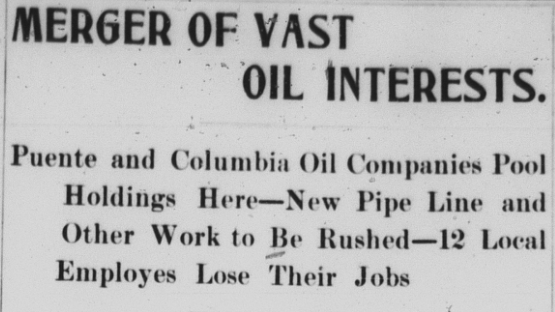
There was, in the minds of some Californians at this time, a distrust of large corporations and trusts, as shown by the avertisement below:

Town Amenities
As the town grew, so did town amenities, like a free Reading Room (a library would be built in 1907), a new telegraph office (in the office of Tribune editor Johnson), and a new hospital.

Homelessness
Edgar Johnson’s attitude toward the homeless was particularly harsh, and not that different from the attitudes of some today. Below are a couple article headlines followed by the full text of the articles.

Orange County Constables are having considerable trouble with hobos who infest its towns. Constable Llewellyn of Anaheim has been particularly active of late in making arrests.
Nearly every day from one to a dozen of these vagrants stop in that town, but they are promptly warned to get out of the limits, under penalty of arrest. Most of them take heed and disappear, but some of the more persistent remain in the face of a threatened arrest. Several of these have been given sentences of from 30 to 90 days on the Santa Ana chain gang. A few of the sentenced ones have proved to be ex-convicts or fugitives who were waned to answer criminal charges in other California towns.
One tramp arrested at Anaheim had served all but one day of his sentence when he was identified as a burglar wanted in Ventura county. After a trial there, he was sentenced to seven years imprisonment at San Quentin.
Anaheim is not alone in being bothered by these wanderers. They abound in Fullerton and vicinity in almost as great an extent as in Anaheim. The experience with some of those arrested in the town down the road is evidence that these tramps are not only an obnoxious but in some cases a dangerous element in the country.
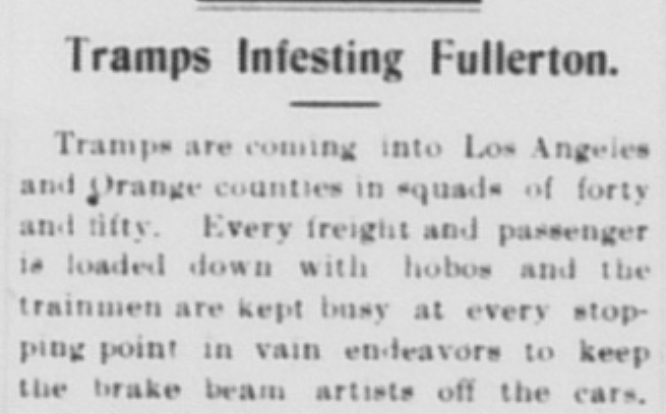
Tramps are coming into Los Angeles and Orange counties in squads of forty and fifty. Every freight and passenger is loaded down with hobos and the trainmen are kept busy at every stopping point in vain endeavors to keep the brake beam artists off the cars.
Friday and Saturday exactly thirty eight tramps were ditched at Newhall.
Twelve were arrested and the other twenty-six were ordered to move on, which they refused to do until they got ready. Railroad men running on the Coast and San Juaquin divisions of the Southern Pacific railroad report that tramps have been coming into Los Angeles in increasing numbers since the rainy season began north of San Jose and Fresno. A number of these Weary Willies have floated into Fullerton the past two weeks but they have been floated our or sent to jail by the local officers. They should be watched and given to understand that they must hove on as the “City of Fullerton” can struggle along without them. In the meantime keep your back doors locked.
Water
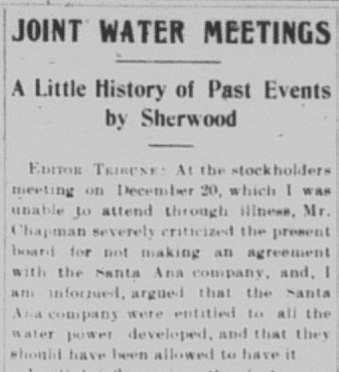
The main local water entity in 1903 was the Anaheim Union Water Company (AUWC). They had water rights to (some of) the Santa Ana River, and shared these rights with other companies like the Santa Ana Valley Irrigation Company. These were private companies whose Board of Directors tended to be owners of large, local ranches. Water rights (also called riparian rights) were a really big deal—water is life, and profits for farmers. Around 1901, these two water companies met together to bring legal action against a Mr. Fuller, “the Riverside county land-grabber” to prevent his taking water from the Santa Ana River. This would be one of many ongoing legal battles over local water rights.
In the meetings of the AUWC, there was discussion of purchasing the water rights of James Irvine, the man whose descendants founded the Irvine Company, which now owns the city of Irvine. In those early days, “maintaining an accurate division of the water [was] difficult if not impossible to devise.”
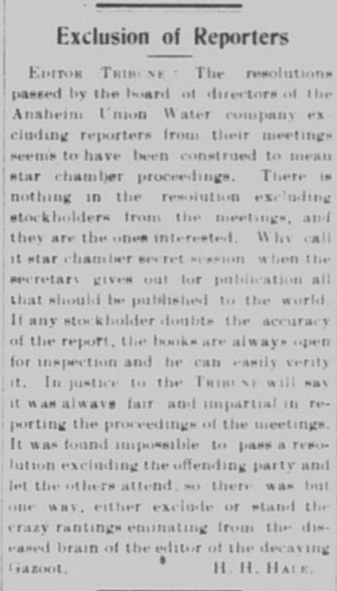
Like any political entity vested with power, the AUWC was occasionally hostile to journalists who were critical of its policies. In 1903, the Board of Directors passed a resolution excluding reporters from their meetings. Shortly thereafter, the Tribune got word that an important report had been suppressed, to which Tribune editor Johnson replied: “The best way would be to permit the reporters to attend the meetings, then the reports and proceedings would not be suppressed.”
Meanwhile, the Anaheim Union Water Company and the Santa Ana Valley Irrigation Company cut a deal to share water rights. Mr. Sherwood, a sometimes Board Member who liked to write lengthy articles in the Tribune criticizing the AUWC, took issue with the deal. To which Samuel Armor of the Santa Ana Valley Irrigation Company replied: “G.W. Sherwood seems to be afflicted with a diarrhea of words accompanied by a costiveness of ideas. For two years or more he has been filling the papers west of the river with misrepresentations and insinuations against the S.A.V.I. Co. until his followers have come to believe the the people on this side are equipped with hoofs and horns and forked tails.” To which Sherwood replied: “I have always taken pleasure in setting Armor right, when he gets tangled up in the mazes of his own alleged erudition…With regard to the proposed division of water, Armor’s premises are false and his conclusions are wrong.”
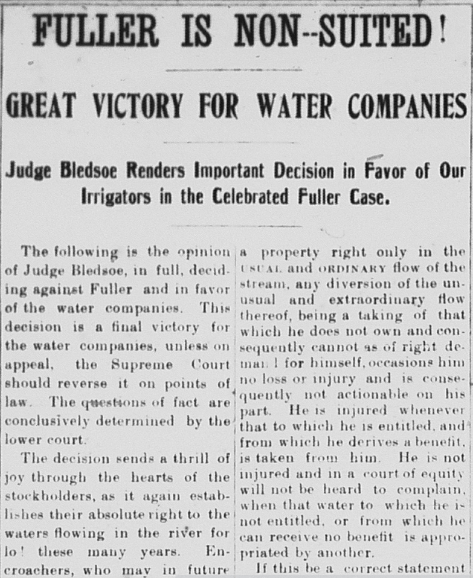
Meanwhile, Fuller, the “Riverside land-grabber” lost in court. An article gleefully proclaiming FULLER IS NON-SUITED! stated: “The decision sends a thrill of joy through the hearts of the stockholders, as it again establishes their absolute right to the waters flowing in the [Santa Ana] River for lo! these many years. Encroachers, who may in the future attempt to divert the water from its natural course, will please take warning. The decision further cements our rights to the life-giving fluid.”
Other News
Edward R. Amerige, who was Fullerton’s representative on the California State Assembly, was advocating for splitting northern and southern California into two states. This, or course, did not happen.

Long time rancher Theo Staley passed away at age 63.

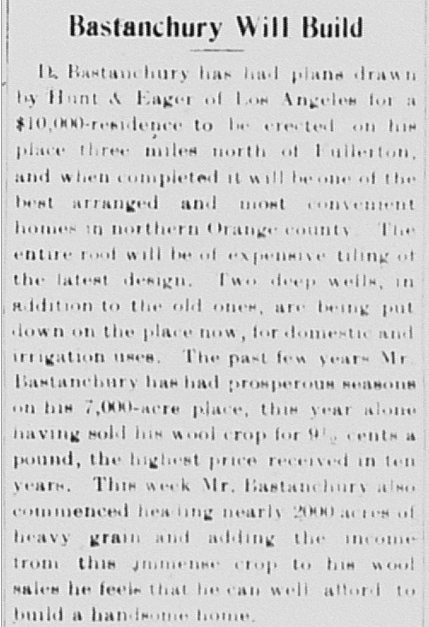
The Bastanchurys built a new home for themselves.
Stay tuned for headlines from 1904!
 Fullerton History
Leave a comment