The following is from a work-in-progress about the history of Fullerton. You can support my ongoing research and writing on Patreon.
Orla Jencks was interviewed in 1971 by Anne Riley for the Fullerton College Oral History Program. Here are some highlights from this interview, along with some historic photos of things he mentions.
He was born in South Dakota around 1895. In 1913 he moved with his parents to Fullerton, and was enrolled in Fullerton High School. He was one of the first to attend high school in its third (and current) location.
The population of the town was about 2,500 people.
He lived on the 700 block of West Commonwealth, on a small orange ranch.
He remembers the first high school principal, Delbert Brunton as well as the principals that followed–Louis Plummer and Mr. Redfern.
Jencks became good friends with Plummer and the manual training teacher R.A. Mardsen–he remembers playing tennis and fishing with them.
He describes a one-handed African-American pitcher on the high school team.
“Of course, we had no such thing as race relations and we had a one-armed colored boy and he could pitch the baseball like nobody’s business,” he said. “He could really throw. He wasn’t a large fellow…Some fellow would think ‘A one-handed pitcher, he can’t do anything.’ He’d just smile at them, you know, and fire one through and he’d fan them like nobody’s business.”
As a young man Jencks worked on the Chapman ranch, which was on the east side of Fullerton and stretched into Placentia. Chapman’s ranch was adjacent to Edward Atherton’s ostrich farm, and Jencks remembers:
“On real hot afternoons I’d have to stop and let the team rest just a little bit. So I’d grab a few oranges off and throw them over in the pasture, and the ostriches would come trotting over and they’d pick them up and have about three of them in their throat, one here and one going down. You could see them gliding down.”
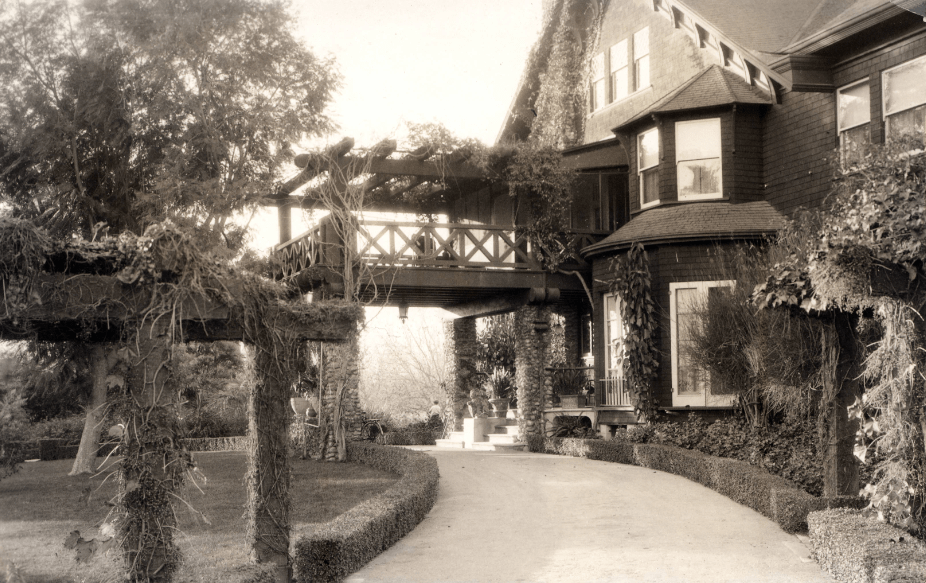
The Chapman Ranch house was near the corner of State College Blvd and Commonwealth.
After graduation, he attended Fullerton Junior College when it was still in its infancy and shared a campus with the high school. His class of 1917 had 54 students.
“And as soon as I graduated from high school, World War I was waiting for me,” he remembers. “it was conscription then, and I just didn’t want to go in the Army. I didn’t like the Army. So, I tried for the Navy and finally got in. I was over in the European area during the war.”
Eventually, after the war, he went to work for Standard Oil and stayed with them for 32 years. Later he served as a director and chairman of the board for the Fullerton Savings and Loan.
He remembers how, when drilling for oil, they would find clam shells and other sea fossils because millions of years ago “all of this country at one time was sea bed. The bottom of the sea.”
He remembers the Santa Ana River before it was channelized.
“From Anaheim to Santa Ana was nothing but a sand road, no bridges,” he remembers. “You had to have a team of horses to get you across the river down there. You couldn’t go across when there was water in it because the quick sand might get you, so we’d go down there when it was dry.”
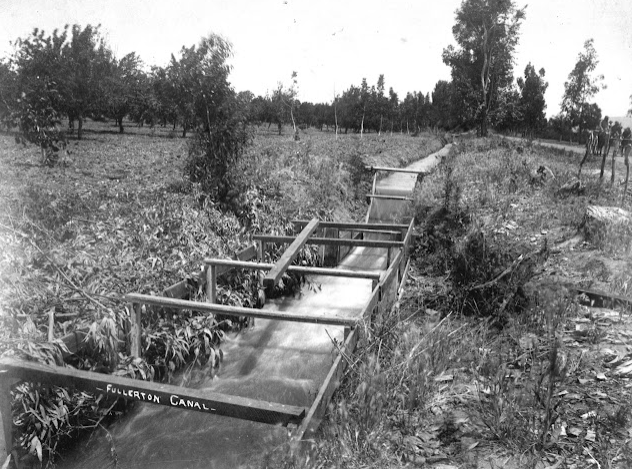
The Anaheim Union Water Company would allocate water from the Santa Ana river for farm irrigation and domestic uses. Further up the river, the water went to the Santa Ana Valley Irrigation Company.
“They’d let the water out in ditches all through and clear down on…[to] West Commonwealth about a mile or two,” he said.
Jencks discusses automobile races that would pass through Fullerton.
“They used to have cross-country races, automobile races from Los Angeles to Phoenix. And that was in the days when Barney Oldfield was a race driver, and he used to come through Fullerton, to go down to Blythe to get across the Colorado River to go across the sane hills to get to Phoenix. And he’d come through Fullerton and he had, now we’d call it, a pretty crude car, but it made a lot of noise,” he said. “He’d come down the Bastanchury Hill, and of course, he had a little steam coming down the hill, and he’d have it wide open going through Fullerton and nobody could be on the streets. And when he’d hit the Santa Fe tracks his car would just lift off the ground, and finally it’d come back down and it was very spectacular watching him! We’d never seen anything like that, because everything we had was about like Model T Ford.”

In addition to the Bastanchurys, he remembers another Basque family, the Arroues, who had about 400 acres of land between here and Brea.
He remembers Stern and Goodman, who ran the general store in town.
“The ranchers would bring in their grain to them and they would buy it from them and if they didn’t have enough grain to pay for this year’s expenses, Stern or Goodman would give them the money. Just word of mouth–and when the year came around, they’d bring their hay and grain in,” he said. “That’s the way life went with them. They didn’t have to really use money. Just a little paper work, that was the way it was. Of course, that helped the country build here because the banks were so small that they couldn’t finance all of these ranchers around there that had to have help.”
Jencks also gives extensive information about the Bordurf family.
Henry A. Burdorf left Germany in 1868 for America. When he arrived in New York he heard that work was plentiful in California and arranged to make the trip. He traveled by boat to the Isthmus of Panama and then by mule across the Isthmus...After working in San Francisco for a year or two, he heard of a German settlement in Anaheim. He decided to come south to see the area. After working for two or three years he decided to buy some land. With two friends for neighbors, he bought one hundred acres of land on East Orangethorpe Avenue...
It was hard to make a living at dry farming, and Mr. Burdorf was instrumental in bringing water from the Santa Ana River. It was later known as the Anaheim Union Water Company.
After the families began to grow it was necessary to build a school. Mr. Burdorf was a member of the first school board, and they built the first school house at the corner of Wilshire and Harvard, known as the Old Red Brick School.
As time went on the family grew until there were nine children in the family and their names were Henry, Marie, Sophia, Dorotny, Anne, Diedrich, Rebecca, Augusta, and Eleanor. All of the children went to school in the grade and high schools of Fullerton.
 Fullerton History
Leave a comment