The following is from a work-in-progress about the history of Fullerton. You can support my ongoing research and writing on Patreon.
Blanch Elder Hale was interviewed by Jackie Malone in 1980 for the Fullerton College Oral History Program. She came to California with her family in 1908 when she was ten years old. Her father, George Elder, was to work in the oil fields in Olinda, a community east of Brea which no longer exists. In the interview, Hale talks about her family and their life on the Stearns Lease in Olinda, about going to school in Fullerton, and later working in the Union Oil company field office.
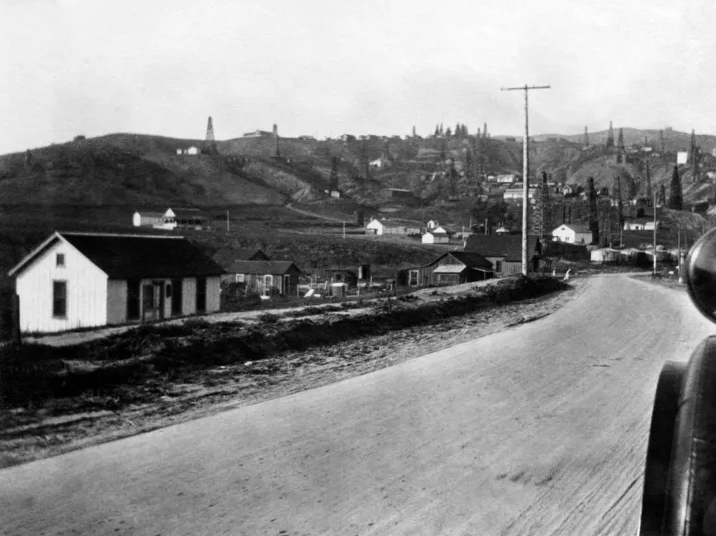
Hale was born in Alvy, West Virginia in 1899. The family moved to California in 1908 after her father’s store burned down.
“Fullerton was a small town then, not very large. The business district was only about two or three streets along Spadra, from Commonwealth to about Wilshire,” she said. “To get to Olinda from Fullerton my dad rented a two-seat buggy with two horses from Marcos Andrade who had a livery stable in Fullerton and one in Olinda.”
In 1909 the family moved to Olinda onto the Stearns lease, which was owned by the Union Oil Company and her dad worked there for Union Oil.
The Stearns lease “was several thousands of acres. The Stearns camp was about half way to Brea. At the camp they had a boarding house and bunk houses for the single men,” Hale recalls.
She was the oldest of five children with four brothers: Ray, Carl, Paul, and Burl.
Union Oil had the practice of allowing workers to build their own houses on the property, “So my dad and mom walked the hills up there until they found this one spot where there was just one house about a block away and they chose that spot.”
In addition to the oil fields, Hale remembers, “We used to have all these beautiful groves. It was a beautiful drive to Fullerton, and the road was only two lanes.”
She remembers when “We had a lot of Basque people around here…The Bastanchurys…There was another family named Hualde that lived on Lambert Road between the Stearns shop and Brea Boulevard where the Randolph School was. They raised sheep. The Union Oil Company would lease those hills for them to run their sheep on.
On their home they kept animals like horses, cows, chickens, a dog, and cats. They also grew much of their own food. On the Santa Fe Lease, there was a Methodist Episcopal Church, branch of the Stern-Goodman general store, and a barbershop.
The Pacific Electric Red Car ran through Brea and she recalls taking it to Los Angeles.
She remembers buying vegetables from the vegeterian/spirituaist commune in Placentia: “They intermarried, and so some of them were a little off here and there. But dad and mom would go there and buy the most beautiful plums and prunes.”
Her grammar school was located in the middle of what is now Carbon Canyon Regional Park. The school moved to Brea when they built the dam.
She attended Fullerton High School, starting in 1915, taking a bus each day from Olinda. Roy Hale, who would years later become her husband, drove the school bus. When she first attended high school, the principal was Delbert Brunton, and then Louis Plummer.
In high school, she played basketball and tennis. She remembers the football rivalry between Fullerton and Santa Ana high schools. At that time, there was an African American football star named Hazel Smith.
“I think he was the only black person who went to school,” she remembers. Due to racist housing politics, there were not many African Americans in Fullerton, and they lived south of the train tracks.
Once a week, there would be an assembly at the high school with a notable speaker. She remembers seeing Helen Keller and Anne Sullivan, and governor Hiram Johnson.
She remembers how, around World War I, the oil workers formed a union for better pay and working conditions.
“A long time ago it wasn’t so good as it was after 1919, because some of the men worked twelve hours a day. In about 1916 or ‘17 when we got into World War I the men started forming company unions,” she said. “At that time they reduced the hours from twelve to eight for everybody and also gave them a raise in pay.”
Baseball was popular in Olinda: “We used to go to those ball games when they were playing in Olinda or in Brea. My brother Burl worked for Shell Oil Company and he was catcher for the Shell Oil Team.”
During the flu epidemic of 1918, her dad was the first influenza patient in the Fullerton Hospital, which was on Wilshire.
“When they took my dad in, they didn’t think he would live,” she remembers. “They had one section of the hospital just for the flu patients…my dad survived…A lot of people died in Olinda and every place around here…most every home [was affected by the flu]. My whole family got the flu. Everybody was in bed.”
She recalls how in the 1920s, there was more growth in the downtown area. She recalls buying her first car from William Wickersheim. Her dad bought his frost car Sitton’s auto.
After she graduated from high school, she (like the rest of her brothers) went to work for Union Oil in 1920, in the office.
In the days before national prohibition, Fullerton was a “dry” town, and Anaheim was not: “They had a dance hall over there. I never did get to go there, but my brothers used to go and dance there.”
When she attended Fullerton High School, and for years, the Board of Trustees wouldn’t allow students to dance at the high school function. To dance, young people would go to Anaheim.
Her second husband was Roy Hale, of the locally prominent Hale family.
Roy’s dad, Harris H. Hale, came to California in 1887 or ‘88 along with his brother William “Billy” Hale. They became orange ranchers.
“Billy Hale’s house is still standing on Chapman Avenue,” she said. “It’s the two story building on the north side of Chapman Ave. between Acacia and State College Boulevard. It’s a Montessori school now.”
Her uncle J.S. “Bub” Elder, served a councilman after they moved to Fullerton in the early 20s. Billy Hale served as mayor. Her husband’s cousin, Harold Hale, served on the Fullerton High School district board of trustees.
From 1928 to 1953, Blanche lived in Los Angeles. She worked for Preferred Theaters Corporation until 1972, when she retired.
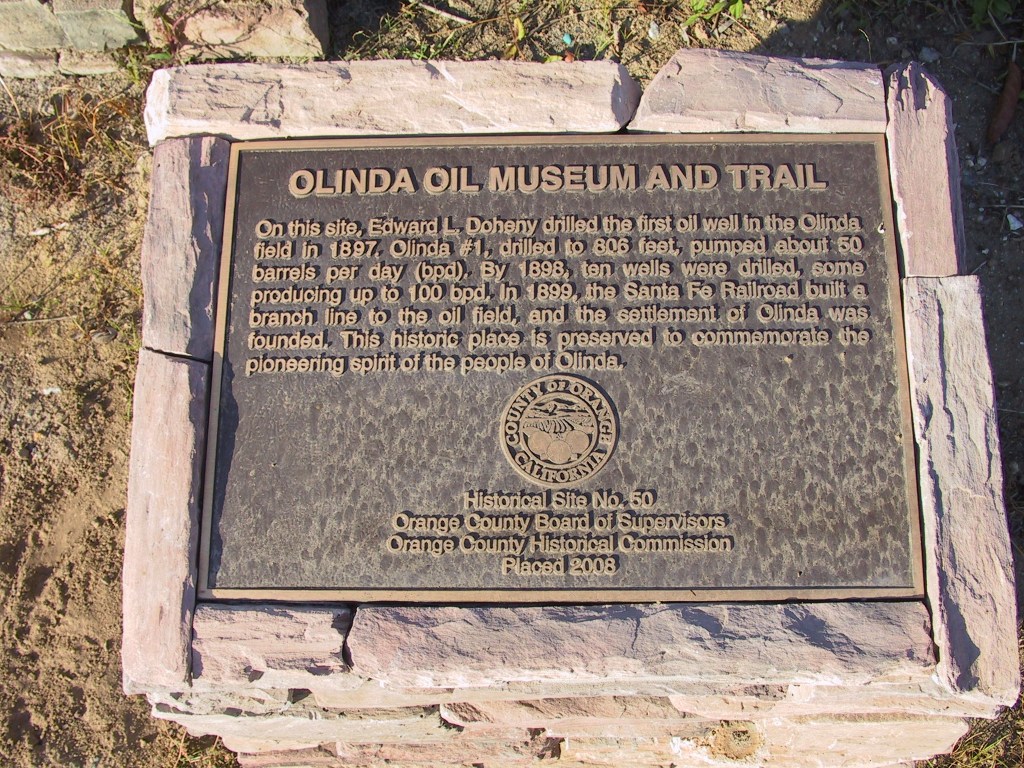
Today, although the town of Olinda no longer exists, there is an Olinda Oil Museum in Brea, which chronicles some of this history.
 Fullerton History
Leave a comment