The following is from a work-in-progress about the history of Fullerton. You can support my ongoing research and writing on Patreon.
The Local History Room of the Fullerton Public Library has microfilm from the Fullerton Tribune newspaper stretching back to 1893. I am in the process of reading over the microfilm, year by year, to get a sense of what was happening in the town over the years. Here are excerpts from some of the articles from 1901.

Local News
Fullerton Votes Against Incorporation
There was a failed vote for Fullerton to incorporate as a city, which would allow for more local control and taxes for things like roads and other infrastructure. Some of those who were against it, like E.K. Benchley, were concerned that it would raise their taxes.

Tribune editor Edgar Johnson was in favor of incorporation, and printed some editorials giving reasons for his point of view.

Evidently, those in the adjacent towns of Orangethorpe and Placentia were (mostly) against Fullerton incorporating.

Fullerton would not officially incorporate until 1904.

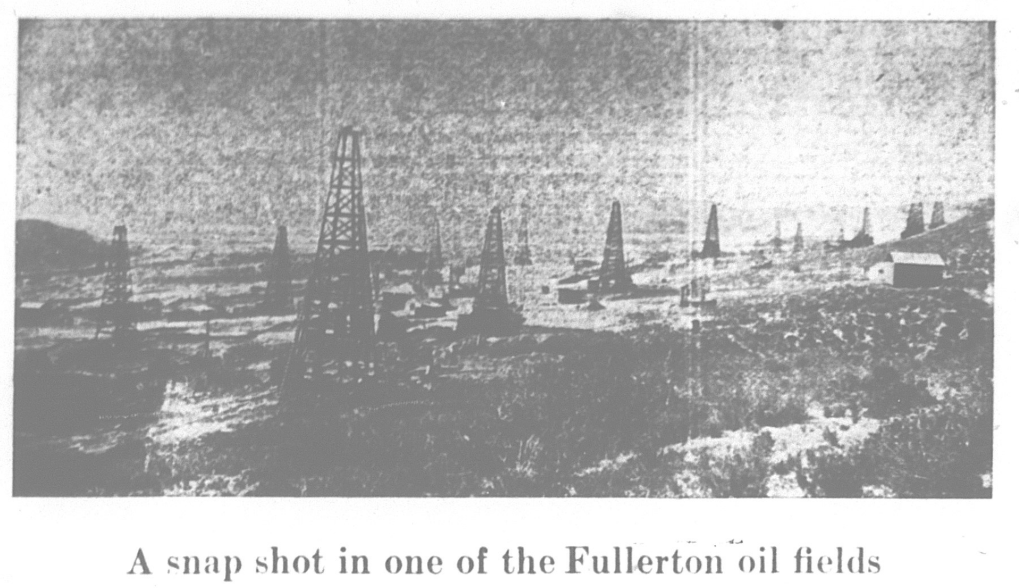
Fullerton Oil Field
In 1901, oil continued to be an important and growing industry, alongside oranges. Most of the oil fields were in the hills of the north part of the town, like Coyote Hills.


When Des Granges Rode the Goat
This funny little poem was printed alongside an article about local farmer Otto Des Granges joining the local Masonic Lodge. In the early 20th century, “riding the goat” was a slang term for joining the Masons–which were quite popular locally.

Orange County’s New Courthouse
In 1901, the Old Orange County Courthouse in Santa Ana was the New Orange County Courthouse.

Local Businesses
Stern & Goodman’s Department store on Spadra (now Harbor) and Commonwealth expanded to a new “annex” building beside it. The Downtown area was growing.


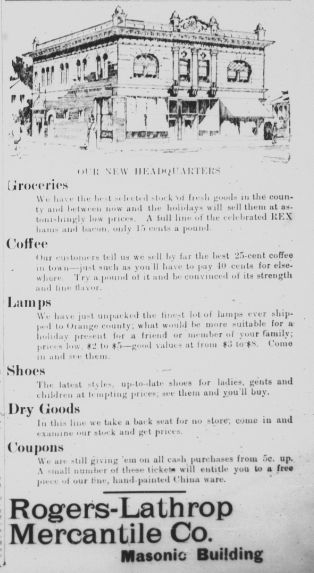
The Rogers Lathrop Mercantile Company was located on the corner of Spadra and Amerige. This building still exists. Actually, I am typing these words in Made Coffee, which is right next to this building.
The orange industry continued to grow. Here’s a photo of a packinghouse.

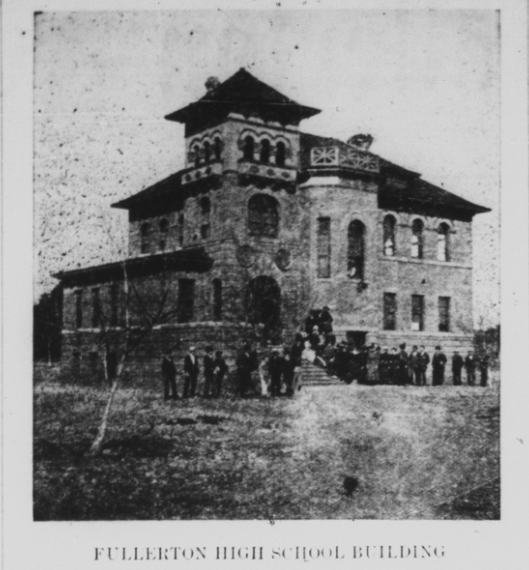
Fullerton High School Building
Here’s a photo of the original Fullerton High School building, which does not exist any more.
Bike Lanes
As the city grew, there was movement for better roads, and also bike lanes.

The Electric Line
The Pacific Electric Line would eventually connect Fullerton with a sprawling public transit system.

Odd Fellows
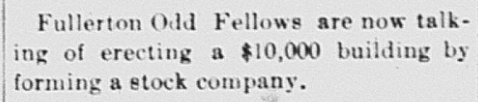
The Odd Fellows were another fraternal organization like the Masons. They eventually built their building on Commonwealth, which still stands today and is one the National Register of Historic Places.
Wilshire’s Socialist Magazine
H. Gaylord Wilshire, who was one of the original investors and builders in Fullerton (Wilshire Ave. is named after him) was a socialist who started a paper that was eventually banned in the United States. Wilshire was known as “the millionaire socialist”–a term full of apparent contradictions.

Constable Pendergrast
Fullerton’s first lawman was constable A.A. Pendergrast, who apparently took ill and sought healing in the hot springs of Riverside.

National and International News
War in the Philippines
In international news, the Philippine-American War continued, which was a consequence of the Spanish-American War.

President McKinley Assasinated
In 1901, president William McKinley was assassinated and succeeded by Theodore Roosevelt.

Farmers on Reciprocity
Local rancher Charles C. Chapman organized a farmer’s club. One of their purposes was to urge congress to pass tariffs and treaties on international imports, to protect their business from competition with foreign growers.

Stay tuned for more headlines from the 1902 Tribune!
 Fullerton History
Leave a comment