The following is from a work-in-progress about the history of Fullerton. You can support my ongoing research and writing on Patreon.
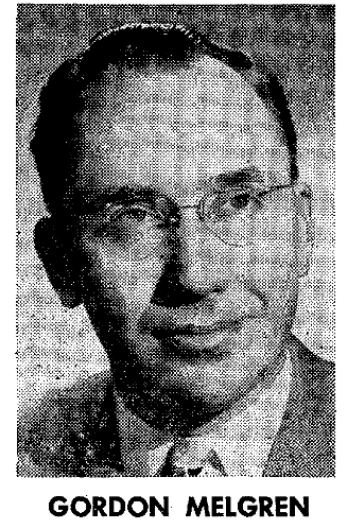
Gordon Melgren was interviewed by Anne Riley for the Fullerton College Oral History Program in 1977. Melgren had retired that year after 31 years with the college. He taught history and political science, and was the first person to hold the position of Dean of Instruction, a position he held from 1955 to 1962. Here is a summary with some highlights from that interview:
Gordon Melgren was born in Chicago. His parents died when he was very young so he grew up with his grandparents in northeastern Kansas. He graduated from KU, and worked as a schoolteacher before he “did what many mid-westerners did in the late thirties,” and moved to the west coast, eventually settling in California.
During World War II, he enlisted and served in the European Theater for nearly four years.
After the war, in 1946, he got a job at Fullerton College, teaching history and government. He was hired by Dr. William Boyce.
After the war, Melgren said, “The GIs just streamed in…virtually doubling the enrollment…Then came the Korean War, and the enrollment dropped again.”

“The really big growth didn’t come until after the Korean War,” Melgren said, “when in addition there was this big onslaught in the population movement into California…[and] the change from a small, almost family-like, local institution to one serving a much larger area with lots of out-of-state students.”
Melgren became dean of instruction in 1955; he he describes the years 1955 to 1962 as “the years of the most fantastic growth from the standpoint of the building program and the student growth, ending with a student body in ‘62 of over eight thousand daytime students…In those years we were bringing in new teachers at the rate of 20 and 30 a year.”
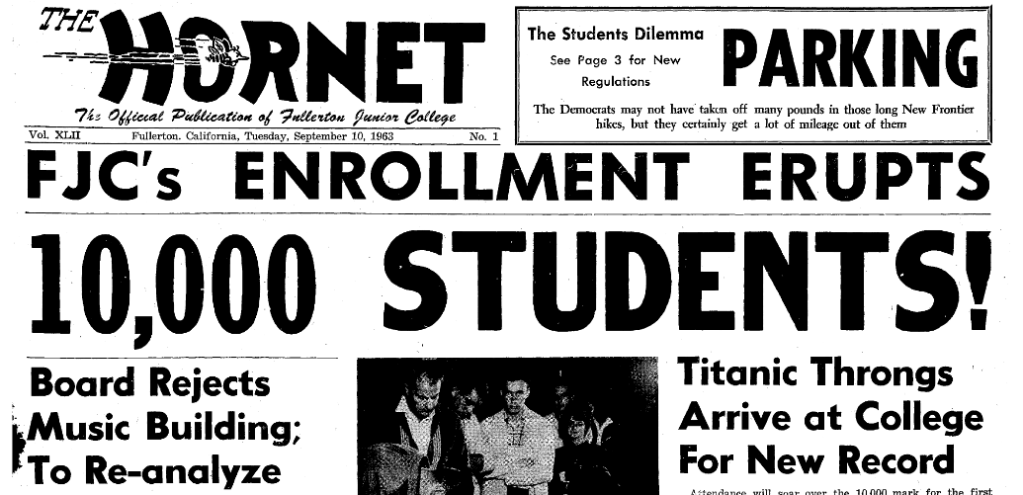
In these years, the city of Fullerton was experiencing a massive population boom, and the landscape was changing from agricultural to more urban and industrial. The new industries created a big demand for an educated workforce.
“The press for manpower in those years, unless you lived through it, you couldn’t believe it,” he said. “There were shortages of teachers, and shortages of engineers, and shortages of doctors. We had an exploding population, and more than that, we had a demand for more health equipment, more sophisticated industrial equipment and even gadgetry. It’s an era in American history we’ll have a hard time to duplicate, if we ever do.”
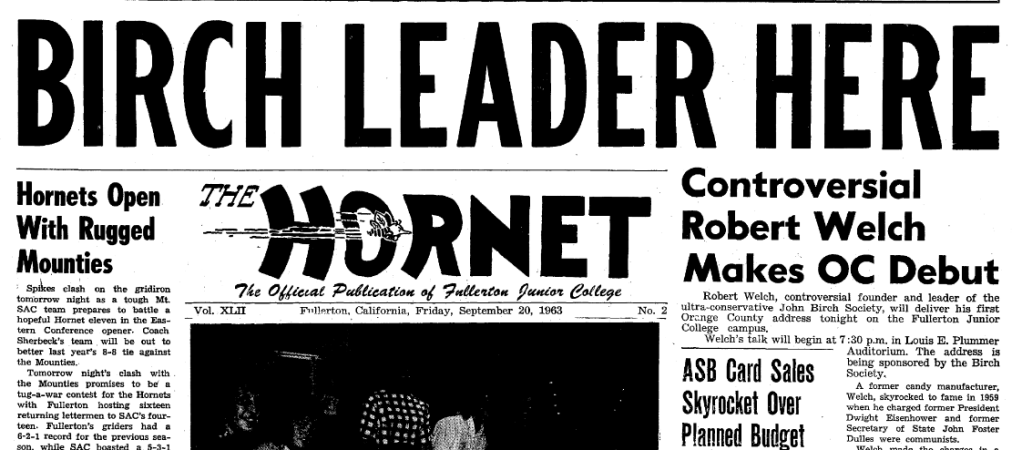
Melgren recalls how in the 1950s and 1960s, during the McCarthy era and Cold War there was an ultra-conservatism that was felt even on the college campuses.
“You only need to go back to the magazines and the literature of the time. The John Birch Society to start with,” he said. “Their hate Russia feelings and their big campaign of anti-communism, even on this campus, and the textbook censorship that was attempted.”
He recalls how Fred Schwarz spoke to large crowds at the Fullerton High School auditorium for his Christian Anti-communist crusade.
“[Schwarz] got the students dismissed to go to hear his rabid rabble-rousing,” Melgren recalls. “Here at the college Dr. Sheller and I resisted dismissing classes, but I was powerless to say that students couldn’t go. So we had a number leave the class on one or two occasions when Dr. Schwarz was here.”
Melgren said that this reactionary feeling was “in the grade schools too. Citizens here in Orange County joined, including the county superintendent of schools at the time…This, of course, was the image of Orange County as the bulwark of ultra-conservatism.”
Melgren attributes this conservatism or “Orange County Syndrome” to the attitudes of the early farmers: “[The] community itself was still so grounded in the fundamental conservatism of New England and the German traditions.”
The conservatism, he said, was as “a protective reaction which will change as the population mix changes, labor unions move in, and the young who grew up in the sixties mature.”
But then he asks the question, after the conservative beliefs of the older generation pass, “Where will be the base of stability? Where will be the traditions that guarantee that the thing is going to hang together and mean something?”
Melgren was at Fullerton College through the turbulent 1960s, recalling “the confusion and disruption we have had over the years, even including the worst of the middle and late sixties, which was aggravated by the Vietnam War and the so called generation gap.”
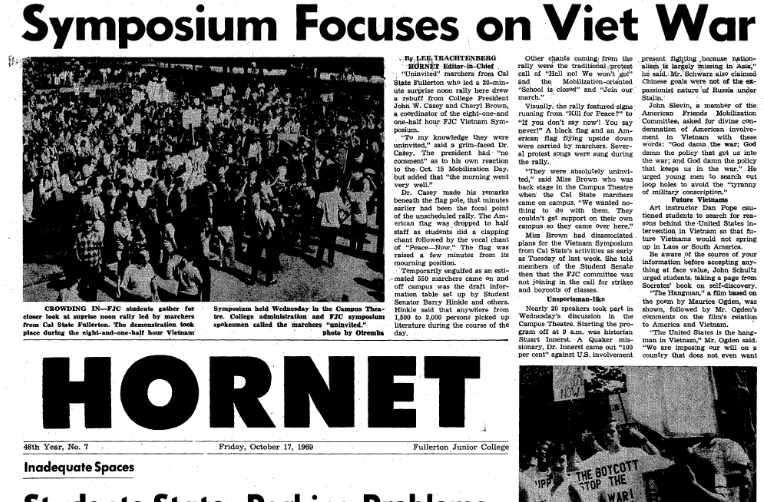
While Fullerton College did not experience the same student activism as other colleges of the time, there were protests against the Vietnam war and for civil rights at both the Junior College and at Cal State Fullerton. There was [briefly] an underground “anti-establishment newspaper called The Black Flag” that “raised eyebrows.”
When asked if there were “minority problems,” Melgren said: “Oh, there were no minorities, other than the Spanish, and this was the day of the bracero, so they were out of sight, out of mind, as nothing. Looking back at it now, it doesn’t look very good, but if you could know it, it wasn’t on the scale that it was to become. It was probably more like the better aspects of feudalism.”
He is describing the situation of Mexican and Mexican-American farmworkers in Fullerton, which I have written about in some detail HERE.
Melgren remembers “a big wooden barracks camp along the railroad tracks just west of Raymond” for Mexican farmworkers.
Melgren contrasts the affluence and opportunities of the postwar generation with the situation in the late 1970s: “The day is gone, it’s long gone, when we could think of the college experience as four years away from home in which you’re carefully nurtured, almost like the equivalent of an elitist class, our substitute for the royalty as it were. You can’t maintain that, and it’s been eroding…we oversold college as a meal ticket, as a means to status. Now it’s so common that it can’t be that anymore. We’re training far more people for these status positions of doctor, lawyer, than we can possibly use. Probably, in the immediate future education will have a rough road. There will be a big disillusionment on the part of the people thinking that it didn’t deliver…I think the educational problems were hard at the time I was active, they will be considered a snap in comparison to what’s coming.”
 Fullerton History
Leave a comment