The following is from a work-in-progress about the history of Fullerton. You can support my ongoing research and writing on Patreon.
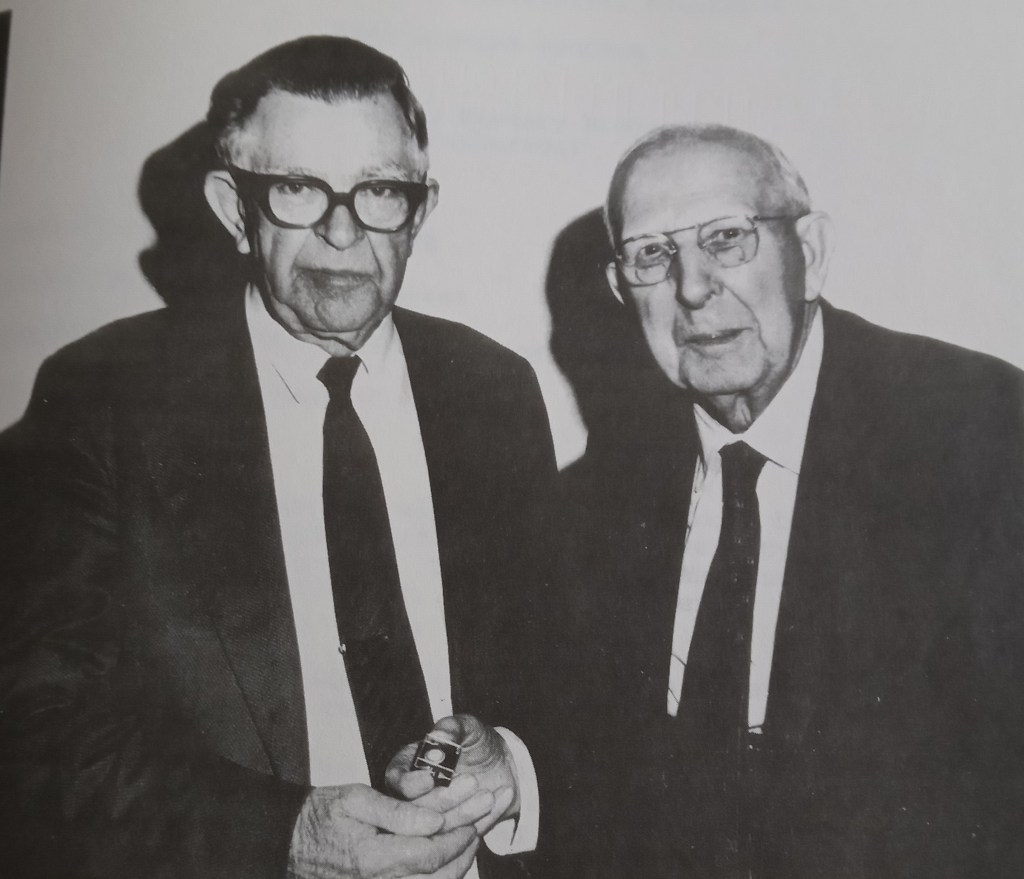
Howard Crooke, a long time Fullerton resident, was Interviewed by Ellis Delameter for the CSUF Oral History Program in 1975. Here’s a summary of that interview, along with some historic photos.
Crooke was born in Odon, Indiana in 1905. Around 1921, he moved to Fullerton where he had two brothers. He graduated from Fullerton High School in 1923.

He went to Fullerton Junior College one year, and then USC where he studied electrical engineering. After graduation, he worked a number of jobs, including for Southern California Edison’s Big Creek project, and for the Griffith Paving Company.
He was married in 1929.
The Flood of 1938
Crooke’s recollections of the devastating 1938 flood are worth including here:
As the water came down the Santa Ana River, it carried lots of debris and built a debris dam in the upper portion of the Santa Ana Canyon. Then when the water that was building up behind this dam cut loose, it all came down in a rush…the river broke out to the north and came down where the Old Santa Ana River channel used to be. It went southwest through what is now La Palma park in Anaheim. Then the river went down within about five or six miles of the ocean and just fanned out in the lowlands…It sure raised havoc around the county.
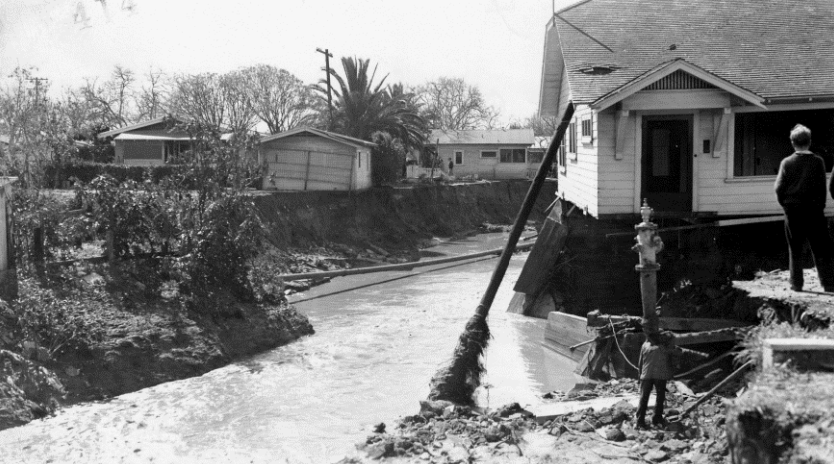
Sometime during the night of the flood, I heard quite a noise. Later, I found out that the noise was created by some fifty thousand barrel oil tanks that had broken loose in Atwood and were bobbing down Orangethorpe Avenue in the water. Of course, the oil was probably gone out of them, as they had ruptured. There was a lot of oil in the orchards and there was deep sand and silt deposits in some of them. They had to dig the trees out.
There were quite a few people killed in the flood. I have forgotten how many, somewhere between 20 and 40, but we finally got the mess cleaned up.
The water went through the southerly portion of Fullerton…I went to my brother’s house…we had to wade in water about three feet deep to get to the house…
The northern part of Anaheim got it very bad. It put many people out of business. Some automobile dealers had cars under water and full of sand. Many of them did not survive the financial loss…
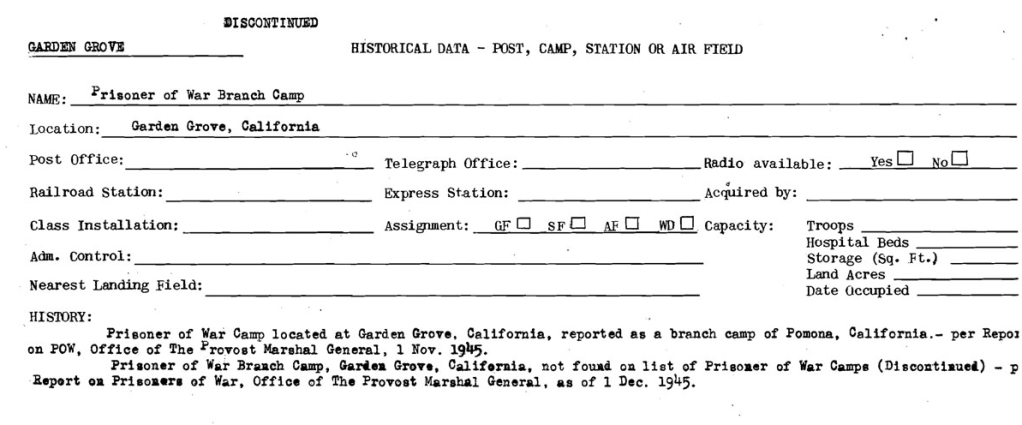
Orange County’s German Prisoner of War Camp
During World War II, Crooke worked as manager of the German Prisoner of War Camp in Garden Grove. Here are his recollections of that experience:
In 1941 Orange County was one of the largest citrus producing counties in California…During World War II there was a heavy demand from the military for manpower and support help…The farmers were in difficult straits and a demand for farm workers had developed…
We had many German war prisoners here in this country…We needed some of this help in Orange County…I was asked by Citrus Growers, Incorporated to handle the camp and the manpower in the German prisoner of war camp. We had about 700 of them, 75 GIs, and 3 officers. We had to build the camp to house them. Uncle Sam paid the citrus growers one percent of the value of the camp per month, while it was occupied by the prisoners of war. We had these boys one season and part of the next so we didn’t get much salvage of our investment in the camp. The camp had a heavy chain fence around it, with barbed wire on top and machine gun towers on diagonal corners. We broke these men up, 600 of them, into 20 crews of 30 men each. Each crew had to have a picking foreman and an armed guard with it…
After the war, Crooke managed a citrus packinghouse in Garden Grove and became active in the Associated Chamber of Commerce [of Orange County], and became president in 1952.
In this role, he worked with local leaders to develop a countywide sanitation system, and to improve the County’s flood control system.
In 1953, he became manager of the Orange County Water District at a time of explosive growth in Orange County–the beginning of urbanization and industrialization, and the decline of agriculture.
“The water situation was to me the most vital and important of all,” Crooke recalls. “We were already experiencing growth. We knew we had a limited water supply of water.”
In order to increase revenues for Orange County’s water supply, Crooke helped to establish a “pump” tax, which was opposed by some farmers, but ultimately passed.
Securing Orange County’s water supply also meant legal action against water companies and users who were drawing from the Santa Ana watershed further upstream, above Prado Dam, in Riverside and San Bernadino counties.

A legal action was brought against these upstream water users and went to trial in 1956. The trial lasted 114 trial days and involved so many lawyers that “We used almost a whole floor of rooms at the California Hotel.”
The case ended [somewhat] favorably for OCWD.
The story of water use in Orange County is a long and complicated one. For further reading, I recommend “A History of Orange County Water District.”
Howard Crooke retired in 1968.
 Fullerton History
Leave a comment