The following is from a work-in-progress about the history of Fullerton. You can support my ongoing research and writing on Patreon.
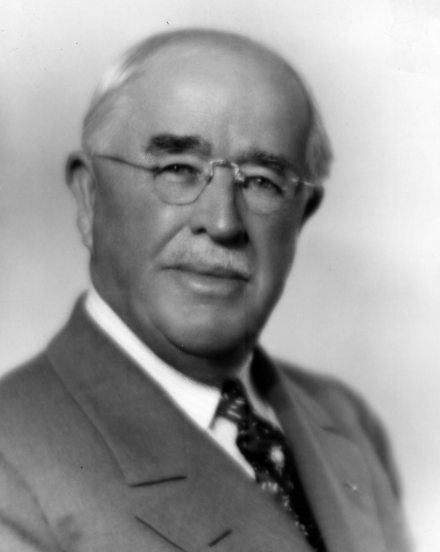
C. Stanley Chapman, son of Fullerton’s first mayor Charles Chapman, was interviewed in 1976 for the California State University Fullerton Oral History Program by Nita June Busby. Here are some excerpts from that interview, along with some historic photos. I have also included a bit of commentary to clarify or give context.
We became connected with Fullerton in 1894, although we did not move down here to live until 1898. We acquired the property for our first grove in 1894…So we have been connected with the city for a goodly number of years.
To tell you what the town was like when we came here, it was an ordinary village. It was, of course, on the railroad and it was a shipping point for, strangely enough, asparagus and walnuts–there were many walnuts. As an orange shipping place, it had no particular standing at all. I suppose you are aware that the name “Orange County” was not from the orange industry. It was named by A.B. Chapman and Glassell who founded the city of Orange and named it after Orange, Virginia, I think.
When we first came here, I was quite young. We had come from Chicago. The actuating reason was my mother’s health. She only lived a very few months after we came here.

Father had been in a great number of activities in Illinois including a very considerable operation of publishing county histories…He had a very limited education; in fact, he never did actually get beyond the fourth or fifth grade, but he was a man who educated himself by his association with others. He became exceedingly well read and a very fine public speaker.
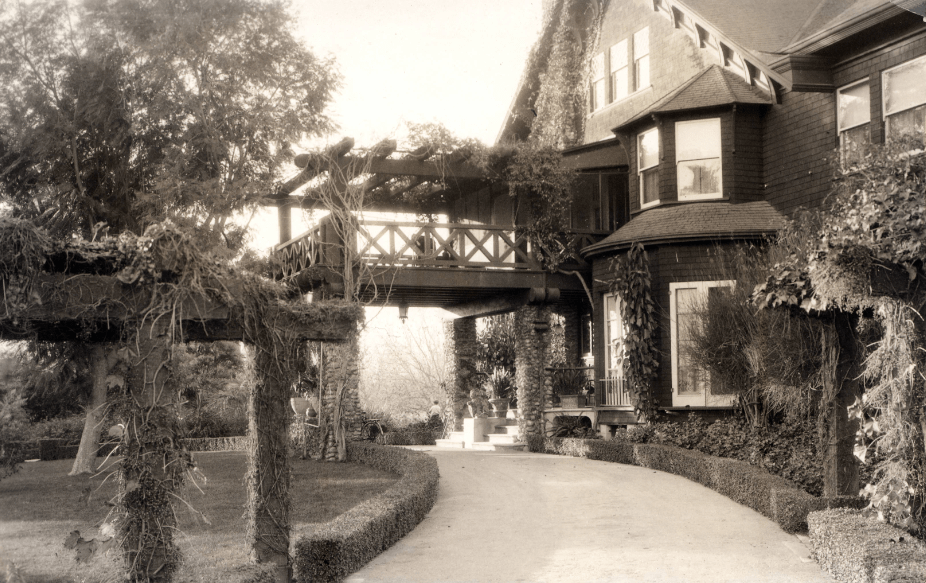
We came out here in the Spring of 1894 and a year or so later built a small cottage on our Fullerton property which was two miles east of the center of town on what is now State College Boulevard. It was then Cypress Avenue and we lived in that little cottage until 1903 when we built a very substantial three-story house, with some beautiful formal gardens and an arrangement of buildings which misled many people who came out to think they were in a separate community.
Father’s acquaintance with oranges up to that time had been only when he had been in Florida and had seen some growing. When we came to the grove, among many varieties which were there, were twelve rows of variety the neighbors all said should be budded because they did not get ripe in time to ship. So he watched them and said, “Why don’t you hold them on the tree?” They said, “Oh, you mustn’t do that because they have to get off the tree by June at least.” Well, he had come from the East where he knew that certain times of the year there were no oranges at all. So he did hold them, and then, in September of 1895, he shipped the first carload of Valencias that had ever been shipped into New York. They were an immediate success and he was known universally as the “father of the Valencia orange industry.”
Orange County turned out to be ideally climatically placed for that orange and it became the universal planting.
We had over fifty-five acres of walnuts–Placentia was the beginning of the walnut industry and the Placentia Perfection is still the choice walnut of the whole industry although it has all moved up north. This land down here became too valuable for that kind of crop.
Fullerton itself was a small community. There were, I think, about four or five stores and about that many saloons. On the main street there were not even any sidewalks. The haulage was all by wagon and team. It was a very familiar site to see a four horse team pulling a big hay load down through the middle of town.
There were three or four types of stores. Stern and Goodman had their big department store on the corner where Stein and Strauss came later, where the Fullerton Hardware store is now.

The Balcom Bank was across the street where the Security Bank is now. In the middle of that block was the Greater Gem Pharmacy of Mr. Starbuck.
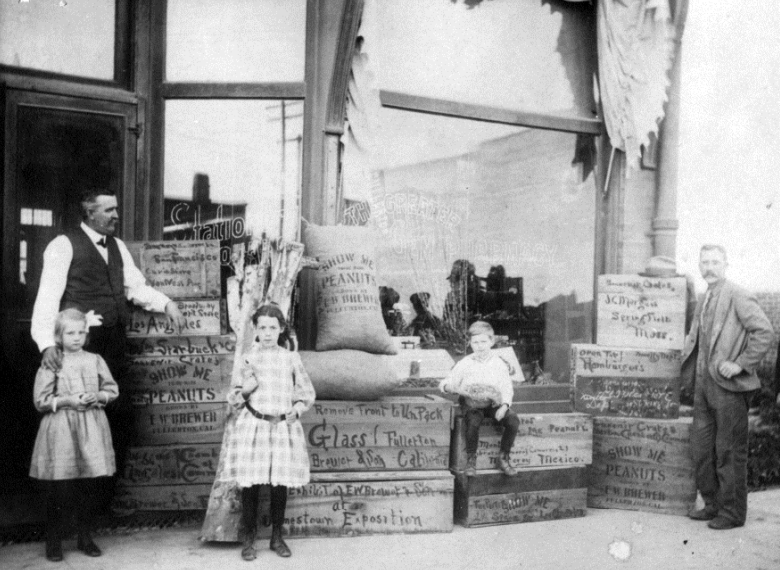
That was the place where the telephone exchange was. At that time there were, I think, five telephones. We had one of them. You never had to use a number; you just rang up and said, “Sophie, get me Mr. Dean.” Dean had the hardware store. There was a clothing store on the east side. On the southeast corner was the ice-cream fountain Mr. Ford had. In the middle of that block was the blacksmith shop.
So it was a real community and everybody knew everybody else. It was a very pleasant place to live.
Father was interested in progress, of course, and he was active in the incorporation of the town and became its first mayor.
There was a hotel on the northeast corner of Commonwealth and Harbor–Harbor used to be known as Spadra Road. It was the main road, the old stage road over the hills to the town and station of Spadra so that’s where it got its name.

That big hotel [The St. George Hotel] was one of a series that had been built by the railroad in 1883. They had this big drive for people to come out here and they gave free passes to travelers. There was one in Anaheim, one in Olive, one in Santa Fe Springs. All became great places for the kids to play in, in later years. The Ameriges had the one here in Fullerton.
The first move of the new city council was to put in sidewalks. There was a great deal of opposition to it until they saw the first set put in on the first block on Spadra and then, of course, everybody wanted them. It was in 1910 or 1911 that the first paving was done in the main block.
The activity of the community was all agriculturally directed and it wasn’t until along in the fifties that industry began.
The high school was on the northwest block of Wilshire and Balcom and the grammar school was on Wilshire, where the junior high [now the School of Continuing Education] is still located. Fullerton High School was the center of seven school districts. Ours was the largest graduating class up to 1905. We had thirteen members and were the first ones to publish an annual…We called it the Lucky Thirteen…There were thirteen of us and about four or five teachers. We had strict discipline.
I came down to high school in 1901. The high school had just received an athletic field due to the fact that for some unknown reason a whole grove of walnut trees fell down one night and it turned out to be a nice place for a baseball field. How it happened, nobody ever knew (laughter)…
Our senior year we had quite a pitcher who came down from Olinda named Walter Johnson, who turned out to be something pretty good…
I feel that one of the greatest educations that can be given to any child is discipline and the fact that the world is not going to take care of him when he gets out…
I never saw that second high school. I was away at college when it was built. They said it was a very nice school but it burned just about a year later…

You mentioned some of the businesses–Stern and Goodman and the blacksmith shop. Did they have lots of businesses? It was a small town.
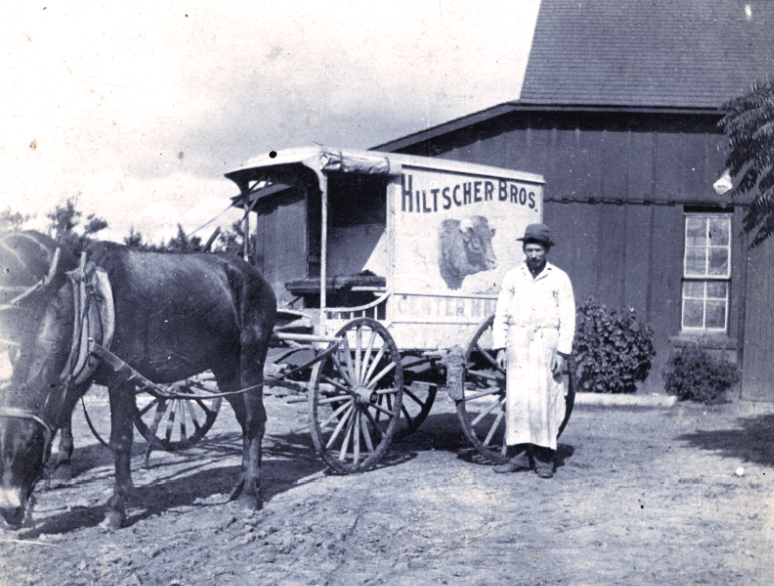
There was the Hiltscher Brothers’ machine shop and butcher shop. They had the only refrigeration in town from their machine shop…
One thing I am curious about is: were there any Mexicans or Chinese, or whatever around at the time that Fullerton was beginning? Where did our barrios come from, our own Fullerton barrio down around Truslow?
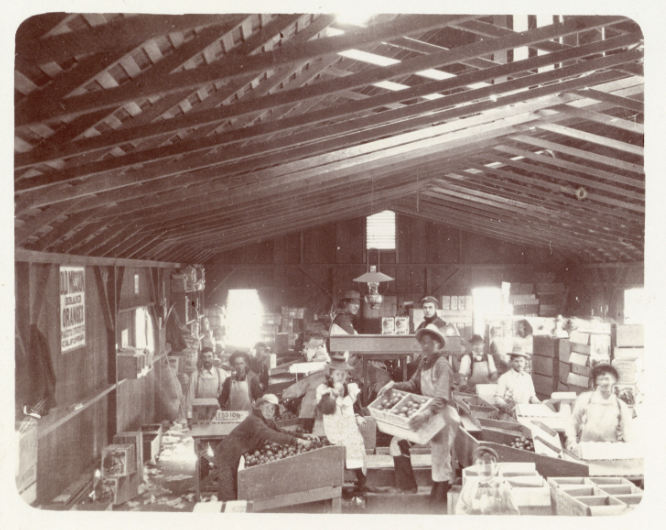
The barrio came in much later. I wouldn’t know what year. Nobody thought of it as being a barrio. On our own ranch we had housing for our own employees. We had about twenty or thirty full-time employees, teamsters and irrigators, and we had a place over on the hill across Placentia Avenue where we had a little village for them…homes, multiple homes, single homes for them to live in. When we first came, we had a bunkhouse for the teamsters, dining room and all. They lived there and ate their meals. Then, of course, we had our own crew that did our picking and our own packinghouse. The girls came in from their homes. But there was no development in that area as far as housing was concerned. The downtown residential portion was almost nonexistent. Have you talked to Lillian Yeager?
No.
She lived right downtown and one of my earliest recollections of her is standing up on a box so she could turn the crank on the first gasoline pump the town had.
Did her family own the place?
Yes, that was their home there right across the street from the church, the Christian church for which Father built the first little chapel. They moved the chapel over to Union avenue.
Was it the only church at the time?
Oh, no. There was the Baptist church, the Methodist church, and the Presbyterian church which was down on Highland and Commonwealth. Those three were the only churches here. The Catholic church was in Anaheim.
Would you tell me a little about the law enforcement?
Charley Ruddock was the chief of police in town. He was not the first constable, I’m sure, but he was the first one I remember. He went on to become Orange County sheriff. The police force was never very big…
What did people do for entertainment in the early days?
Until the first theater came in–my wife’s father had the first motion picture theater in Fullerton, that would have been along about 1915 or 1916–up to that time we made our own entertainment…We had parties and picnics. To have fun, it was not necessary to have mechanical equipment…we used to have nice high school parties and grammar school shows…Very few people had cars and the roads were not fit to go anywhere if you did…I remember starting out to go hunting in the Santa Ana Canyon with the little one cylinder car…
Could we talk about the orange ranch and packinghouse?
Our property in the east of town was owned by the Placentia Orchard Company when we acquired it and the company is still in existence. It was incorporated in 1892 so it is probably one of the oldest in the state. We still maintain that corporation.
Most of the growers belonged to associations and to the Fruit Growers’ Exchange which was organized a bit later. The growers’ associations formed the exchange.
A lot of people think Sunkist is a brand; it is only a quality mark.
When father first started to ship, the growers said, “Don’t use the same label twice because the people will remember and they won’t want to buy the fruit.” In those days, the fruit was all shipped in wooden boxes. He said, “Well, why don’t you make a label they will like?” They said. “You can’t do that.” But he and his brother, Frank, who had started out in Covina, had always been impressed with the old missions and they looked for a label that would display it. They started the “Old Mission” brand. For thirty in the New York market, that Old Mission brand brought the highest price…That was the first quality brand label, as I said, before Sunkist came into being as a quality mark.
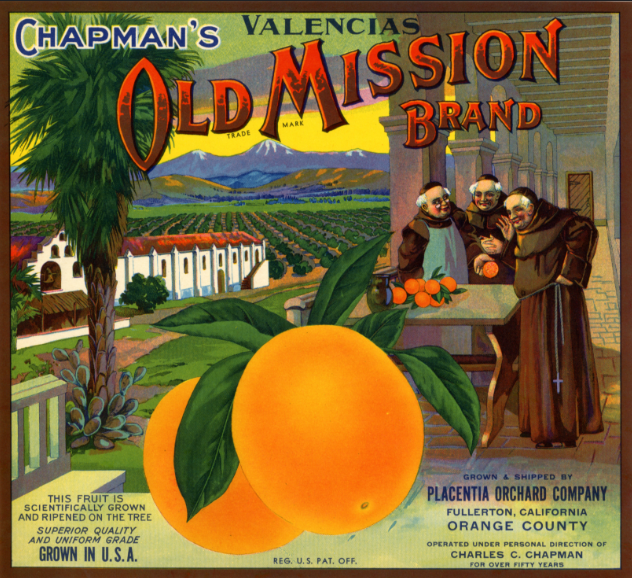
Each packinghouse and each association had its own brand but they have to pass a certain quality for the Sunkist mark. Father was given credit for that, too, in the citrus business.
It was amazing, after he had been here for only a short time, he was going around to “citrus institutes” telling people how to grow and sell oranges. He became quite an authority.
Could we talk about water? I would think that citrus fruit would take a lot of water. Where did the water come from?
Water in this area comes from the Santa Ana River. The water is divided between the Anaheim Union Water Company and the Santa Ana Valley Irrigation Company. It was years ago that it was divided. Father was always on the Anaheim Union Board. There were some wells, but most of this area was all developed by the Santa Ana River water…
So much water was later taken up here from wells that the artesian flow stopped. The “saltwater barrier” gave way and the salt water moved in. But, water was no problem in those early days. The river furnished everything that was needed up here.
Please talk some more about your family: your mother and sister and so forth.
Well, as I said, Mother died. My sister was the queen of the first Orange County Fair. She married Dr. William Wickett.
Tell me more about the medical services in the town.
When we came, there were two doctors, Dr. Freeman, a general practitioner who was our doctor and Dr. Rich who was the surgeon. Dr. Rich had the fist Oldsmobile in the town. In those days the doctors came to your house. There was no such thing as going to a doctor’s office…Dr. Clark came in later. His home was taken out to the university.
Can you talk about Atherton’s Ostrich Farm?
We always felt the ostriches were a novelty for them and as far as I know they did not commercially operate. All our relationship with the ostriches was when once in a while we would take a bag of oranges up and throw them over the fence and watch them. They would swallow the oranges whole and you could see them going down around their necks. So that was our only contact…

Your list of topics here mentions the Bastanchury Ranch. The Bastanchurys were one of the large group of Basque people who came here in the very early days. I do no know if you are familiar with them. Many of the families are still here.
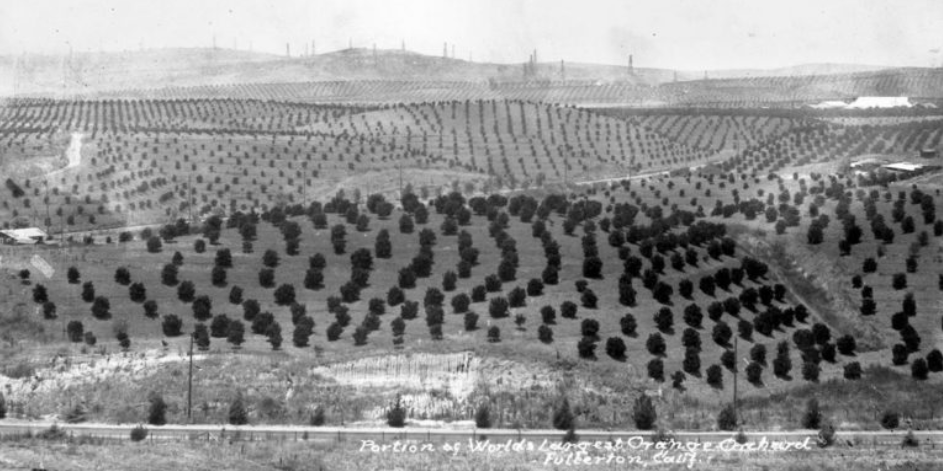
The Bastanchury Ranch was the largest. They had about three thousand acres and they ran a lot of sheep on their property in the early days.
I was never well-acquainted with any of them as much as I was with Gaston who was one of the sons. I remember going out to the ranch in the old days where they had sheep and going into the dining place where the men were all around this long table. They would pass around great loaves of bread. Each man would cut off a slice. They had wine in leather bottles that they passed along. There was a quill in the end of the bottle. They would squeeze this into their mouths without ever touching the quill at all. It was a great novelty for me.
Subsequently, when Gaston formed the Bastanchury Ranch Company, they set out the whole thing in citrus and it was just too much. They also set out the Union Oil Company land across from what is now Harbor Boulevard. In raising some of his money, he had sold bonds. The bond-holders took the ranch over under the name of “Sunny Hills.” It was really a very tragic thing because if it had been done a little at a time, it could have been a tremendously successful operation…
With the thirties came the Depression. In relation to the citrus business, it was remarkable. In 1930 we got one of the highest prices we ever received for oranges: $3.10 a box on the tree. In 1931, we got $.86; 1932, $.64; 1933, $.54. All that time, of course, the operation had to be kept going. It was a terrible thing. It represented a terrible monetary loss. It took many years to recover. That same year, came the earthquake.
Were there soup kitchens?
One of the things Alice was instrumental in was a kitchen at the Ford School. At that time we had a meat plant over in Anaheim and we supplied the bones and meat to make the soup. Molly Thatcher, who just recently was named “Woman of the Year” by the Business and Professional Women, was the principal. She was determined that no child would know whether the others were paying for their meals or not. So she established a “token” system. The parents, if they could, would buy tickets for their children so that no one would now. For many of the children it was the only hot meal they were getting…
When I built the theater [the Fox Theater, originally called Chapman’s Alician Court Theater], my aunt, Mrs. Dolla Harris, who had established a great reputation in Los Angeles with tearooms, under the name of Mary Louise, put a tearoom in the building that was a beautiful place.
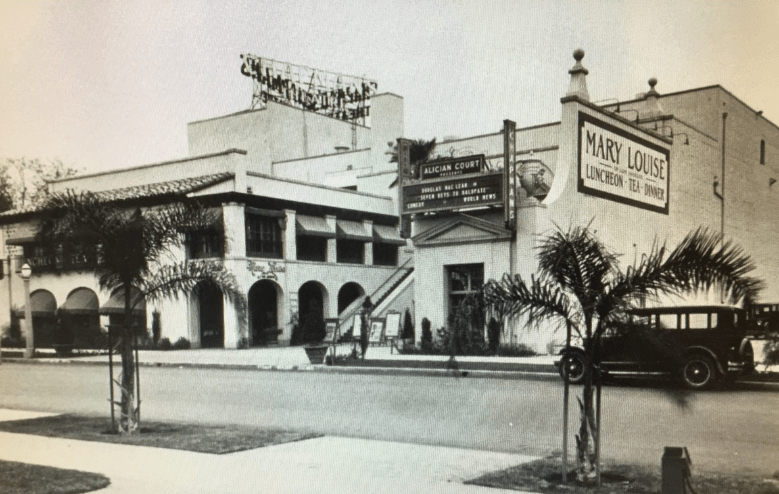
In the old days music for the movies used to be a great kick. They had the player piano with two sets of rolls. They would run the picture and set the rolls to go with the scenes…My sister-in-law, Mrs. Winifred Semans, was a high school teacher for years at the Fullerton High School. She played the piano at the theater first and then Alice took it over. Then when we went into the big movie house, we had a beautiful pipe organ. It was really a gorgeous thing, with an echo organ on the roof.
On the walls–and I’ve often just about cried about this–on each side, there were three great big arches, and on each side a set of beautiful murals depicting early California, Portola’s landing and all that on both sides…beautiful. When the Fox Movie people bought it, they got in a hurry and went in there and put white paint over the whole thing. The murals were on canvas. I would have paid ten thousand dollars for them but they painted them over with just white paint. Those beautiful murals.
Who did the murals? Where did they come from?
I forget who painted them. They were done in Los Angeles. They were on canvas. They could have been removed. I would have gladly taken them over to Chapman College. They would have been gorgeous over there. They were really beautiful sets of historical California.
So progress destroys. I’ve often thought that progress is the worst thing that can happen to anybody or any place. It seems like it moves with a hand that is intent only on the greatest return right now. It neer thinks about fifty years from now. What will they think of this modern trend in buildings? They used to be beautiful. Now they’re just straight up and down.
Now mention the Fullerton library…I think that is without question the ugliest building I have ever seen.
I think everybody has read Fountainhead, that book by Ayn Rand where the hero takes all the facades off and makes everything plain. I think all architects read that so there is no more rococo or embellishmments of any kind. It is a shame.
Father built that five story building [the Chapman building] that was just ahead of the town a bit, too. The store, the first one was too good and the second was too poor.

In 1937 there were two physical disasters. One was a big freeze and the other was a flood [the flood was actually in 1938]…The Santa Ana River broke over its banks and came back into its old bed, right down what we called the “sand wash,” and went right down into the Mexican village of La Jolla…The American Legion…one of our activities was disaster relief.
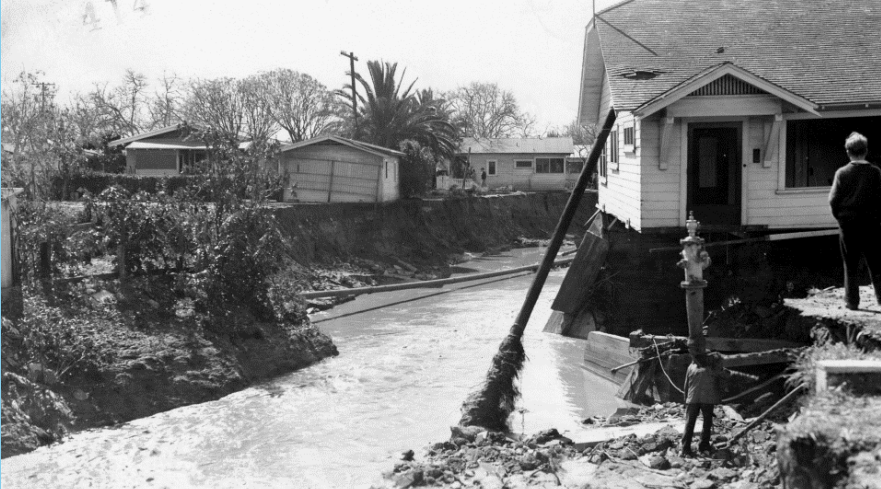
When we went out in the truck along Atwood Road, you could hear the people calling for help across the great rushing river. It was just a mad torrent. The whole river went through. The next day, when it had eased, we went through the water in the truck and picked up a lot of people and took them up to the Fullerton Legion Hall.
The Legion Auxillary ladies were all up there. Alice took a lot of baby bottles and nipples and milk and so on. I think we had about 165 people living in the Legion Hall for white a long time. I remember I was wading across the river, looking around and I found this little girl’s body. It was a terrible thing.
Do you suppose it could happen again?
No, the Prado Dam has been put in since then. That flood was before there was any dam at all on the river or any control of any kind. So it will never happen again…

What did that frost do to the orange groves?
It was not anywhere near the killer that the 1913 frost was. That was the bad one…
Did the Masons start to be a big force in the thirties? When was the Masonic Hall built?
The temple was built in 1920. The old temple was down on the corner of Amerige and what is now Harbor…The lodge was chartered in 1890…it was quite an influential organization because many of the prominent men belonged to it…

Is it more social and service oriented?
Yes. It is an organization of men who are devoted to the improvement of themselves and society, the schools and the things that are for the benefit for all mankind, but it absolutely never engages in any political activity of any sort.
I can see then that it was just the exact opposite of the Ku Klux Klan. Was it ever very large in Fullerton?
Oh, for heavens sake, no. The John Birch Society was more important than that. I never knew anybody that belonged to the Ku Klux Klan. I don’t think it was ever anything here.
[Note: There was an active Ku Klux Klan in Fullerton in the 1920s that included many prominent citizens.]

We had no racial problems here whatsoever. As for the Mexican population, well, they located by themselves but there was never any racial problem. The association in the old days was a very delightful one with the Mexican people because the older ones were the most gracious and lovely people you could imagine. We never felt that they were working for us. We were all just working together. The association was always delightful. One boy, Joe Martinez, who is in the hospital now, has been with us for fifty years. He lost one of his feet here years ago, but he kept on working…
[Note: Relations between Mexican Americans and the larger white community were not as rosy as Chapman relates. There was active segregation and discrimination. Click HERE to read more.]
Our employees are getting fewer and fewer…John Reyna, a truck driver who is up at our Yucaipa property now and is getting up toward his sixties was born on the ranch…
There was never any racial problem in the old days and the idea of a barrio or anything like that just did not exist. They were more comfortable living together. As I said in the other interview, on our ranch we had our own housing for them.
There was never any need for the Ku Klux Klan to come in and ruin everything, like they did in Anaheim?
No. In the schools there were never any pressures.
Did the Mexicans go to the same schools as everybody else?
Oh, sure. Of course, in the olden days, there was no parochial school in Fullerton. The only Catholic church was over in Anaheim. There was never a need for forced integration or forced anything of the kind. It was a natural association.
[Note: There were at least two “Mexican” schools in Fullerton: one on the Bastanchury Ranch and one at a Mexican work camp at Balcom and Pomona.]
Were they allowed to use the swimming pools and the movies and everything else, then, too?
Oh, sure.
[Note: According to an oral history interview by Jessie Corona de Montoya, Mexicans were often excluded from the public pool in Fullerton.]
There were only a few Negro families and they were very high in the estimation of the community. There was this poet, she was just tops. Her name was Ruby Goodwin. Her people were most highly respected. There was never any feeling of difference between us.
[Note: According to numerous Black residents interviewed for the book A Different Shade of Orange: Voices of Orange County, California Black Pioneers, there was in fact housing discrimination in Fullerton. Warren Bussey, an African American man who moved to Fullerton in the early 1950s, said “We [blacks] were only living on two blocks [he lived on Truslow as well]…Living in California at that time, it was more prejudiced than it was in Texas.”]
Were the people proud of the Fullerton High School football team?
There was great support for them.
Do you remember the mural at the high school that the WPA artist painted? Why did they paint that out?
I don’t know. They put one in the Post Office titled “Picking Oranges.” How anybody ever imagined such a thing! Have you ever seen them pick oranges? Men have a bag over their shoulders with the bottom that drops out to lower the front into the box. This picture showed women up on ladders picking oranges without clippers and throwing them at the box. It is the stupidest thing. Anybody who would try it would break his back or his neck. The one down there at the school was almost as absurd. They were painted by that WPA business and the painting did not go with the architecture of the school. It was a great relief when they did paint them out. They were not an artistic addition to the building by any means.

Can we talk about the politics in the thirties on the national level now?
Yes, we had that big blow up with the Bull Moose Party and Hiram Johnson here in California and the Southern Pacific Railroad and Teddy Roosevelt with his Bull Moose.
My father was always very active in the Republican Party and he was very much opposed to the Bull Moose Party. In fact, at that time, he actually considered running for the Legislature, or the State Senate, just to hold the party from the Progressives. He always called it the G.O.P., the Grand Old Party, and he was always very active in it; not wanting an office, but wanting the Republicans to be kept in office. He was a conservative and he was very active in getting the tariff on oranges and lemons that made the whole industry possible. He made many trips to Washington. On one of the trips, Herbert Hoover invited him for lunch.
The foreign producers had the advantage of cheap labor and their freight was actually cheaper to ship than it would be from California by rail. So, ti became evident that if the orange industry was to survive, there had to be some protection. And it began to mean a lot to a lot of people as the industry and planting grew. Father made several visits to Washington to work on various congressmen and senators and so forth until they did get–I think it was a cent a pound on oranges and on lemons. Of course, the lemon market was completely in the hands of the foreign producers. When this tariff was established, it immediately gave us a chance to compete because it would make up for the difference in cost and freight and so on. They even got the Democratic Congressmen to support them even though their great rule was “free trade.”
Actually the life of the industry was protection from foreign growers…Several times in the course of the next fifteen years we had to defend this thing. The Democrats wanted to take it off.
That was one reason Father was always a Republican. He believed in the protection of American industry. “Buy American for the Americans.”
When was the tariff put in?
I think the first one was along in about 1905.
Being as Fullerton didn’t encourage saloons, did Prohibition make a difference?
Father was a great Prohibitionist and one of the things about the incorporation of the city was his desire to control or get rid of the saloons. The city got fifty dollars a year, I think, from each saloon. Some felt that if they put them out, they would not be able to carry on the city. So he said, “I’ll make up any deficit.” So they put them out. He never had to pay a nickel. The business and everything jumped in the town. Orange County was never involved in the grape business to any extent. The big vineyards were up near San Bernadino.
There were no “blind tigers”–places where people could get illegal alcohol in Fullerton?
I doubt it very much because Anaheim had always been the Mecca. They had the Germans in the first place; they had their wineries, and they had grapes over there, and they had their saloons and everything. It got to be the custom: if anybody wanted anything, he went to Anaheim, and I presume there were places over there. It never became a factor of any moment that I ever heard of in Fullerton. There was plenty just across the “sandwash.”
There’s one little sidelight that might be of interest about the citrus topic, and that is the decline of the citrus industry. For a number of years, we had noticed that along the highway the trees didn’t do well. We all thought it was the dust or something like that. Then it began to be evident that it was the exhaust from the automobiles. As that increased, the damage increased.
Then there was a very tragic and important thing. Have I ever said anything about sour stock or sweet stock? Trees on sour stock were subject to a good many more diseases than trees on sweet stock. From 1916 on, about 85 percent of all plantings were on sour stock. Then, in Brazil, the industry was destroyed by “quick decline.” Then there was an infestation of quick decline up in Glendora…there was no starch in the tree. So this was the “quick decline.”
…And it meant that all of this planting, which was eighty five percent on sour stock, was doomed. There was nothing you could do about it. And this kept spreading, and all they could do was to dig out the tree and burn it. They found it was a virus carried by a little wasp that pierced the leaf…
The land began to get more valuable for other things, but it was a tragedy. If we had stated with the sweet roots, these other diseases were secondary in damage. But, of course, the smog would have gotten them.
 Fullerton History
Leave a comment