The following is from a work-in-progress about the history of Fullerton. You can support my ongoing research and writing on Patreon.
The Local History Room of the Fullerton Public Library has microfilm from the Fullerton Tribune newspaper stretching back to 1893. I am in the process of skimming over the microfilm, year by year, to get a sense of what was happening in the town over the years. Here are some local headlines from the years 1896 and 1897.
Note: The lines in the articles are lines and cracks in the microfilm, which was produced over 50 years ago, and was meant to last 50 years. Thankfully, there are plans to digitize the microfilm. Unfortunately, some of it has become unreadable.
1896
The Water Fight
In this letter to the Tribune, town co-founder Edward Amerige criticizes the directors of the Anaheim Union Water Company (AUWC) for using company funds to create cement irrigation ditches around their own properties. The AUWC was the main supplier of water from the Santa Ana River for north Orange County. It was owned by stockholders and run by a board of directors who included W.F. Botsford, William “Big Bill” McFadden, W. Crowther, and F.G. Ryan.

Hetebrink-Edwardson Marriage
In a town as small as Fullerton, marriages were big news. Below is an announcement of the marriage of John Hetebrink and Carrie S. Edwardson. The Hetebrinks were prominent Fullerton ranchers.

Sudden Death
The below article tells of the sudden death (possibly by suicide) of a Mrs. Lavina Anderson, a housekeeper in Placentia.

The Chadbourne Failure
This article tells of the bankruptcy of Forrest S. Chadbourne, a furniture dealer in San Francisco. The connection to Fullerton, I think, is that the Chadbourne building (at the northwest corner of Harbor and Commonwealth, since destroyed) was a popular gathering spot for local events in town. I suspect that it was built or owned by Mr. Chadbourne.

Farmer’s Institute to Meet at Fullerton
The Farmers’ Institute, a group of academics studying modern methods of agriculture, came to Fullerton to present recent findings.

1897
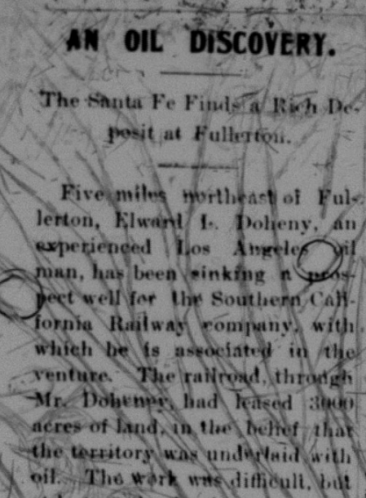
The New Oil Wells
On the hills of north Fullerton, new oil wells were being developed. In addition to oranges, oil would become a big business in Fullerton in the first half of the 20th century. There are still some wells today.

Edward L. Doheny, the oil tycoon, drilled some wells north of Fullerton for the Southern California Railway Company.
Atherton-Selinger Wedding
Fullerton’s eccentric ostrich farmer, Edward Atherton, married Carolina J. Sellinger of Anaheim.

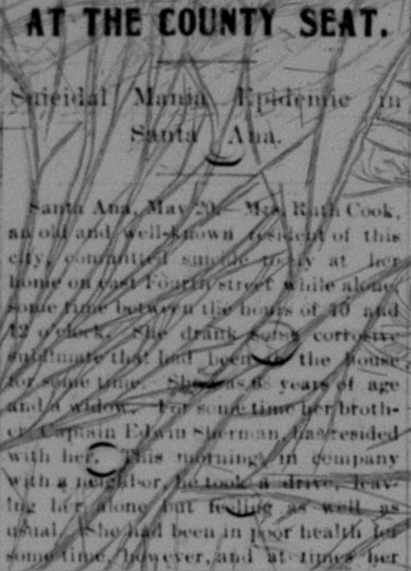
At the County Seat: Suicidal Mania Epidemic in Santa Ana
This somewhat sensationalized story tells of more suicides in Santa Ana.
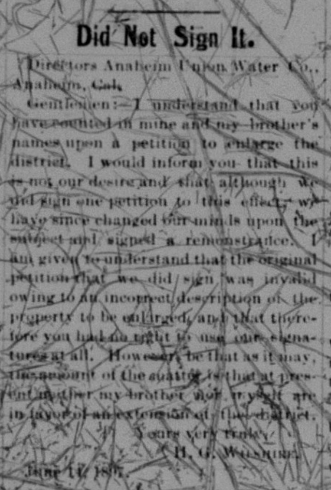
Illegal Act Exposed
This article describes more shady shenanigans of the board of directors of the Anaheim Union Water Company, particularly over the issue of expanding the territory of the company. Perhaps there was an inherent conflict of interest to have the owners of large ranches on the board of the company that provides irrigation.

Town co-founder H. Gaylord Wilshire (the “millionaire socialist”) wrote a letter to the Water Company Directors asking to take his name off a petition regarding enlarging the company’s acreage.
Fullerton: Mid Orange and Walnut Groves: A Solid Town Built Since the Boom and Growing Rapidly at Present Shipments
The July 3, 1897 issue of the Tribune includes a front page article re-printed from the Los Angeles Herald that gives an interesting overall portrait of Fullerton at that time. I have re-typed the entire article below.

Where southern skies, blue as Saxon eyes, bend o’er the emerald expanse of orchard, field and vine, where the…breath of roses, orange blooms, fragrant walnut groves, sweet smelling alfalfa, lemons and olives weight the air, almost in the shadow of Puente hills, which break the northern blasts, and where ocean breezes freshen every fruit and flower–in a valley rich beyond compare–nestles the picturesque, bustling, growing town of Fullerton. Here all nature smiles in this paradise of loveliness. Tropic trees shade the vernal lawns and the meadows are…with growths of grasses, fattening and sweet while the honey bee may gather its store from December to December. It lies in the midst of a veritable land of sunshine and flowers.
In a good many things Fullerton is different from other towns. Here no high hopes born of the boom lie buried beneath the wrecks stretched along the receding shore of prosperity. No citizen points to vacant blocks and tells the stranger of “boom times” or with a sigh and lament bemoans the passing of prosperity. These things are not here. Where they exist their causes antedate Fullerton. It is not the child of the boom.
It was not until 1888 that it was decided to build a town where Fullerton is located. At that time a large body of land was secured and the town laid out. The original purchase comprised a tract of 430 acres. It takes its name from Mr. George Fullerton, who was a director of the Santa Fe. The voting district now covers about thirty-six square miles and contains fully 1500 people. The rapid growth of Fullerton has made in the past few years is not surpassed by any locality in the state. The annual shipment of produce from the six large packing and warehouses in Fullerton has so increased from but a beginning in the year 1888 that now, by actual railroad statistics, it exceeds that of any other point south of the Southern California metropolis.
This year upward of a thousand carloads of hay grain will be shipped from Fullerton. Two hundred carloads of oranges have already been shipped, with about eight or ten more to be forwarded. Thirty carloads of cabbage, ten of lemons, twenty-four carloads of wool, and about sixty carloads of walnuts were shipped the past season.
As the area brought under cultivation for the growing of all these products is being constantly expanded the shipments will increase in the future as rapidly as in the past. Hundreds of young walnut and lemon orchards are just coming into bearing which next season will materially swell the output. Five fruit packing and forwarding firms operate at Fullerton, where some of them maintain the largest and best equipped establishments of any in Southern California. Such is the nature of the soil and the climate here that shipments of products from Fullerton continue throughout every month of the year. This accounts in a great measure for the great prosperity of the place. There is no period of dullness here, no season of inactivity. Garden truck of every kind, potatoes, beets, onions, berries, etc. grow rapidly and plentifully, finding a eager and profitable market. Tomatoes, a most tender plant, grow and are shipped from Fullerton the entire season of summer and winter.
The soil of the extensive back country, or land lying around Fullerton, including the productive Placentia, La Habra, and Orangethorpe districts contiguous thereto is a rich sandy loam of great depth, varying from ten to sixteen feet, and on account of sub-irrigation, grain can be raised without water. There are over over 8000 acres of this land in barley this season.
In its capacity for production it is the most varied and at the same time the richest body of land in Southern California. In the foothills a few miles back of town are some forty oil wells which are producing an abundant and constant stream of oil of good quality, which adds much business to the town. Recently oil has been developed just outside the town, the Santa Fe railroad company having sunk one well from which they obtain…sixty barrels per day, and are boring others in the same locality.
The growing of walnuts is one of the most profitable pursuits in and around Fullerton…being peculiarly well adapted for their successful production. Most of the immense crop of walnuts in the district is handled and marketed by the Walnut Growers’ association, an organization started in 1893 and which has been the most successful and with the most satisfactorily managed association in Southern California.
The orange groves about Fullerton are considered the best in the state. This seems a broad assertion to make but as a matter of fact the navel varieties grown in the district command always the top prices.
Fullerton is a delightful place in which to live. The environment is charming. Being twenty-three miles south of Los Angeles and only fourteen miles from the seashore and six miles from the mountain foothills at an elevation of 200 feet above sea level it receives the benefit of the ocean breezes, which ameliorate and regulate the temperature, making it cool in summer and warm in winter. Malaria and epidemics are unknown in Fullerton, and the oldest farmers in the vicinity say the district embraces the largest area of frostless belt known in the state.
On arriving in Fullerton a visitor there for the first time will be surprised at the many good, substantial business blocks have been erected. One will soon find, too, that these imposing structures were not built on speculation. All are occupied from cellar to garret and were built to meet the actual and pressing needs of business. Hundreds of beautiful homes have been built in and around Fullerton within the past few years, and many more are in course of erection. Last year thirty-eight new cottages were put up by the thrifty and contented home-builders of the town.
The citizens are highly intelligent and moral in character, and take deep interest in educational matters. There are three excellent schools in the district, with spacious and comfortable buildings for exercises. One of the only two high schools of Orange county is located at Fullerton. The high school district comprises Fullerton, Placentia, Buena Park, Orangethorpe, and La Habra. There are five teachers. W.R. Carpenter is principal and Miss A. Tucker assistant.
Fullerton is on the through line of the Santa Fe and the sea shore line of the same road, which gives frequent and splendid train service.
The rapid growth of Fullerton is indicated by the fact that at the election two years ago the district cast only 198 votes, and at the last election 300 votes were cast.

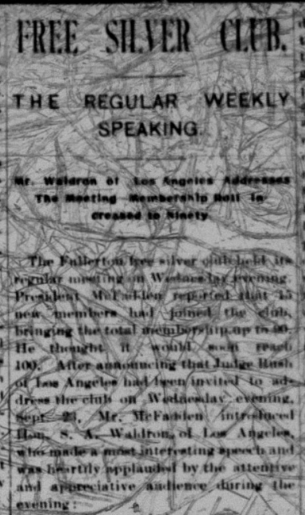
Free Silver Club
Fullerton had formed a Free Silver Club, which sought to expand American monetary policy to include silver, not just the gold standard.
Henderson/Faulkner Marriage
Town blacksmith Alex Henderson was married to Agnes Faulkner.

For some reason, C.B. Huggans thought it was a good idea to take out a full page ad for ginger ale.

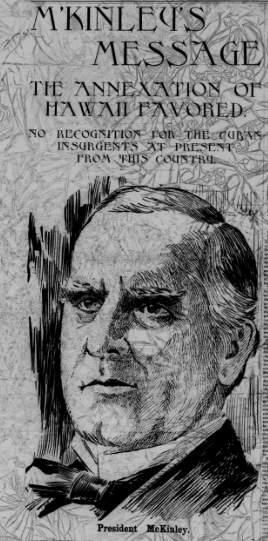
McKinley on the Annexation of Hawaii
In national news, President McKinley gave a message in favor of the annexation of Hawaii.
Stay tuned for more headlines from the Fullerton Tribune as I continue my journey through the microfilm!
 Fullerton History
Leave a comment