The following is from a work-in-progress about the history of Fullerton. You can support my ongoing research and writing on Patreon.
The Local History Room of the Fullerton Public Library has microfilm from the Fullerton Tribune newspaper stretching back to 1893. I am in the process of reading over the microfilm, year by year, to get a sense of what was happening in the town over the years.

A big issue in Fullerton in 1894 was the presence of saloons and the sale of liquor. There were a few saloons in town, at least two of which were regular advertisers in the Tribune: Dierksen House (operated by a Mrs. C. Dierksen) and Nicolas House (operated by a J. Grimaud).


As the year progressed, the saloons in town became the target of two local prohibition groups–the Women’s Christian Temperance Union (WCTU) and the Law and Order League. The liquor question would create serious divisions in the town. Things started peacefully enough:
February 3: It is reported that the local WCTU will ask our merchants and saloon keepers to sign an agreement to close their business houses on Sunday.
In 1894, Fullerton was not yet incorporated as a town, so the main governing political body was the county Board of Supervisors. In April, anti-saloon people circulated a petition which they presented to the Supervisors in hopes of getting them to pass an ordinance outlawing saloons in Fullerton. At the same time, saloon owners circulated their own petition.
April 28: The anti-saloon petition has been signed by 93 voters, making a majority in Fullerton precinct. The petition will be presented to the supervisors a week from next Monday. The saloon men have been circulating a petition during the week and have got about 70 voters to sign it. It is reported that a number of voters signed both petitions, one favoring and the other opposing saloons.
The Supervisors passed an ordinance of questionable legality, as this April article explains:
The saloon men of this county consulted a prominent Los Angeles lawyer this week in regard to the legality of the ordinance passed by the board of supervisors a few days ago compelling the saloon-keepers to remove all chairs, card, billiard, and pool tables and have nothing whatever for people to sit on. The saloon men are not at all pleased with this ordinance, hence the move to have it declared illegal or unconstitutional. If their legal advisor says he can knock out the ordinance, then they will make a test case of it.
In early May, the Supervisors took further action:
May 12: At the special meeting of the supervisors on Tuesday the board decided that there was a majority of voters on the anti-saloon petition and therefore refused to grant a saloon license for Fullerton precinct and it now looks like Fullerton will be a prohibition town for a year at least. The board refused to recognize the petition in favor of the saloons, and there is some talk of the saloon men contesting the matter. The people on both sides have been worked up over this question, and hard feelings over the matter will exist for months. It is reported the saloon men in Anaheim are rejoicing as they expect to get a good share of the saloon patronage from this precinct.
Following this decision, saloon owners took humorous action:
May 19: The ex-saloon keepers have posted the following notices on their public water troughs: “No prohibitionists allowed to water here.”
Tribune editor Edgar Johnson was usually outspoken about where he stood on most issues, however, he remained quite neutral on the liquor question.
On May 26, he wrote, “Hard feelings continue to exist between the saloon and anti-saloon people and it will be sometime before all of our citizens work together again for the best interest of the town and community. These local fights are a bad thing, and do much towards keeping the town from advancing to the front rank.”

Some prominent local residents took it upon themselves to rid the town of saloons by creating a Law and Order League, whose main goal was “the enforcement of law, and the preservation of order in all lawful means, and more especially the suppression of the unlawful sale of liquor in our midst.”
In June, Johnson wrote, “The war between the saloon and anti-saloon people continues and will undoubtedly do the town more harm than any local question that has ever come before our citizens.”
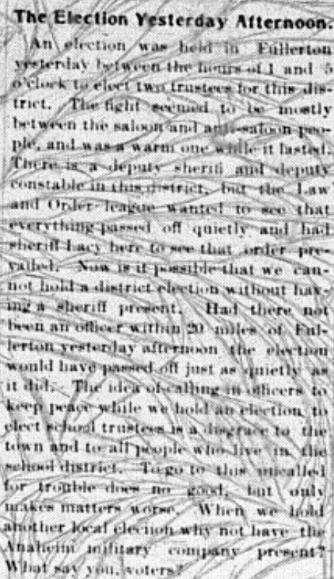
Things evidently got so heated that something as innocuous as a local school board election divided the town on the saloon question, and the Law and Order League brought out Orange County Sheriff Theo Lacy to keep the peace, as the article below explains:
An election was held in Fullerton yesterday between the hours of 1 and 5 o’clock to elect two trustees for this district. The fight seemed to be mostly between the saloon and anti-saloon people, and was a warm one while it lasted. There is a deputy sheriff and deputy constable in this district, but the Law and Order league wanted to see that everything passed off quietly and had Sheriff Lacy here to see that order prevailed. Now is it possible that we cannot hold a district election without a sheriff present. Had there not been an officer within 20 miles of Fullerton yesterday afternoon the election would have passed off just as quietly as it did. The idea of calling in officers to keep peace while we hold an election to select school trustees is is a disgrace to the town and to all people who live in the school district. To go to this uncalled for trouble does no good, but only makes matters worse. When we hold another local election why not have the Anaheim military company present? What say you, voters?
By the way, S.F. Daniels and E.R. Amerige defeated H. Burdorf and P.A. Schumacher in the election. “There were 100 votes cast, being the largest number ever in Fullerton,” Johnson reports.
The Santa Ana Blade newspaper commented on the Law and Order League: “Some of the people of Fullerton have organized a law and order league to enforce the recent order of the supervisors closing the saloons. In a law abiding community, such an organization should be as superfluous as a vigilante committee, and it only becomes necessary when the sheriff fails in his duty.”
Meanwhile, the saloon owners won a legal victory as a Judge Towner ruled against the legality of the Supervisor’s anti-saloon ordinance.
On June 16, Johnson reported:
“It is understood that the Fullerton saloon keepers will go before the board of supervisors next Monday and ask that licenses be issued to them on the ground that they have already qualified and that the ordinance is mandatory on the board in accordance with the recent decision of Judge Towner. No doubt another ordinance imposing restrictions on the liquor trade will be prepared and presented to the board.”
However, the anti-saloon people were apparently successful in getting another ordinance passed.
On July 7, the Tribune reported, “The law and order league had all of the Fullerton saloonkeepers, O. Jensen, J. Grimaud, and P. Golter, arrested this week on a charge of selling liquor without a license. The cases will probably come up for a hearing next week.”
And on July 21, the following reports appear in the Tribune:
It is reported that every man that has sold a glass of liquor in Fullerton since May 1, will be arrested.
O.M. Skinner and Mrs. Paul Golter arrested this week on a charge of selling liquor without a license. Why did not Skinner wait until Mrs. Golter’s husband recovered from his sickness? Why not have Golter’s two little children arrested too? There is nothing gained by taking advantage.
The Tribune does not believe that Rev. J. M. French did the right thing when he swore to a complaint charging Paul Golter with selling liquor without a license when he (Golter) was in bed sick. Mr. Golter is a poor man and has a family to support. Rev. French knows that if the papers had been served Mr. Golter would have been thrown in jail unless he could have given good and sufficient bonds for his appearance before a Justice. Mr. Golter has been very sick for some time and for several days was not able to walk. One or two doctors know this to be a fact. Why couldn’t Mr. French have waited until he got up from his bed before trying to have the papers served. We are not waging war for the saloon keepers; have tried to steer clear of the fight on both sides, but don’t like to see one man take advantage or try to impose upon another. If a majority of bona fide voters in this or any other district do not want saloons we believe they should be closed. The saloon men claim there was not a majority of qualified electors on the petition presented to the supervisors asking them not to issue a liquor license in this district and therefore keep the saloons open. We are anxious to see this fight settled at an early date, as it is doing the town much injury.
On August 4 the Tribune reported:
O. Schumacher, C.B. Huggans, and O. Jensen were tried at Anaheim this week on charges of selling liquor without a license. Several hours were taken up in the election of a jury.
Oliver Shumacher, who kept Huggans’ saloon a few days, was tried first.
M.H. Dunn swore that the defendant sold beer to W. Lowe and F. Donnelley in the presence of the witness. Donnelley said he had drunk at the saloon and possibly might have been root beer. He could not remember what day he was in the saloon and he was not very clear as for what happened while he was there. C.B. Huggans testified the remember the time and occasion when Donnelly and Lowe were in the saloon and drank and swore it was not beer they had.
After argument the case was given to the jury, who after a short time acquitted the defendant.
The first case being disposed of, the court at once began the second of the series, that of the People vs. O. Jensen, the defendant being charged with the same offense as was Mr. Schumacher in the first case. Jensen was promptly acquitted as was also C.B. Huggans, the third defendant, in less than five minutes, when court adjourned until Thursday.
There has been great rejoicing among the saloon men and their friends over the victory won.
The case against Mrs. Golter was tried Thursday afternoon but the jury disagreed. J. Grimaud will probably have a hearing next week.
Apparently, things did not go well for Grimaud, as the Tribune reported later that J. Grimaud’s saloon fixtures were sold.
By October, saloon owner C.M. Huggans had evidently also closed shop and “moved up to the oil wells this week, where he has accepted a position with the company.”
1894 was an election year, so Prohibition became not just a social, but a political issue. There were state and local conventions.
After the election, Johnson reported, “With one exception the next board of supervisors will be anti-saloon.”
 Fullerton History
Leave a comment