The following is from a work-in-progress about the history of Fullerton. You can support my ongoing research and writing on Patreon.
Victoria Consuelo Celestina (nicknamed “Jessie”) Corona de Montoya was interviewed in 1975 by Esther Katz for the CSUF Oral History Program.

A Yorba Descendant
Jessie (born around 1906) was a descendant of the pioneer Yorba family on her father’s side. Her father was Jose Maria Corona and his mother was Manuela Vejar, a direct descendent of Don Bernardo Yorba, a son of Jose Antonio Yorba, who came with the Portola expedition to California in 1769.

Her mother Romanita Aguilar was born in Arizona. Her parents met at a dance, and were married in a church in Anaheim in 1894 or 1893, with “a big feast that went on for three days.”
Her siblings were Ramon Francisco (Ray), then Orlando Antonio, Alphonso Filiberto, Lorinda Dulcinea, Juan Alejandro, Arturo Jose Maria, and Eduardo Lorraine. Three of her brothers served in the first World War.

Her family lived on Raymond Avenue since 1915, when most of the land was agriculture–citrus and walnuts.
Childhood Memories
As a young child, she sometimes went to live with her grandmother (on her mother’s side, who was part Native American), who lived on a small plot of land where the Prado Dam is now.
Montoya lovingly recalls her grandmother’s deep knowledge of growing and preparing food: “She raised squash, tomatoes, corn…when she harvested all those vegetables, she dried them in the sun. She dried her corn and string beans, and then she saved them in little sacks that she made, until wintertime. When wintertime came, she dropped these vegetables in boiling salted water, and it was just like they were just picked.” Near the garden, her grandmother had plum, apricot, and peach trees.

She remembers the native remedies she learned from her grandmother, such as sauco, yerba del manso, mansanilla, and yerba buena, which she continued to use.
She remembers, as a young child in Fullerton, swimming in a local irrigation ditch.
“There was an irrigation ditch on Orangethorpe and Raymond that was to irrigate all the orange orchards and walnut orchards that were around our home,” she said. “This little ditch was about two feet deep and maybe about three feet wide. In the summer, when it got so hot, that’s where we’d swim. A lot of times if the zanjeros that cleaned these ditches didn’t come around and clean them, they were full of moss and real slippery. A lot of times we wouldn’t step in, we’d slide in. That’s how we cooled off–that’s where my brothers and I played.”
She would walk about two and a half miles to school from Raymond Avenue through orange orchards where she went to the old brick grammar school on Lemon and Wilshire, which has since been torn down.
The family had a horse, and she remembers when “all three of us were on that horse riding through the orange orchards. We had a friend who had a flatbed wagon. Without my parents’ knowledge, we’d all climb onto this wagon and ride up to the Bastanchury Hills where St. Jude’s Hospital is now to pick watermelons.”
Her younger brother John had two whippet dogs, greyhounds and she remembers going into the Bastanchury hills to hunt rabbits.
Jessie has fond memories of the large family get-togethers of her childhood. The Spanish and Mexican families of early California, from which she descended, were very large.

“It seems like all the pioneers, if they weren’t related, they liked to believe that they were just one big family,” she recalls. “The Sepulvedas from Pomona, the Vejares, my grandmother, oh, I could name so many.”
“The family was so large that my parents would plan to meet, maybe in the Santa Ana Canyon where the river runs, and everybody would take something to picnic. It was usually carne asada, tortillas, and salsa,” she said. “I guess there were as many as forty to sixty people that attended…if there was a baptism, a marriage or other occasion for a party, or a get-together, we would have one. Sometimes they would last the whole weekend.”
She remembers that there was always somebody who could play the guitar or a violin. Her mother sang beautifully and would often sing Spanish songs while her brother played the violin.
Disease Epidemics
Jessie remembers two disease epidemics of early Fullerton–the first being a smallpox epidemic.
“We were quarantined. Our doctor was Dr. Clark here in Fullerton and Dr. Truxaw from Anaheim,” she remembers. “the health authority came with a very big sign, “In Quarantine.”
The second was the flu pandemic of 1918.
“I think there were six of us sick at one time and my dad and mother taking care of us, six in bed with the influenza…a lot of people died. There were lots and lots of deaths from that,” she remembers.
A Family Tragedy
Her father started out as a rancher, with fifty acres of land in Riverside County. The family didn’t own much land in Fullerton, mainly just the house and a bit of surrounding land. After her father quit farming, he worked as a foreman in a rock and gravel company.
Her father was a Republican who was very interested in politics. He served as a school trustee for the grammar school, and played the tuba in the first city band.
She remembers a trip her father took to San Clemente Island around 1919 to shear the wild sheep, back when civilians were allowed to go there (it is now wholly owned and operated by the U.S. military). Jessie still had a pillow filled with the wool her father brought back.
Her father tragically died in 1922 in a work accident in which he was burned to death. He was 55. Jessie was 13. Her mother, on the other hand, lived to be 99.
Racism in Early Fullerton
The ancestry of the Coronas was a mixture of French, German, Mexican, and Native American. Thus, some of the members had blonde hair and blue eyes, and some were darker-skinned. This variety of complexions and mixed ancestry led to a lot of confusion and conflict in the 1920s in Fullerton, where discrimination against Mexicans and African Americans was fairly widespread.
“In the twenties, there were people that weren’t allowed anywhere,” Jessie recalls, “Mexican people, even blacks…they wouldn’t serve them, just because they had a dark skin.”
Describing her experiences going to the movies at the Chapman (later called the Fox) Theater, she remembers, “Another thing that was really bad, I thought the worst, and was so humiliating was when you went in a theater and they flashed a flashlight on your face, to see what color you were.” In those days, “the blacks and other races sat on the left-hand side, in a little small area.”
Jessie recalls an experience where she and her siblings went to the public pool in Fullerton. To enter the public pool, they had to go though a turnstile. Her youngest brother, Edward Lorraine, had blonde hair and blue eyes, and he was allowed in. Her sister, who had light brown hair and an olive complexion, was allowed in. When one of her darker-skinned brothers tried to get in, the man at the turnstile said, “You can’t come in, we have a day for Mexicans to swim.”
This made her older sister, Esther, really mad. Jessie recalls, “She grabbed the man and she pulled him over right close to her face and she said, ‘He is my brother. His skin is darker than mine. How come you let the blonde one in? They’re from the same father and mother.” Esther, in a rage, “hit him one time, she grabbed him…by the hair. She grabbed him by the neck and she punched that man until somebody called the police.”
When the police came, Esther held her ground.
“What’s this all about?” the police asked.
“He wouldn’t let us in for swimming. We paid our way; we had money. He let those two in and then when this brother was ready to go in, he wouldn’t’ let him it. So when he said there was a certain day for Mexicans to swim that made me awfully mad because we are Americans, and I never knew we were anything else but Americans.”
The police man looked at the beat-up turnstile man.
“Did you do this to him?” the officer asked Esther.
“Yes,” she said, “and I’ll do it again.”
“You let them go on in and swim,” the officer said.
“I wouldn’t go in there if he paid me,” she said, and took her siblings home.
Jessie recalls another incident where her family was at the movies in Anaheim and a couple teenagers called her father a “Kraut” because he had blonde hair and blue eyes. This was during WWI, and her brother was actually overseas fighting the Germans.
“That made us very angry,” she recalls, “We were twelve, and maybe seven and eight…so all three of us in unison jumped over dad and mom, over the next seat where those two young men were, they were teenagers, and beat up on them. We were outlaws, I guess.”
Marriage and the Depression
Jessie married her husband Patricio very young (at age 16), and they had two sons, Eduardo Patricio and Ronaldo.

Her husband was a brickmason and during the Great Depression had trouble finding work locally, so he found work in Santa Barbara, and then in San Simeon, working on the construction of Hearst Castle.
She remembers her husband telling her about how William Randolph Hearst would fly his mistress, Hollywood actress Marion Davies, to the castle. He told her of the lavish parties Hearst would throw with many celebrities.
After the Depression, Jessie and her family moved back to Fullerton, and stayed there, raising her two sons Eduardo Patricio and Ronaldo.

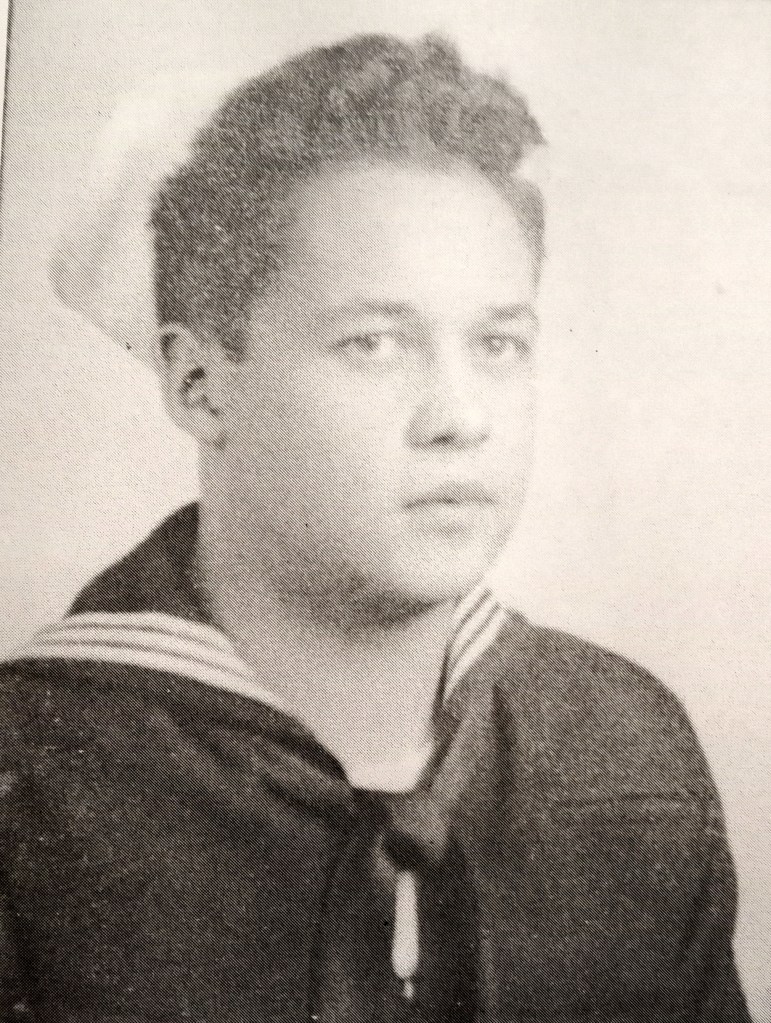
At the time of the Interview, Jessie showed to the interviewer some of the handicrafts that she learned from her grandmother that she continued to do, such as woven baskets and hand-painted gourds.
Reflecting on the past, Jessie says she misses the large family gatherings that her large extended family used to do regularly: “It seems like they have just drifted apart. How come we don’t get together? I’ve a lot of cousins, a lot of relatives, but we don’t have those big get-togethers, the picnics that they had long ago.”
 Fullerton History
Leave a comment