The following is from a work-in-progress about the history of Fullerton. You can support my ongoing research and writing on Patreon.
“Pastoral California,” the 75-foot long fresco mural on the side of the Auditorium at Fullerton Union High School was painted in 1934, during the Great Depression, painted over by order of the Board of Trustees in 1939, and restored 58 years later in 1997. The story of this mural, what it depicts, why it was painted over, and finally restored, is one worth reflecting upon.
The first major public art projects in Fullerton were commissioned during the Great Depression by the New Deal, which was created by Franklin D. Roosevelt to put America to work at a time when lots of people needed jobs. The various New Deal programs (including the well-known Works Progress Administration, or WPA) gave over eight million unemployed Americans jobs in its eight-year existence. The City of Fullerton benefited tremendously from the WPA. Many of the buildings at Fullerton College are WPA buildngs. The post office, the Fullerton Museum Center, the Police Station, and the stone structures and paths in Hillcrest Park were all built by New Deal money and unemployed Fullerton residents.
In addition to building projects, the WPA also commissioned murals in cities across America, including Fullerton, in an effort to give people not just jobs, but a sense of hope and beauty in difficult times. Perhaps the most famous of these murals is “Pastoral California,” one of the two largest frescoes commissioned by the WPA.
Charles Kassler, who had studied art at Princeton, traveled extensively, and apprenticed under a fresco painter in France, completed “Pastoral California” in 1934. Kassler had only one hand. He’d lost the other in a high school chemistry accident. He was married to famous Mexican singer Luisa Espinel, who was the aunt of pop superstar Linda Ronstadt.
Kassler clearly did local history research before painting the mural. It depicts a Spanish/Mexican southern California. From the 1700s to 1821, California was controlled by Spain. From 1821 to 1848, it was controlled by Mexico. Around that time, the United States decided it was their “Manifest Destiny” to control California, so they took it through a war of conquest, the Mexican American War. Kassler, however, chose to depict not an Anglo-American California, but a Spanish/Mexican one.
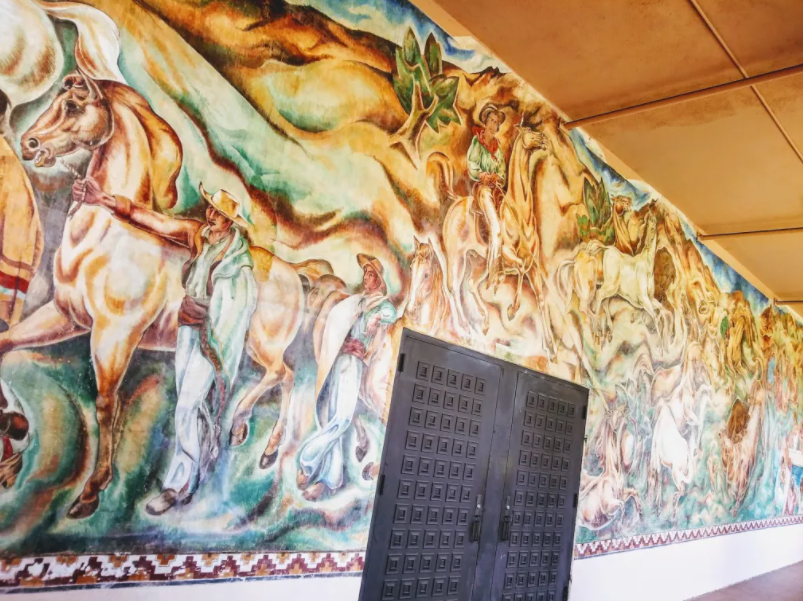
The mural depicts historical figures like Jose Antonio Yorba, a large landowner whom Yorba Linda is named after. In the background is Mission San Juan Capistrano. To the right is Pio Pico, the last Mexican governor of California. Most of the figures are Latinos doing everyday activities: washing clothes, riding horses, eating together.
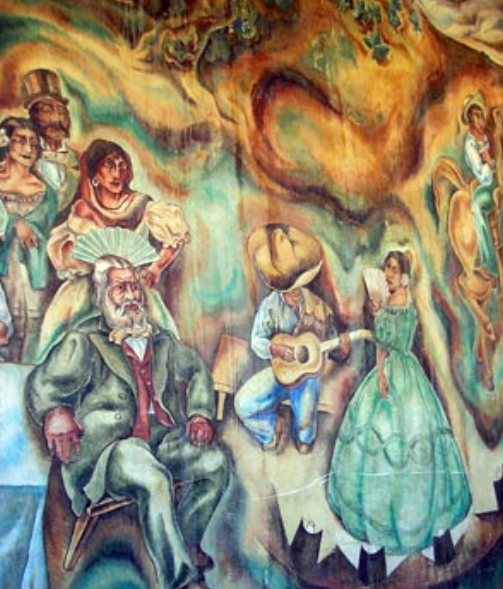
1930s LA art critic Merle Armitage praised the mural: “Kassler has adhered not only to the beautiful traditions of pastoral California, but at the same time has also borne in mind the splendid Spanish architecture, and, lastly, created a beautiful fresco of amazing vitality and freshness of viewpoint.”
Dr. H. Lynn Sheller taught English and History at Fullerton College in 1934, at the time “Pastoral California” was painted. “I watched him [Charles Kassler] put the mural up there,” Sheller recalled in an interview for the Fullerton College Oral History Program, “I would visit him day after day as he was working…the feature of a fresco is that the paint is mixed in with the plaster, thus it is supposed to be permanent.”
But not everyone was happy with Kassler’s mural.
An article from August 30, 1939 in the Fullerton News-Tribune entitled “High School Mural Doomed; Paint it Out, Trustees Order” reads:
“Fullerton Union high school’s much discussed and criticized mural which covers the outside west wall of the auditorium received its death sentence at the hands of district trustees last night who ordered the wall paint sprayed to cover the painting.
This mural is approximately 75 feet long by 15 feet high with its huge figures of horses and riders and other human forms depicting early California days has been a mooted [sic] point since its completion several [five] years ago by the artist Kassler as a federal art project.
Most occupants of the high school will shed no tears over the decision of the board; it was indicated today as the lurid colors and somewhat grotesque figures have apparently failed to capture popular fancy.”

C. Stanley Chapman, son of Fullerton’s first mayor, Charles C. Chapman, and a city council man himself, was one of the ones who “shed no tears.” In an interview for the Cal State Fullerton Oral History Program, Chapman said: “The [mural] down there at the school was almost as absurd [as the one in the post office]. They were painted by that WPA business and the painting did not go with the architecture of the school. It was a great relief when they did paint them out. They were not an artistic addition to the building by any means”
The college student interviewing Chapman replied that superintendent Louis Plummer disagreed with this assessment: “Mr. Plummer seemed to think they were nice although he did not say so. He simply quoted a long article from the Los Angeles Times art critic who said they were lovely and truly representative and that the colors were beautiful. Mr. Plummer ends that little discourse by saying, ‘and they were painted over,’ as though he was disappointed.”
Chapman repied, “Oh, yes, the colors were good. But I have forgotten what the theme was.”
The interviewer reminded him, “Mexican entertainment; with the horses, and the children playing.”
Chapman replied, “Oh, yes, Well, the colors were nice. I don’t know. I was never involved in the school board or anything like that.”
Why was the mural painted over? I have heard some speculate that it was because some of the women depicted in the mural had naked, exposed breasts. However, I have seen no evidence that there was any nudity in the mural. In the mural as it exists today, and in every photo I’ve seen, the women are clothed. Some of them have big breasts, but that hardly seems justification for painting over the whole mural.

“It wasn’t until we had a group of trustees in here who were negatively inclined, that it was painted over,” Sheller remembers. When asked why it was painted over, Sheller said, “Some people felt it was vulgar or gross in some way. It simply showed the Mexican women as they were probably attired at that time. They were very bosomy women. I don’t think that we would feel that there was anything wrong with it. I never felt there was.”
But others have a different view, one I believe makes more sense, given the social context of 1930s Fullerton.
“It was too Mexican, that’s why,” speculated Charles Hart, 75, who was a student at the high school and remembers the mural before it was covered up. “The school board didn’t want to leave the impression that this town was anything else but Anglos. Too extreme for them, I guess.”
Hart said this in a 1997 Los Angeles TImes article.
The decision to paint over this mural probably had to do with its subject matter. It celebrated Mexican culture at a time of heightened racism against Mexicans, and when Mexicans lived in segregated communities, attended segregated schools, and were often forcefully and illegally deported back to Mexico during the Great Depression.
I have written about this at some length in an article entitled “The Roots of Inequality: The Citrus Industry Prospered on the Back of Segregated Immigrant Labor.”
“Pastoral California” remained painted over for six decades years until, in 1997 it was restored, thanks to a massive community effort. I was actually attending Fullerton High School at the time. Some of my friends, art students, helped with the restoration. I remember thinking, even then: Why would anyone have painted over something so beautiful?
 Fullerton History
Leave a comment