The following is from a work-in-progress about the history of Fullerton. You can support my ongoing research and writing on Patreon.
In 1949, Louis E. Plummer, former superintendent of Fullerton High School and Fullerton College, published a book entitled A History of the Fullerton Union High School and Fullerton Junior College 1893-1943.
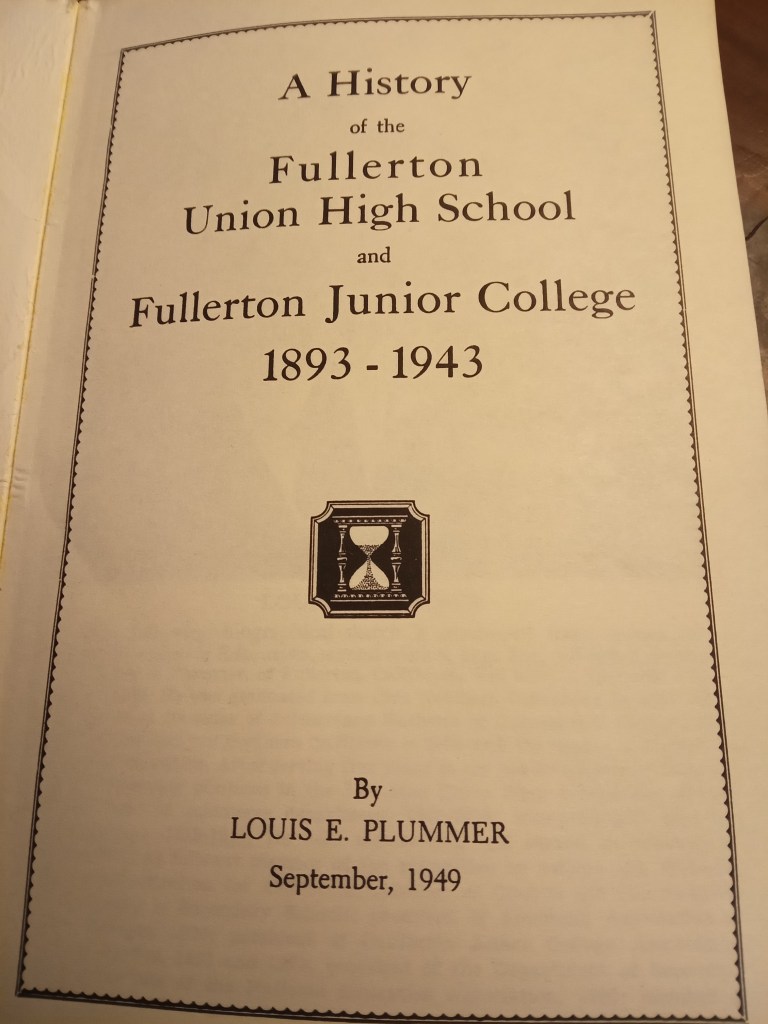
His book is packed with valuable historical facts about the history of our local high school and community college. However, as a historian, I am faced with a bit of a dilemma.

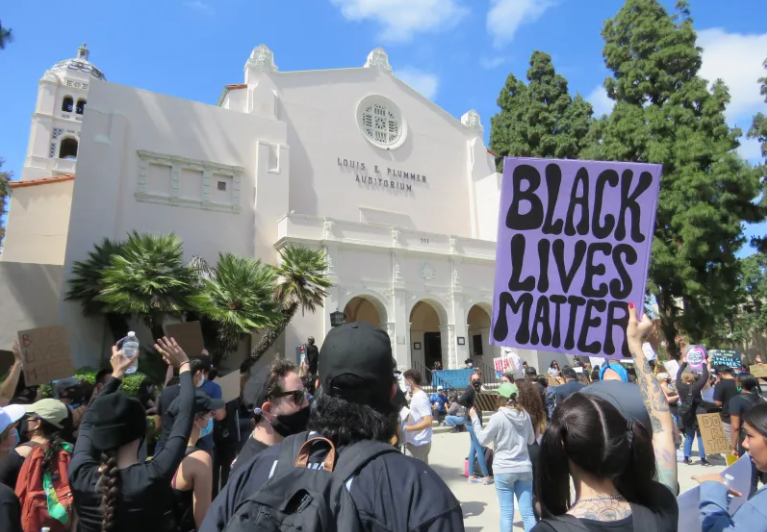
In 2020, the Fullerton Joint Union High School Board of Trustees voted unanimously to remove Plummer’s name from the high school auditorium which had borne his name for many years amid evidence that Plummer was a member of the Ku Klux Klan in the 1920s.
The Board agenda item read as follows:
“The historical record indicates that Louis Plummer was associated with the Ku Klux Klan. The KKK is known to have engaged in acts of violence and terrorism against minority populations. Louis Plummer’s association was noted in a 1979 doctoral dissertation by Christopher Cocoltchos (UCLA) entitled The Invisible Government and the Viable Community: The Ku Klux Klan in Orange County, California During the 1920s. Cocoltchos wrote, “Plummer was . . . a leader in the Myers-led Klan.” (page 288).
A facility named for someone associated with the KKK is at odds with both Board Policy 0100 (a) Philosophy and Goals and Board Policy 0145: NONDISCRIMINATION (Educational Programs or Activities) “The Fullerton Joint Union High School District shall not discriminate on the basis of race, color, religious background, national origin or ancestry, ethnic group identification, marital or parental status, gender, sex, age, physical or mental disability, gender preference or sexual orientation, or the perception of one or more such characteristics, or economic status in the educational programs or activities which it operates for its students.”
At the time, I was an editor and writer for the Fullerton Observer Newspaper. I wrote an article about the school board’s decision, which occurred in the context of large-scale Black Lives Matter protests.
I also read Cocoltchos’ 500-page dissertation and wrote a summary of it for the Observer.
I recently read Plummer’s history of the high school and college, and would like to present here a summary of this interesting history as part of my own local history. I do so with the caveat that Plummer was, evidently, a racist.
“The Fullerton Union High School existed, in embryo within the minds of early settlers years before its recorded birth in 1893,” Plummer writes. “In the summer of 1892 William Starbuck and Alex McDermont canvassed the northern part of Orange County, hoping to transform educational ideas into action. During the spring of 1893 these activities bore fruit in the form of a request to the county superintendent of schools to call an election for the organization of a union high school district.”
An election was held, and voters favored the creation of a new high school. The first trustees were William Starbuck, A.S. Bradford, B.F. Porter, and Dr. D.W. Hasson.
W.R. Carpenter was the first principal. At first, the new high school rented a room on the second floor of the Fullerton elementary school building, located at the corner of Wilshire and Harvard (now Lemon) avenues.
The Fullerton Union High School district first consisted of the territory of the elementary school districts of Buena Park, Fullerton, Orangethorpe, and Placentia.
Fullerton Union High School opened for classes in the fall of 1893 with eight students. Classes taught by Carpenter that year included Latin, physics, algebra, geometry, history, and English.
Adele Tucker joined the faculty in 1895 and taught Latin, English, and history. Helena L. Ingraham joined in 1899 to teach art. German was added in 1903 with Miss H.M. Oehlmann.
According to Thomas McFadden (class of 1896), “…during all the years I attended the Fullerton Union High School I drove back and forth with a horse and cart. All other students had to provide their own transportation.”
Worthington Means, class of 1898, said, “On the back boundary of the school grounds was located what would be a curiosity nowadays, namely, a shed where we could tie our horses.”
In 1908, the school moved to a new building on West Commonwealth.

Enrollment in the Fullerton Union High School grew from 24 in 1896 to 62 in 1906, when Delbert Brunton became principal of the school.
“During that first summer he [Brunton] spent much of his time upon a bicycle visiting the homes of all eligible students whose names and residences he could learn. The school had not been completely accepted in all parts of the community as a permanent institution. It had added to the tax burden. The need for an educational program above the eighth grade was not universally recognized. Because of these conditions Brunton’s reception was not always cordial and results for the first year were not those for which he had hoped,” Plummer writes.
At the turn of the century, Fullerton was a rapidly-growing community. In 1900 the population was about 2200 inhabitants. By 1910 the population was 4415 and by 1920 it was 5540.
In 1910, tragedy struck.
“During the early morning hours of November 18, 1910 people of the district watched the fire department of Fullerton futilely attempt to fight back flames of unknown origin that consumed their high school building,” Plummer writes. “By daybreak all that was left of it were a few charred timbers, foundation, a tall smokestack, and a little equipment saved from the domestic-science and manual training rooms in the basement.”

As the trustees figured out what to do, classes were held in tents and then bungalows.
In 1911, Fullerton voters approved a bond to pay for new buildings.
There was disagreement and debate over the location of the new high school buildings.
“For two months prior to May 11, 1912, the district had owned three high-school sites; the old one on West Commonwealth, the Hilliard tract three fourths of a mile east of town on Chapman avenue, and the newly-purchased Central tract. On May 11, the Hilliard tract was sold to Delbert Brunton and H.W. Daniels. The Central Tract became the new school campus,” Plummer writes.
To be continued…
 Fullerton History
Leave a comment