The following is from a work-in-progress about the history of Fullerton. You can support my ongoing research and writing on Patreon.
The tribe that originally occupied North Orange County and Los Angeles has been called different names over the years. Historians often refer to them as Gabrielenos or Gabrielinos, because that’s what the Spanish missionaries (like Father Junipero Serra) called them, after Mission San Gabriel. The Spanish adopted a policy of re-naming California Indian tribes after nearby missions. According to other sources, the local tribe is called the Tongva. But I’ve met members and leaders of the local tribe, and they have told me they prefer the name Kizh (pronounced Keech).
Ostrich Eggs for Breakfast, a history of Fullerton I had to read in third grade, includes this passage: “Sometimes people ask, ‘What happened to the Indians?’ As far as anyone knows, there are no Gabrieleno Indians left in Fullerton.”
While this may be technically true, it implies a great lie: there are no more local native people left anywhere–no more Kizh. I know this is a lie because I’ve actually met the chief of the local tribe. His name was Ernie.
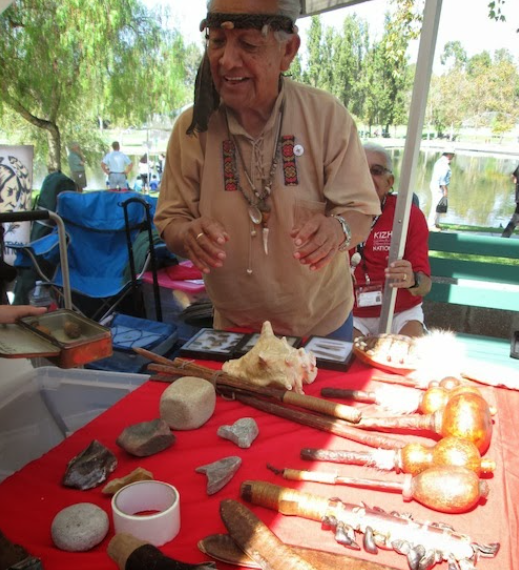
In 2013, I attended a fascinating event at the little Paleontology Museum located inside Ralph Clark Park in Fullerton. The event was about Orange County’s “prehistory,” and (to my astonishment) actual, living Kizh Indians were there, including their chief, Ernie Salas, and tribal historian, Timothy Poyrena-Miguel.
I sat down with Timothy. I didn’t have any agenda or prepared questions.
“Tell me about your people,” I said and, man, did he have a story to tell.
The history of the Kizh people goes back thousands of years. For millennia, they had developed a complex and beautiful culture, which included religion, astronomy, rich and varied cuisine, economy, and social structure. They developed ingenious ways to live sustainably off the land and its natural resources. The name of the tribe, Kizh, comes from the dome-like dwellings they lived in. They had tools, technology, clothing, handicrafts, dances. They were one of two California tribes who mastered boat-building, and traveled along the coast of Southern California.
In the 1700s, Spain began to colonize California, and thus began the long journey of suffering for the Kizh people. Contrary to what we learn in school and on field trips to California Missions, the Spanish were not a benevolent presence in California. The missions they established were like concentration camps, where Indians lived in a state of quasi-slavery, and were made to abandon much of their culture. Violence and disease decimated the local native populations. Kizh women were raped by Spanish soldiers and died of syphilis. Timothy compared Spanish figures like Father Junipero Serra to Nazis, in the way they systematically destroyed native cultures and lives.
Both Timothy and I expressed our frustration that the California Missions are taught to children in public schools as benevolent, even quaint examples of California history, when the truth is much darker.
Things did not improve for Native Americans when Mexico won its independence, nor when the United States conquered California. Under American rule in the 1800s, a policy of “extermination” of native people was pursued. Timothy told me the story of a whole Kizh village rounded up into a valley near where the Rose Bowl is today, and blasted with guns and cannons. Some children managed to escape, and found shelter among Mexican-American families in the San Gabriel area. Children of slain parents were adopted by Mexican-American families, and this is why Many Kizh people today have Spanish/Mexican surnames.
Due to widespread racism, these children feared to identify themselves as Indian, stopped speaking their native language, and learned Spanish or English.
One result of all this suffering and bloodshed was the eradication of the Kizh language. Timothy told me they have some words and songs that were passed down orally, but no one alive today speaks their native language.
As I listened to Timothy tell the story of his people, I felt a heaviness in my chest, a complex mixture of sadness, outrage, and compassion. It is this last bit, compassion, that I hope to evoke with my writings. If we don’t know their history (and most people don’t know Kizh history), we do not feel compassion. But, in listening to their stories, harrowing and horrific as they are, we develop a strong sense of compassion. We pay for the crimes of our ancestors, but we do not have to repeat those crimes. The act of storytelling can be a powerful, healing force. It is my hope that, in listening and sharing stories like this, a new chapter in the Kizh story may open, one of understanding, healing, and reconciliation.
To learn more about this local tribe visit their web site: www.gabrielenoindians.org.
 Fullerton History
Leave a comment